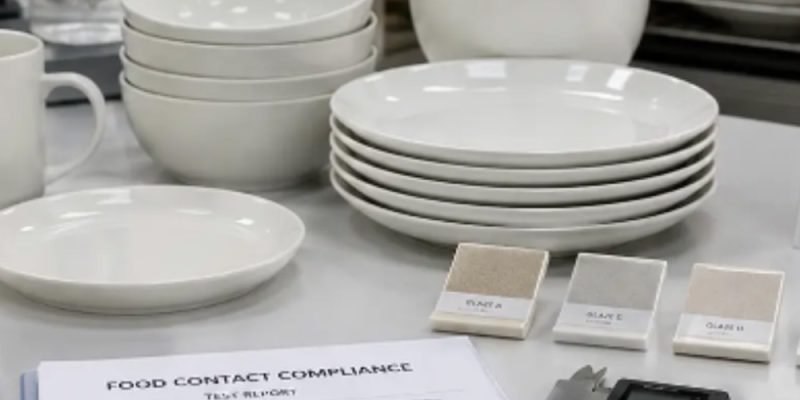
A tableware specification sheet for a hotel should include material and body type, precise measurements and weight, glaze and decoration technique, FDA 21 CFR, LFGB, or ISO 6486-1 certification, dishwasher cycles and impact test strength, and commercial terms such as minimum order quantity, lead time, and batch matching for reordering.
For more than 20 years, we have been creating hotel tableware specifications for hospitality groups, and all the properties that avoid costly reordering errors share one common attribute: they do not issue a verbal order to a supplier. They provide a written spec sheet.
In this guide, we explain in detail what should be on that sheet, the certification numbers you should inquire about by name, and the durability limits that make one level of program versus another and make it a five-star program or a time-consuming guessing game.
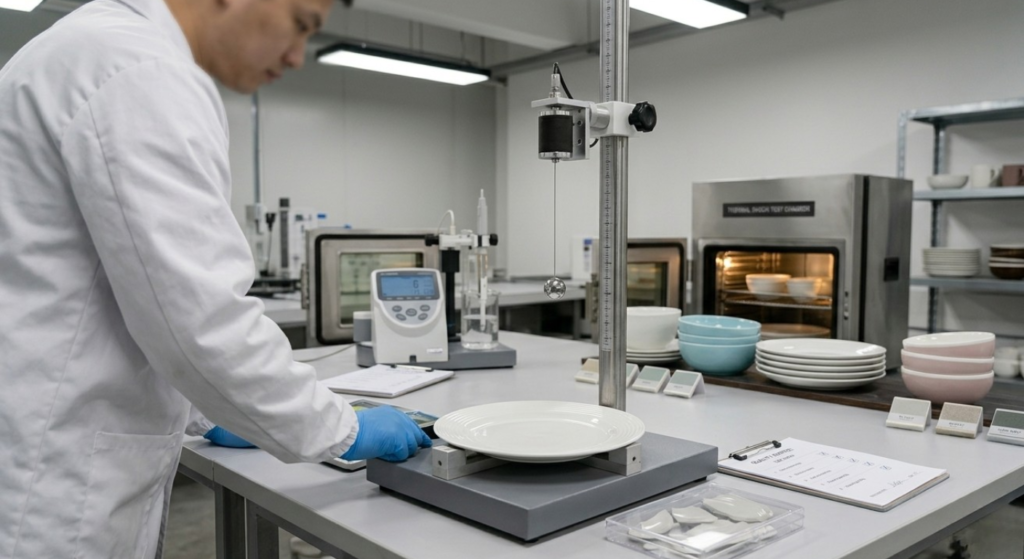
Table of Contents
What Is a Hotel Tableware Specification Sheet?
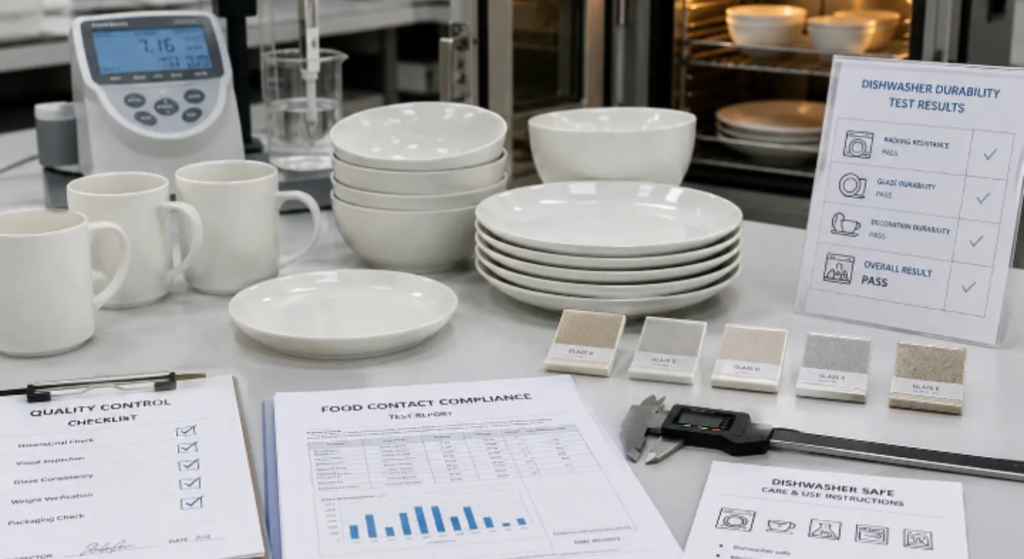
A Hotel Tableware Specification Sheet is a document detailing the exact material, performance, certifications, and commercial terms that the supplier must adhere to before production begins. It is the agreement that both parties agree upon, and which no one writes on the phone.
Each spec sheet is divided into three sections: material details, supplier requirements, and pricing details.
Why a Written Specification Protects Your Procurement Budget
An oral agreement is not a binding contract. If a batch comes in with an incorrect glaze finish or if a chip rate is excessive, the written spec is the way to get a supplier to take responsibility, rather than going around and around about what was “understood.”
We have had properties literally have a season’s worth of budget wiped out due to reordered items that did not match the original order, which was only captured in a product photo and an email thread. A specification sheet fills in the gap that a specification leaves open.
The 4 Core Elements of a Hotel Tableware Specification Sheet
All of our spec sheets begin with four categories that address four different ways a shipment can fail.
Material and Body Type
State the grade of ceramic, clay body, and firing temperature. If it is vitrified porcelain (fired at a higher temperature), the resulting body will have less absorption, and this should be indicated on the sheet and not left up to the discretion of the supplier.
Dimensions, Capacity and Weight
State exact diameter, height, capacity and piece weight; all with a given tolerance. Two plates with the same claimed diameter can easily be quite different in weight and wall thickness, and it doesn’t take much for the difference to be visible the very moment they are put side by side with your current stock.
Glaze and Decoration Method
Define if decoration with logo or pattern is underglaze or on-glaze. Underglaze decoration is applied under the glaze and is very tough to the wash, but usually represents a 15-20% higher decoration cost. This is a trade-off you want to put in your spec, not a surprise 6 months in.
Color and Finish Match
Expect that the glaze formula be given and documented, not just a physical sample in a drawer somewhere. Formulations are the key to ensuring that in 3 years’ time, your exact shade isn’t completely lost as the original sample has long since disappeared.
Flatware-Specific Specifications
Please do not put the term “18/10 stainless steel” on a flatware spec. Since 18/10 and 18/8 are not grades themselves, but market labels, it’s necessary to identify the actual grade as 304 stainless steel, which is part of the 304 family. Ask for a mill test certificate, specifying the percentages of chromium and nickel content, instead of simply taking the label.
State the gauge (the thickness of the metal, more important than the alloy ratio). Medium weight up to extra-heavy and forged are restaurant-grade flatware, and the hotel front-of-house programs usually call for extra-heavy or forged. Also request food-contact compliance with FDA 21 CFR and EU Regulation 1935/2004 (EU-linked properties).
Glassware-Specific Specifications
For all other high-volume outlets, use soda lime glass with a test to ISO 7086. If you’re looking for fine dining or event service, choose lead-free crystal, which is clear and has a thinner rim. In either case, put the numbers on the sheet: a capacity tolerance of within plus or minus 5 percent; a base thickness of 4 millimeters or more (for stability); a documented thermal shock rating, since a commercial glassware sample should be able to withstand about a 60-degree Celsius temperature change without cracking.
Also consider asking for an annealing certificate, as this is proof that the glass has been stress-relieved when it was produced, and will not weaken when exposed to multiple dishwasher cycles.
Durability and Testing Requirements to Specify
By the time day one is over, you will not be able to tell much about how tableware will work over 100 services. We believe that every spec sheet should stipulate these tests in writing, and that the thresholds themselves should be specified and not left up to interpretation.
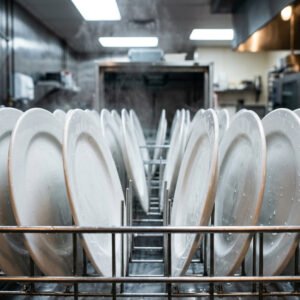
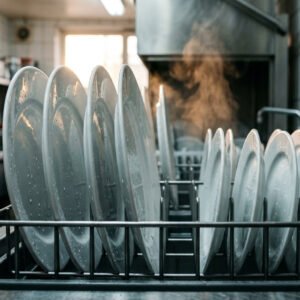
Dishwasher Cycle Testing
Ask for a dishwasher cycle count, preferably 1,000 or more wash cycles for ceramic dinnerware and 2,500 or more wash cycles for glassware, with no visible degradation of glaze or clouding, per the test conducted at 65-85°C wash temperature, in accordance with EN 12875-1 or a similar commercial wash cycle simulator. Don’t expect to find a dishwasher-safe claim in the specification: it’s just a guess.
Drop Ball Impact Resistance
High-volume programs or five-star programs should include an impact test using a drop ball (usually a 200-gram steel ball from 40cm height) without chipping. This is how a plate is normally knocked off, while being passed or pushed onto a table’s edge. Some manufacturers test above this minimum point – ask your supplier about the threshold and don’t take the industry minimum as a given.
Thermal Shock Resistance
If your property uses plates from a hot pass to a cold buffet display or cups are taken directly from the dishwasher to the boiling liquid, you need to use a thermal shock rating. The shock resistance of alumina-reinforced porcelain bodies is generally about 200 degrees Celsius, adequate for the normal service procedures in F&B departments of hotels.
Certifications to Require in Writing
Certifications are asked for all the time and rarely checked. A logo on a product page does not constitute anything like a lab report with a verifiable report number does.
Food Safety Certifications
If the property is facing out towards the USA, then ensure it is FDA 21 CFR compliant with a lead leaching limit of 0.5 mg/L or less and a cadmium leaching limit of 0.25 mg/L or less for flatware-style pieces. Test with the more stringent LFGB conditions, typically 4 percent acetic acid at 70 degrees Celsius for 2 hours, with different limits by vessel type, if the property is part of an EU or German-linked group.
Also ask for ISO 6486-1 documentation. Unlike FDA and LFGB, which can be satisfied with a single test, ISO 6486-1 requires testing as part of an ongoing production quality control system, so a supplier holding it is testing every batch, not just the one that earned the certificate.
How to Verify a Certificate Is Genuine
Do not trust a certificate logo on a web page as authentication. Ask for the lab report from an accredited laboratory such as SGS, Bureau Veritas or Intertek, with the lab accreditation number, the batch that was tested, and the numerical results of the leaching test, not just a pass or fail summary.
If the lab provides a verification portal online, compare the lab report number to the portal. This one step will catch any certificates that are copied or out of date before they end up in your procurement file.
Ethical and Environmental Certifications
Include ISO 9001 for quality management, and BSCI or Sedex for ethical supply chain compliance. If your group has sustainability targets, request specific documentation such as Global Recycled Standard certification and an environmental management system reference like ISO 14001.
Batch Consistency and Reorder Matching
The key requirement that filters out the maximum number of suppliers in serious hotel programs is not a food safety requirement; it’s batch consistency: a capacity to reorder pieces that were purchased three years ago. This will depend on the supplier keeping a record of the dye lot and glaze formulation that matches your exact specification and not a generic line entry that can vary between production runs.
Directly inquire about the manner in which the supplier controls dye lot uniformity and obtain a written assurance of the formulation number that will be used for subsequent reorders. If the supplier cannot answer this clearly, that tells you something about how they’ll handle your fifth reorder, not just your first. Our hotel tableware procurement checklist covers what to ask before your first order, specifically to protect this down the line.
MOQ, Lead Time and Payment Terms to Specify
The commercial terms should be included on the spec sheet, just like the material data. Be sure to confirm the minimum purchase per item, not per order, as a minimum per order MOQ can sneak up on you and cause you to end up over-ordering categories you don’t really need. Standard porcelain MOQs typically start at 200 pieces per item or as high as 500 pieces and higher for fully custom OEM designs.
The typical standard specifications require 3-4 months of lead time before the date of their requirement, which includes a production lead time of 45-90 days and an international freight and customs clearance period of 2-4 weeks. Exclusive glaze colors or branded programs, or fully custom shapes require 6-9 months. 30 to 50 percent is the normal payment method required, with the rest being paid off before shipping or on delivery.
Pre-shipment inspection rights: either to inspect the factory or to get a third-party inspection report before shipment; usually ask for a written quality guarantee that indicates an acceptable defect rate along with the supplier’s policy on what to do if the item is found to be defective after shipment.
Our guide on how to choose tableware for hotel buffets has more detail on setting flexible MOQs for high-breakage categories.
Packaging and Shipping Specifications
Packaging is easy to overlook until a shipment arrives with a breakage rate that erases whatever you saved on unit price. Specify break-resistant export packaging, individual protection for fragile goods such as stemware, and carton drop-test documentation where available. Ensure the supplier maintains full export documentation and can arrange door-to-port or door-to-door freight, and agree in writing on who is responsible for freight breakage above an agreed threshold
Sample Approval Process to Specify
Don’t miss out on a pre-production sample and don’t approve an order based on a photo. Request a physical sample to be made to your exact specification and require them to check the weight, dimensions, glaze color, stability, and finish consistency; then formally approve it before mass production begins.
We would also recommend holding on to an approved reference sample on a bigger hospitality project as well. That sample is your team’s ‘standard’ for all future reorders, outside the supplier’s statement of what it is identical to.
Sample Hotel Tableware Specification Sheet Checklist
The basic format we put in each spec sheet before sending it to a supplier for a quotation.
Specification Category | What to Require in Writing |
Material and body type | Ceramic grade, clay body composition, firing temperature, water absorption rate |
Dimensions and weight | Exact diameter, height, capacity and piece weight, with stated tolerance range |
Glaze and decoration | Glaze type, underglaze or on-glaze decoration method, logo application process |
Flatware grade | Grade 304 stainless steel confirmation, gauge, mill test certificate for chromium and nickel |
Glassware specification | Soda lime or lead-free crystal, capacity tolerance, base thickness, annealing certificate |
Durability testing | Dishwasher cycle count, drop ball impact result, thermal shock rating |
Certifications | FDA 21 CFR or LFGB, ISO 6486-1, ISO 9001, BSCI or Sedex, with verifiable lab reports |
Batch consistency | Written dye lot and glaze formulation reference for future reorders |
Sample approval | Pre-production sample sign-off and retained reference sample on file |
Packaging and shipping | Break-resistant export packaging, drop-test documentation, export paperwork |
Commercial terms | MOQ per item, lead time, payment terms, pre-shipment inspection rights |
Common Specification Mistakes That Cost Hotels Money
The most costly error we observe is when a certification is required but not the lab report or tested batch, just a certificate. A website containing a certificate logo does not equate to a certificate.
The second is failing to specify dimensions instead of a stated tolerance range, which is the beginning of the mismatched stacking and storage problems. The third is ignoring the batch consistency altogether and later figuring out that a reorder has a color other than the original one.
The fourth is the absence of any writing of “18/10 stainless steel” and no requirement for a supplier to provide a mill test certificate to prove that the material being supplied is the correct grade, which leaves room for a supplier to pick up a lower-nickel alloy that looks the same on day one. The fifth is authorizing an order for product photos rather than a physical, signed-off sample – this is the number one reason an entire shipment turns up different than expected
How Brett Supports Your Hotel Tableware Specification
Since 1998, we have provided ceramic tableware for hotel standards to 80+ countries, and all quotes are based on a written specification and not a verbal request. We take the lead in helping multi-outlet groups to establish consistent specifications throughout their entire property portfolio with our hotel procurement process guide.
If you want to drill down into material selection, our commercial dinnerware buyer’s guide explains how we support buyers in determining which is the best material to specify before you get there.
FAQ
What information should be put on the hotel specification sheet?
Material and body type, exact size and weight, glaze and method of decoration, necessary certificates, durability testing parameters and limits, and commercial terms such as MOQ, lead time, and batch matching requirements.
What type of qualifications should hotel tableware suppliers have?
At least, FDA 21 CFR or LFGB for food safety, ISO 6486-1 for lead and cadmium release tests, ISO 9001 for quality management systems, and BSCI or Sedex for ethical norms of the supply chain.
How many loads of dishes can a hotel tableware withstand in the dishwasher?
It is recommended that you use 1,000 or more commercial dishwasher cycles with no visible glaze degradation according to EN 12875-1 or an equivalent standard and with documented lab results, rather than a verbal assurance.
What is Batch Consistency and why is it important?
Batch consistency is a supplier’s ability to reproduce the colour and glaze of reordered pieces, which were bought years earlier. It must be recorded in formulas and production, and one of the more frequent causes of hotel tableware programs not being consistent over time.
What's the earliest I can ask my supplier for a specification?
Usually, 3-4 months lead time is required for the standard specification. Fully custom shapes should be ordered 6-9 months before the opening or launch date, and each color of glaze or branded program should be ordered separately.
What should the flatware specification be for a hotel?
Please identify the actual grade, usually 304 stainless steel; ask for a mill test certificate (to confirm chromium & nickel content) and please specify gauge (thickness is far more important to the product than alloy ratio).
Conclusion
A restaurant tableware specification sheet is not a piece of paper. It’s the document that will make it easier for you to know whether or not your reorder three years later will be the same as what’s always on your tables, or you’ll be beginning all over again.
We suggest documenting the material, dimensions, durability limits, certifications, and commercial terms before a quotation is sent, and only ask for laboratory reports, not certificate logos, for all claims that are important.
We support hotel procurement teams in creating a complete hotel tableware specification, which is supported by FDA, LFGB, ISO 6486-1, ISO 9001, BSCI, and Sedex documentation upon request. Contact our team for a specification template to get your property started at Cbhoreca or WhatsApp +86 13535413512.