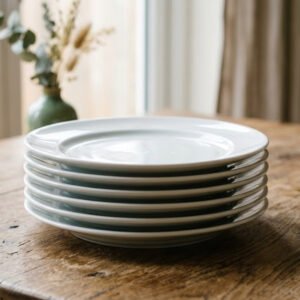

An edge chip warranty is a written guarantee from the supplier that they will replace a tableware product with a chipped rim or edge resulting from normal commercial use over a certain number of years. The terms and conditions differ substantially from supplier to supplier.
The warranty only covers the rim’s chip, not cracks, thermal shocks, accidents, mishaps, and other incidents. Before you rely on one, ask how long it runs, what counts as normal use, what proof you must send, what the remedy is, and who actually honors the claim. A warranty works best alongside sample testing, a breakage allowance, and batch matching, not as a replacement for them.
This article will discuss what an edge chip warranty covers and what it does not, as well as what questions to ask the supplier before relying on an edge chip warranty and what to do if the supplier does not offer an edge warranty.

Table of Contents
What Is an Edge Chip Warranty?
A written warranty from the manufacturer/supplier is termed an edge chip warranty. A piece that chips at the edge or rim during normal commercial usage during the above period shall be replaced by the supplier. Terms of 5-year to lifetime warranties are offered in some ranges.
Rim chips are the single most common visible damage type in a busy restaurant or banquet kitchen. Hence, the supplier begins with this offer. This addresses a cost that is common knowledge to all operators.
It is also a narrower warranty than it sounds. A chip warranty is not a general breakage warranty. Breakage, cracks, shattered plates, and worn glaze generally fall outside the scope of a chip warranty. It also differs from a delivery defect guarantee. A defect guarantee covers goods that arrive faulty. Our procurement checklist suggests getting a written commitment of below 3 percent defects, with a replacement guarantee. A chip warranty covers chips that happen later, in service. You can ask a supplier for both.
Why Edge Chips Matter So Much in Hotel Service
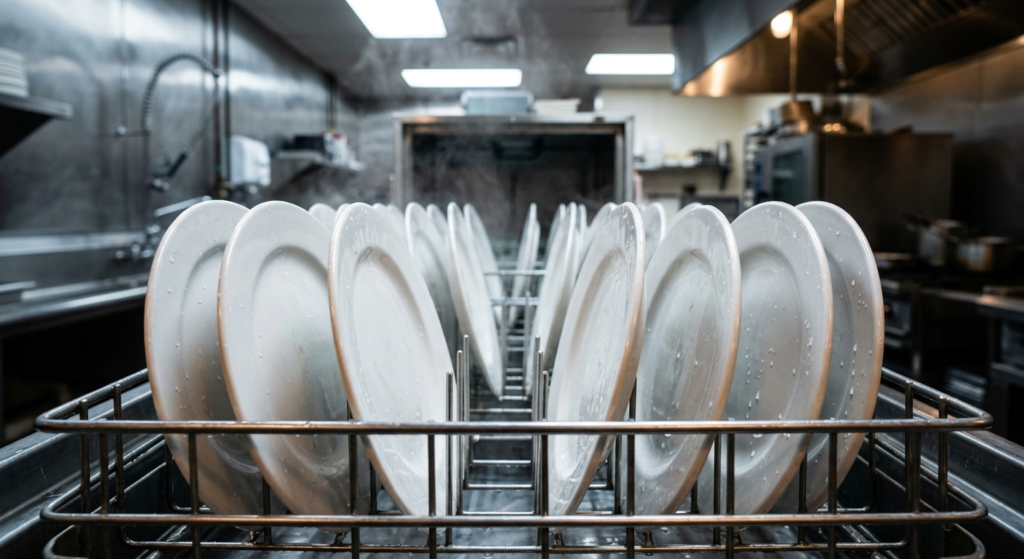
The reason chips occur at the rim is that plates meet at the rim. The table had to be cleared in order to prepare for the dishes to be washed: the edge was stressed by the rush to stack the dishes and put them away in the rack.
Risk changes due to material changes. Thin edges of porcelain on restaurant dinnerware will chip, and bone china dinnerware has the lowest incidence when staff training and volume are controlled in our restaurant dinnerware buying guide. Stoneware is designed to be hard-wearing and can withstand normal use, but can crack if exposed to sudden temperature changes. Melamine doesn’t chip, but it scratches over time.
It’s more than looks when it comes to the cost of a chipped piece. Most operators take away chipped plates for presentation and cleanliness reasons; one chip means one more replacement.
What a Chip Warranty Usually Covers and Leaves Out
The terms vary among suppliers. The following table is intended as a guide to check against the actual document and is not intended to guarantee any specific product.
Type of damage | Often covered? | What to check in the fine print |
Rim or edge chips from normal use | Yes, this is the core promise | How the document defines normal use |
Cracks from sudden temperature change | Often excluded | Whether your wash and storage routine fits their rules |
Breakage from drops or impact | Usually excluded | Whether impact includes stacking collisions |
Glaze wear and surface scratches | Usually excluded | Whether any separate surface wear terms exist |
Damage from misuse or wrong cleaning chemicals | Excluded | Which detergents and wash temperatures are allowed |
Damage during shipping | Usually a separate claim | The claim window after delivery |
The top-most row is the most crucial. Define normal commercial use in writing from the supplier. That one definition determines the acceptance or rejection of a claim.
Questions to Ask Before You Rely on a Chip Warranty
How long does it run, and when does the clock start?
Decide the start of a period: invoice, shipment, or delivery. If you place an order overseas, the number of days of shipping could be an important part of the process. Also enquire if the replacement part has a new warranty or if it will have a reduced warranty.
What constitutes "normal use"?
Some warranties require commercial dishwasher cycles within set limits, approved detergents, and standard stacking. If your banquet team stacks higher than the supplier allows, a claim could be refused. Get the conditions in writing.
What proof do you have to send?
Expect photos, and sometimes the chipped pieces themselves. Ask about the claim window too. Some suppliers want claims within a set number of days of finding the chip. A claim process that’s slow or unclear costs you more than one that’s simple.
What is the solution and who bears the shipping costs?
There are three possible outcomes: a replacement piece, a credit note, and a refund. If replacing from overseas, enquire who is responsible for freight on replacement and how long it takes. A free replacement that lands weeks later doesn’t fill the gap on Saturday night.
Will the same pattern still be available?
A replacement can only be of benefit if it matches. If the pattern or glaze colour is not available, enquire what the supplier will be using instead. Our hotel tableware sample approval guide covers glaze color match checks, which also help you confirm batch consistency before your first order.
Who actually honors the claim?
Try to find out if the promise is from the manufacturer, the distributor, or the importer. Ask questions about applying claims if it is an overseas manufacturer and who is responsible. Our hotel tableware procurement checklist provides you with examples of how to include terms like these in an RFQ, so they are agreed upon prior to ordering.
Why a Warranty Alone Won't Protect Your Operation
A warranty pays you back after a chip happens. It doesn’t stop chips, and it doesn’t keep plates on the table while you wait for replacements.
That’s why prevention does more work than most buyers expect. Before a bulk order, test samples for chip, edge resistance, stacking, and repeated dishwashing. Our sample approval guide includes what to test before mass production, including dishwasher cycles after 50 washes.
Verification matters too. A warranty is only as good as the man behind it. Our guide on how to verify tableware certifications from China explains how to check the documents before you trust them.
Other Protection Terms Worth Negotiating
One tool is a chip warranty. They may be placed beside it, or used instead of it if none is available from a supplier.
Term | What it does | When it helps most |
Delivery defect guarantee | Commits the supplier to replace faulty goods against an agreed defect rate | Every bulk order, since it covers what arrives wrong |
Breakage allowance | Ships extra pieces with the order at no added charge | The first year of service, when attrition is highest |
Arrival damage claim window | Sets a clear deadline to report damage after delivery | Overseas shipments with long transit |
Inspection before shipment | Checks the order against an agreed quality limit | Large or custom orders |
Batch matching on reorders | Keeps glaze color and shape consistent | Any program you’ll reorder from |
Written replacement lead time | Commits the supplier to a delivery timeframe | Properties with no spare stock on hand |
Be aware that you may not have a warranty; be prepared in case you don’t. The commercial dinnerware guide suggests about three of each type of plate that are used often, and a 10–15 percent margin of mistakes for the first year of breakage. That’s what you have indeed for Day One.
Where a Chip Warranty Matters Most by Material
A tableware warranty is as useful as the materials that it stands for. When your operation is fine dining, you’ll want a material that offers elegant chip protection, and when high turnover speed is your concern, you’ll want to consider a material that provides targeted chip protection.
Material | How it behaves at the rim | How much a chip warranty matters |
Bone china | Lowest rim chip rates when staff are trained, and volume is controlled | Worth asking about for fine dining, where each piece costs more |
Porcelain | Thin edges can chip during rush stacking, though it’s easy to replace | High value in high volume service |
Stoneware | Handles everyday knocks well, but can crack from sudden temperature change | Check that thermal cracks aren’t excluded |
Melamine | Doesn’t chip, but scratches over time | Rarely relevant. Ask about surface wear instead. |
Rim design counts as much as the warranty. Rolled or reinforced edges lower the odds of a chip in the first place, so ask which edge profile the quoted piece uses.

How to Compare Two Quotes When Only One Has a Warranty
A higher unit price can be an indication of a warranty. If the supplier will be splitting it out, ask them the price for the same product with and without warranty provision.
Compare the amount lost in a year vs. the warranty replacement. As an example, if you lose 100 plates a year and the warranty covers chips but excludes cracks and drops, only the chipped share gets replaced. The rest stays on your budget.
If there are two quotes, use an easy-to-read side-by-side table like the one below.
Factor | Quote A | Quote B |
Warranty length |
|
|
Clock starts at (invoice, shipment, or delivery) |
|
|
Damage covered |
|
|
Proof required and claim window |
|
|
Remedy (replacement, credit, or refund) |
|
|
Freight on replacements |
|
|
Price per piece |
|
|
Common Mistakes With Chip Warranties
The worst mistake is to consider a chip warranty as a complete breakage warranty. It isn’t. Generally, cracks, drops, and thermal damage are not covered, and these are responsible for many losses.
The second is skipping the claim process details until a chip happens. By then, you’re reading the terms under pressure, and you may have missed a deadline.
The third one is paying more for an additional warranty for a material that requires a different spec. If a plate is stoneware and is cracked due to thermal shock, it will not be repaired with a chip promise.
The fourth is that replacements will be the same. A replacement plate might be slightly different in colour from a matched plate, and this will be visible on the table.

How Brett Supports Quality Protection
The dinnerware meets EC No.1935/2004 and is certified by SGS and TÜV, and samples can be provided for testing for chip and edge resistance on actual dinnerware before production. Our custom product pages list breakage protection programs and replacement policies for bulk orders. Details regarding claim windows, replacement and timing, and batch matching vary by product line and order; please consult our staff for details before ordering, and have any commitments related to these details documented in writing.
Frequently Asked Questions
What is an edge chip warranty?
It is a written assurance from the supplier to replace the tableware if the edge or rim of the tableware chips during normal commercial use within a given time frame.
Will an edge chip warranty cover any cracks or breakage?
Usually not. Most only insure against chips, not drops, misuse, thermal shock, and cracks. Go through the Exclusions in a document.
What is the time frame of edge chip warranties?
Suppliers advertise terms from five years to lifetime. Ask when the clock starts and what conditions apply, since those details decide how useful the term really is.
To make a claim under the warranty, what do I need to do?
Be prepared to send pictures and sometimes the broken parts. Remember to ask for the claim window in advance – some suppliers might have a time limit for filing claims.
Is a chip warranty worth paying more for?
It is based on your volume, your material, and whether they will pay out claims or not. Check out the warranty’s replacement and test it against your expectations of chip losses before paying a premium.
What can protect me if a supplier doesn't offer a chip warranty?
Sample testing, Breakage allowance, inspection before shipping, Batch matching on reorder. They do most of what a warranty would, and they start before the damage occurs.
Conclusion
An edge chip warranty can be a useful part of a tableware contract, but it’s narrower than it sounds. It covers chips, usually under defined conditions, and it leaves out most of the other ways plates get damaged. The terms matter far more than the headline number of years.
Ask how long it runs, what counts as normal use, what proof you need, what the remedy is, and who stands behind the claim. Then pair it with sample testing, a breakage allowance, and batch matching, so you’re protected before the first chip, not only after it.
With full compliance documentation (SGS, TUV, No. 1935/2004, FDA, LFGB, ISO 9001, BSCI and Sedex on request), we provide hotel and restaurant dinnerware. Reach out to our team at Cbhoreca or WhatsApp +86 13535413512 to discuss replacement terms and quality documentation for your next order.