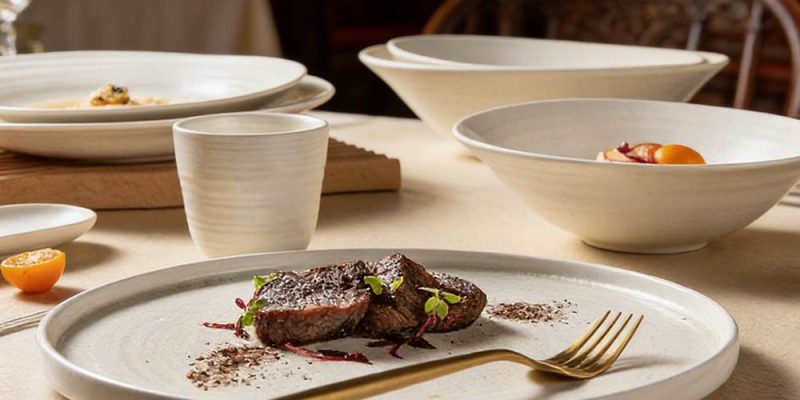
A chef spends twenty minutes on a stunning plate of duck confit, garnished with precision, sauced with care. The server sets it down in front of the guest, and the first thing they notice is a chip on the rim. That moment costs you, not just in perception, but sometimes in a review.
Restaurant tableware is a recurring operational cost, not a one-time purchase. To give you an idea, the commercial tableware market is projected to reach $16.6 billion by 2034 with an annual growth rate of 6.1%. Commercial dinnerware for restaurants alone accounts for 59.2% of that market, emphasizing its role in the foodservice operations.
This guide covers everything, from material selection, matching tableware to your concept, sizing standards, and quantity planning, to cost management, compliance, and supplier evaluation. The insights come from BRETT, a manufacturer with direct supply experience across 8,000+ five-star hotels and 10,000+ restaurants in over 60 countries.
Restaurant Tableware Materials: What Works (and What Doesn't) for Each Concept
Walk into any restaurant supply showroom and you will see shelves of commercial dinnerware for restaurants that all look similar from a distance. Up close, the differences are enormous. Material determines how a plate holds up in a 180-degree commercial dishwasher, how it feels in the hand, how much it costs to replace, and whether it fits your concept visually.
Porcelain
This is the industry workhorse. Vitrified at temperatures above 1300 degrees Celsius, porcelain becomes non-porous, meaning it does not absorb water, bacteria, or food particles between washes. That is not just a durability feature; it is a food safety feature.
Porcelain handles repeated commercial dishwasher cycles without the glaze softening, and its rolled-edge construction reduces chipping where plates stack and collide. For most restaurants, porcelain remains the benchmark for restaurant quality tableware, balancing durability, presentation, and cost.
Vitrified porcelain sees an estimated annual replacement rate of 50-150% in high-volume settings. The main downside is that busy operations can still go through a lot of it.
When NOT to use porcelain: If you want a rustic, handcrafted look, standard white porcelain will feel clinical by comparison.
Bone China
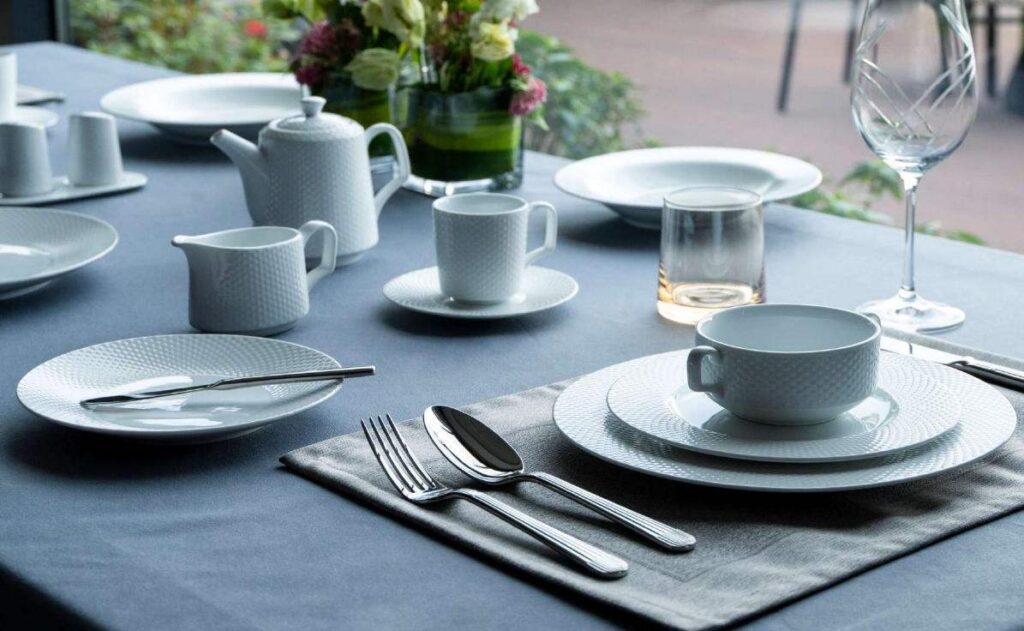
Bone china contains calcium phosphate from bone ash, which gives it a translucent quality and a lighter weight than standard porcelain. It is the material of choice for luxury restaurant tableware in white-tablecloth dining, private members’ clubs, and high-end hotel restaurants.
It excels where presentation matters more than volume tolerance. The per-piece cost is higher, but in a controlled fine-dining environment where service is careful and breakage is low, the investment holds up.
When NOT to use bone china: High-turnover casual or QSR operations. The cost of breakage at scale becomes hard to justify.
Stoneware
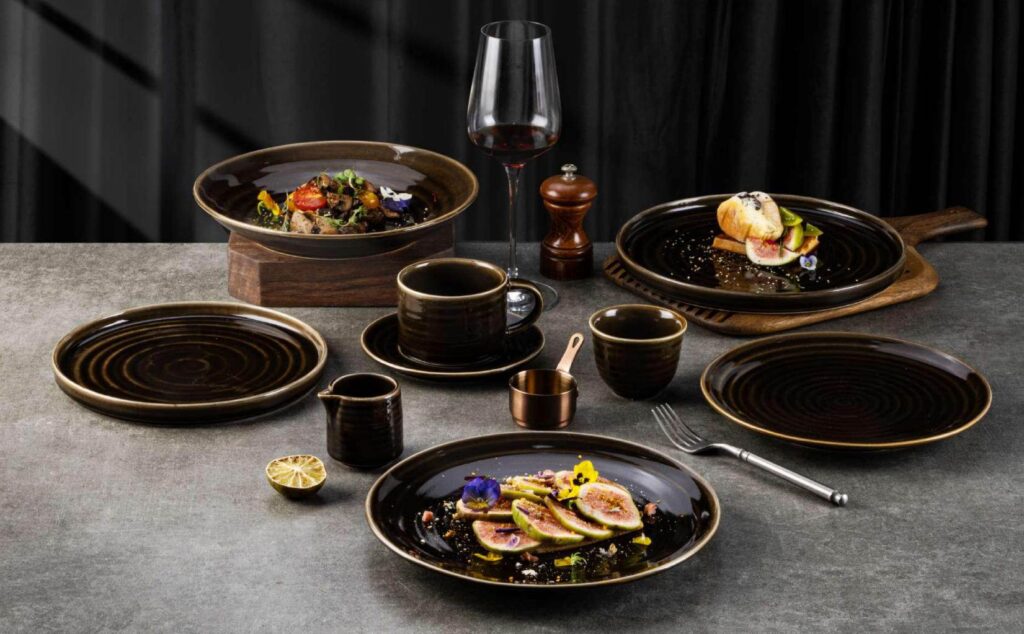
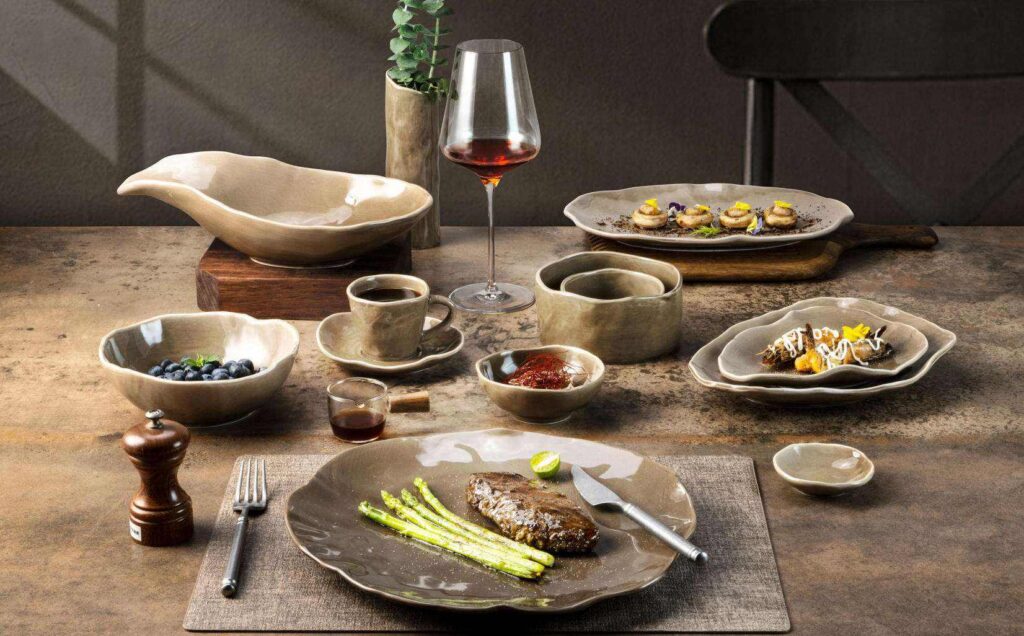
Stoneware has a denser, earthier look and feel than porcelain. It suits farm-to-table restaurants, rustic concepts, wine bars, and casual dining environments where the aesthetic is intentionally warm and informal.
Reactive glazes, organic rim shapes, and tonal variation work in stoneware’s favor. The caution here is that some glazes soften under aggressive commercial wash cycles, so always ask suppliers about commercial dishwasher compatibility before ordering in bulk.
When NOT to use stoneware: Fine dining environments where consistency across pieces matters most, or operations with very high dish turnover.
Melamine
Melamine is shatterproof and genuinely budget-friendly, which makes it the standard choice for QSR, outdoor dining, poolside service, and high-volume cafeteria settings.
Drop a melamine plate on a tile floor, and it bounces. Drop a porcelain plate, and you are sweeping up. That difference alone justifies melamine in the right context.
Melamine’s Annual replacement rates sit at roughly 10-20%, well below ceramic alternatives. But melamine has real limits: it is not microwave-safe, lacks the tactile quality that upscale settings require, and does not carry heat the way ceramic does.
When NOT to use melamine: Any concept where guest perception of quality is central to the experience.
Tempered Glass
Glass tableware is a growing niche in modern restaurants. It has visual clarity and a contemporary look that works well in minimalist or high-design concepts. NSF/ANSI 2 was updated in 2021 to include glass and glass-like tableware, adding specific testing requirements for impact resistance and thermal shock.
That regulatory recognition is a sign that glass is moving from novelty to mainstream in certain segments. The tradeoff is that glass remains more fragile than vitrified ceramics under heavy use.
When NOT to use tempered glass: Busy casual dining environments with rapid table turns and high plate stacking volumes.
Ceramic tableware is projected to hold a 52.7% market share in commercial foodservice in 2025, confirming that porcelain and bone china remain the dominant choices across the industry.
Matching Tableware to Your Restaurant Concept
Knowing what each material does is only half the equation. The other half is knowing which restaurant tableware belongs in your space. And that depends on what your restaurant is trying to be.
The National Restaurant Association reports that 50% of consumers rank food quality as a top-three priority when selecting a full-service restaurant, and 18% of millennials specifically cite ambiance as a deciding factor. The plate is part of that ambiance, whether you think about it consciously or not.
Fine Dining
Wide-rimmed porcelain or bone china is standard. Main course plates typically run 11-12 inches; appetizer plates 8-9 inches. White or soft neutral tones work across almost every cuisine type. Consistency across the set is non-negotiable.
Casual and Family Dining
Durable porcelain or stoneware, with coupe shapes that stack efficiently in back-of-house. Forgiving colors and patterns that hold up visually after a few hundred wash cycles without looking tired.
Farm-to-table and Artisan Concepts
Stoneware with reactive glazes and organic shapes. Small variations between pieces are expected and add to the character rather than looking like quality control failures.
QSR and Fast-casual
Melamine or heavy-duty porcelain. Stackability and speed of handling matter more than presentation finesse here. Every second in the clearing process adds up across hundreds of covers.
Buffet and Catering
A mixed approach makes sense. Heavier plates for hot items on the serving line; lighter options for self-service stations where guests are carrying their own plates.
When BRETT works with restaurant groups on commercial tableware procurement, the concept brief comes first. The material selection follows from that, not the other way around.
Sizing and Quantity Planning: How Much Dinnerware Does Your Restaurant Actually Need?
Underordering is one of the most common procurement mistakes in new restaurant openings. Every restaurant plates buying guide will tell you the same thing: plan for more than your seat count.
A 120-seat restaurant orders plates for 120 covers, has a full house on a Saturday night, and finds out at 7:30 pm that they are waiting on dishwasher cycles to turn tables.
Here is how to avoid that.
Standard Sizing Course
- Dinner plates: 10-11 inches
- Salad and appetizer plates: 7-8 inches
- Bread plates: 6-6.5 inches
- Bowls: vary by use (soup bowls typically 10-12 oz; pasta bowls 20-24 oz)
Piece per Seat
The widely used industry rule is 3 pieces of each frequently used item per seat.
- First set: on the table or in active service.
- Second set: going through the dishwasher.
- Third set: reserve, waiting in the rack.
For a 100-seat restaurant, that means 300 dinner plates minimum before accounting for breakage.
Factor in Your Wash Cycle Timing
If your commercial dishwasher takes 90 seconds per rack and you are pushing through 200 covers in a two-hour dinner rush, the math on plate availability tightens fast. Restaurants with slower dishwasher throughput or multi-course menus often need to push that multiplier to 4x or even 5x on the highest-use items.
Pull Your Sales Data Before Ordering
Dishes running on 90% of tickets need deeper inventory than the ones serving your low-volume specials. On your initial order, build in an extra 10-15% above your calculated need to cover first-year breakage. Most restaurant tableware suppliers can advise on buffer quantities based on your concept type and expected covers.
Safety Standards and Compliance: What Your Commercial Dinnerware Must Meet
Procurement managers often treat safety compliance as a box-ticking exercise. It is more than that.
The standards that govern commercial tableware exist because the wrong material, or a poorly fired glaze, can leach lead or cadmium into food. That is a liability issue as much as a regulatory one.
NSF/ANSI 2
This is the core U.S. standard for commercial food equipment, and it now covers dinnerware directly. The former standalone standard NSF/ANSI 36 was withdrawn and folded into NSF/ANSI 2 in 2018.
The 2021 update added specific testing requirements for glass and glass-like tableware, covering impact resistance and thermal shock. NSF certification is not legally required in most U.S. jurisdictions, but many health inspectors look for it, and it is the clearest signal that a product has been independently tested.
FDA Food Contact Regulations
All commercial dinnerware for restaurants sold in the U.S. must comply with FDA limits on lead and cadmium leaching, particularly in glazed ceramics. This is where cheap imported stock can become a serious problem. Always ask suppliers for test documentation.
EU EC 1935/2004
For restaurants sourcing internationally or operating in European markets, this regulation requires that all materials in contact with food must not transfer harmful constituents. Suppliers like BRETT hold SGS and TUV certifications alongside EC 1935/2004 compliance, which is what you want to see on the documentation.
Commercial Dishwasher Compatibility
This is where retail-grade plates consistently fail in commercial settings. Repeated exposure to high-temperature wash cycles and industrial detergents can soften glazes, cause color fade, and degrade structural integrity over time.
True commercial-grade dinnerware features vitrified body, reinforced rolled edges, thicker construction, and glaze chemistry. It is designed to survive thousands of cycles.
Cost Planning: Breakage Budgets and Replacement Cycles
Most restaurant operators think about restaurant tableware cost as the price per piece multiplied by the quantity ordered. That is the wrong calculation. The right calculation is the total cost of ownership over a 12-month operating period.
Understanding Breakage Rates by Material
Breakage rates vary enormously by material and handling discipline. Vitrified porcelain in a busy operation can see 50-150% annual replacement, meaning you might replace your entire set once, twice, or more per year. Melamine sits at roughly 10-20%.
Well-managed operations with good training and proper storage have reported annual breakage as low as 2-3%; the University of Montana’s catering department runs at that rate. Moreover, CulinArt saved approximately $10,000 by switching from renting to owning china, with only 2% annual breakage.
Most breakage does not happen at the table. It happens in the window between clearing and the dishwasher: plates stacked carelessly, dropped on tile floors, scraped against metal racks. Staff training on handling procedures has a direct line to your breakage budget.
Calculating Your True Cost Per Cover
A more useful way to think about dinnerware spend is cost-per-cover: your total annual dinnerware cost divided by total covers served. Benchmarking that number against industry norms for your segment gives you a cleaner picture of whether your procurement strategy is working.
Budgeting and Replacement Planning
Stagger your replacement orders across the year rather than making one large annual reorder. It smooths the P&L impact and means you are never caught short if your restaurant tableware suppliers have a lead time delay on your pattern or glaze color.
What to Look for in a Restaurant Tableware Supplier
Finding dinnerware is not the hard part. Finding a supplier who can scale with your operation, maintain consistency across reorders, and actually support procurement rather than just process transactions, that is harder.
OEM/ODM Capability
Can the supplier create custom shapes, glazes, and logo printing to match your brand? This matters more than it might seem. A restaurant group opening a second location two years later needs to match the original dinnerware set exactly. Suppliers without custom production capability cannot guarantee that.
Certifications
Look for SGS, TUV, FDA compliance, and EC 1935/2004 for international standards. Ask to see the actual test documents, not just a claim on a website.
Sample Process
Reputable restaurant tableware suppliers provide physical samples and color proofs before you commit to bulk production. If a supplier pushes back on this, that tells you something.
MOQ Flexibility
Some manufacturers require 500 to 1,000 piece minimums per SKU. Others offer project-based ordering that accommodates mixed quantities across a full tableware range. Know your needs before the conversation.
One-stop Sourcing
Suppliers who can provide dinnerware, flatware, and glassware from a single source simplify your procurement considerably. Design coordination is easier, logistics are simpler, and you have one point of contact for reorders across the full table setup.
Reorder Reliability
Confirm the supplier can maintain consistent glaze color batches across subsequent orders. Color drift between reorders is one of the most common complaints when sourcing commercial dinnerware for restaurants. Ask specifically how the supplier manages dye lot consistency.
CBHORECA operates on a one-stop model for commercial tableware procurement, working with restaurants from initial concept alignment through OEM production and repeat supply. The sourcing model is built for operations that need consistency, not just a first order.
Frequently Asked Questions
What is the best material for restaurant dinnerware?
Porcelain is the most versatile choice, balancing durability, presentation, and cost. But it depends on your concept. Bone china suits fine dining, stoneware works for casual and artisan concepts, and melamine is ideal for high-volume or outdoor settings.
How many plates does a restaurant need per seat?
The industry standard is 3 pieces of each frequently-used plate type per seat: one in active service, one in the dishwasher, and one in reserve. High-turnover operations or multi-course menus should plan for more.
What makes commercial dinnerware different from regular dinnerware?
Commercial-grade dinnerware is fired at higher temperatures, creating a vitrified, non-porous body that resists chipping and bacteria. It features reinforced rolled edges and is built to withstand commercial dishwasher heat and detergents across thousands of cycles.
How often should restaurant dinnerware be replaced?
It depends on the material and handling. Vitrified porcelain can see 50-150% annual replacement in busy operations. Well-managed restaurants can keep breakage to 2-3% annually. Stagger replacements throughout the year rather than one large reorder.
Does restaurant tableware need to be NSF certified?
NSF certification is not legally required, but it confirms that tableware meets food safety and sanitation standards. Many health inspectors look for it, and it demonstrates due diligence in protecting your guests