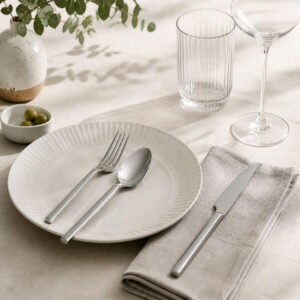
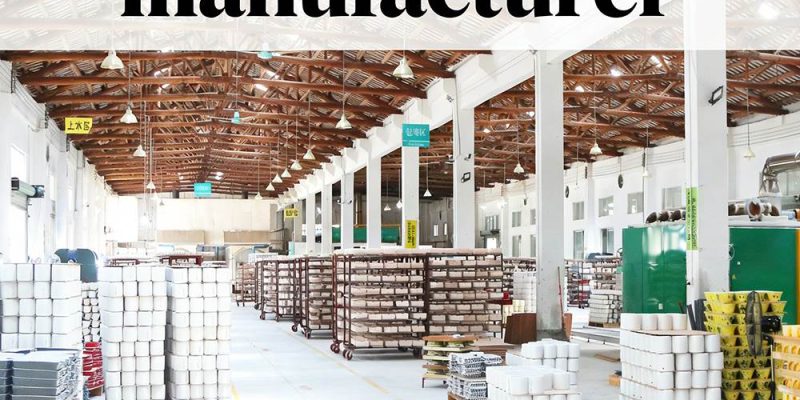
A chef’s job begins long before the serving leaves the kitchen. Every dish is not only made from the perfect recipe, but is built balancing the flavor, texture, and color. The presentation is done just right with the garnish, the sideline, and the sauce all to make it look interesting and delectable.
Only when everything conforms to the dish’s standard presentation is it sent out to the dining area.
That is exactly why custom dinnerware is important. In the hospitality business, whether it’s a Michelin-star restaurant or a global hotel chain, procurement teams know that dinnerware is never just plates and bowls.
It’s no wonder that the current dinnerware market is expected to grow from USD 15.6 billion in 2024 to USD 23.8 billion by 2032. Dinnerware becomes the frame that presents the dish. It can make the dish look either delectable or distasteful at a glance.
And the very reason we need custom dinnerware manufacturers who can create private label tableware for hotels, restaurants, and other dining concepts.
Why Do Hospitality Brands Invest in Private Label Dinnerware
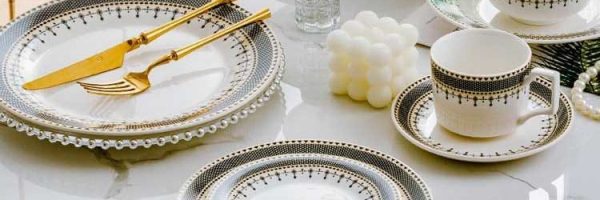
The one thing all successful restaurants and other dining concepts have in common is that the tableware is always a considered choice. The plates intentionally match the interior design or go in contrast with the theme of the restaurant. They may have logos or patterned rims, as part of the branding, too.
All of this comes at a cost. But since hospitality brands are increasingly understanding the importance of enhancing the guest experience, they continue to spend on branding and presentation.
In fact, around 61% of luxury hotel chains demand branded tableware collections today, and over 84% of luxury hospitality chains, in fact, use designer-branded tableware.
Guest Perception
The table presentation does much more than make the dish look attractive. A well-set table with inviting dinnerware can alter the guests’ perception of food quality. Everything from the plating style, color contrast, and design matters.
For instance, white plates are associated with cleanliness and premium positioning. Dark tones enhance color contrast, whereas round shapes exude a traditional feel.
The size of the plate also matters, as larger surfaces make portions appear smaller and vice versa.
Consistency
Another important detail for tableware standardization is consistency. It’s especially for hotel chains that have expanded to multiple locations. Whether a guest eats at an outlet in the busy, bustling, commercial area or another much more exclusive outlet of the same brand, they must experience the same service at both places.
That’s the ‘uniform dining experience’ which can be achieved by standardizing the servings, ambiance, and serveware. Technically, in private label tableware, that means the plate diameter, stackability, color, and logo placement must be exactly the same.
This way, every dish on the menu looks exactly the same at any outlet. Reflecting the same brand standards.
Cost and Customization
Another reason for the shift towards private label tableware is cost control. Initially, hospitality businesses found it easier to procure the tableware through distributors or retail collections.
It was quicker, easier to source, and you could get everything from one place. However, the downside was that the channels often involved multiple markups and offered limited customization.
Instead, working with a wholesale custom dinnerware manufacturer gives you far greater flexibility to design the tableware, choose the materials, and other specs. Professional OEM and ODM hospitality partners like Brett allow you to source dinnerware based on your operational needs.
Reliability
Restaurants and hotels will need replenishment of plates and bowls. The inventory wears down over time, and breakage and theft losses are inevitable. In such a case, partnering with a custom dinnerware manufacturer can get you the exact replacements of the original design.
Seasonal catalogue products may come with small variations in design, glaze, or size. But they can disrupt consistency across locations. Partnering with a custom-branded dinnerware manufacturer resolves the challenge.
OEM and ODM hospitality production ensures that exact molds, specifications, thickness, rim design, color codes, and logo placements can be replicated for years.
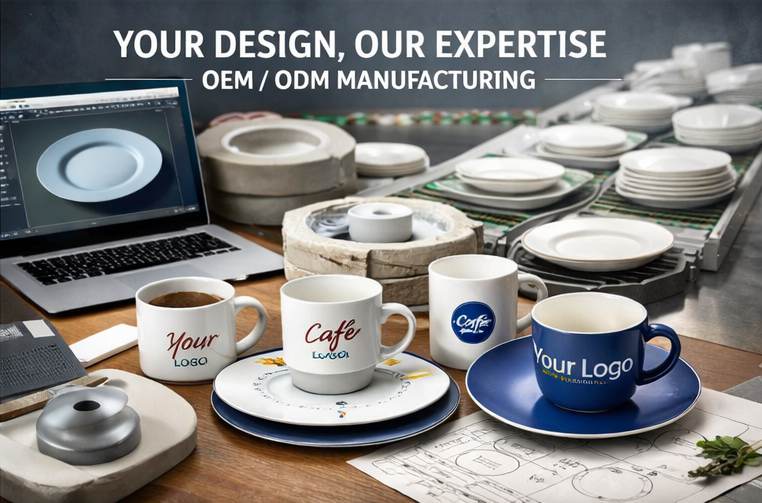
OEM Vs. ODM Tableware Manufacturing
When a hospitality brand uses private label dinnerware, it must choose the right manufacturing approach. The decision impacts both long-term consistency and operational reliability. This is where we use the terms OEM and ODM.
OEM - Original Equipment Manufacturing
OEM allows a brand to design its own custom restaurant plates from scratch. They provide their own design, technical drawings, structure, and other branding elements.
The private-label dinnerware manufacturer then produces the tableware to match the given specifications.
The OEM approach is typically useful for hotels and restaurant groups that need precise control over the mold thickness, rim structure, color specifications, and glaze finishes. This allows exact replication over time, meaning you can get consistent replenishment across multiple outlets over the long-term.
ODM - Original Design Manufacturing
The ODM process begins with a design that is developed by the manufacturer. It begins on pre-engineered models that are built on hospitality-grade standards. However, they can be minimally customized by the brand. You can decide the place and size of branding logos, color, surface finish, and patterns.
The process is more suited for new hotel openings or rebound branding projects where you need to meet faster timelines.
OEM Dinnerware Manufacturing Process
In the OEM model, the restaurant group, hotel, or brand directly works with the OEM dinnerware manufacturer.
- Design Concept:The process begins with the design concept, where you discuss the requirements of the dinnerware. Everything from the size, rim, glaze finish, weight, color, logo, pattern, and structure is decided at this stage.
- Prototype Production:Once the design is approved, the manufacturer begins production of the physical samples. These prototypes allow hospitality buyers to assess how the plate performs in real conditions. Restaurants also test these samples in their kitchens to check stacking, serving, and repeated dishwasher use.
- Custom Mold Creation:Once the samples are approved, custom molds are produced that replicate the shape of the plate precisely. It’s a tooling process for long-term consistency that enables exact reorders in the future.
- Mass Production: Large-scale custom tableware production begins. During this stage, branding and decorative elements are applied. Logos, embossed rims, and signature glaze colors are added as well to match the brand palette.
- Quality Control & Inspection:Professional OEM manufacturing includes a strict quality control check to ensure consistency in thickness, dimensions, finish, and durability before shipment.
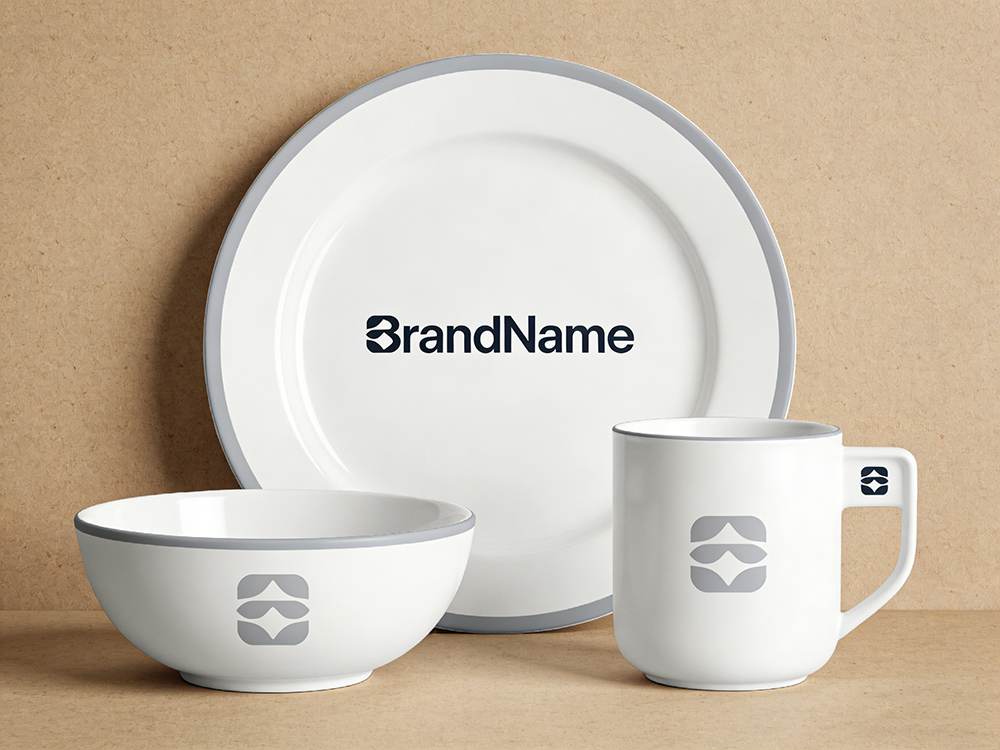
ODM Tableware Manufacturing Process
ODM production, on the other hand, has a slightly different manufacturing process. The manufacturer develops the base design, and the hospitality brand customizes it to match its identity and operational needs. The ODM process is well-structured but does not require mold development from scratch.
- Design Selection: The process begins when the hotel owners select an existing plate shape or collection from the manufacturer’s design library. The catalogued designs are actually already engineered for industrial ceramic production and meet hospitality standards such as durability, stacking efficiency, and commercial dishwasher resistance.
- Customization and Branding: Once a base model is chosen, the brand customizes details such as glaze color, surface finish, logo application, rim details, and decorative patterns. Even though structural changes are limited compared to OEM, visual branding adjustments can make the tableware go with the hotel’s concept and identity.
- Sampling: Before mass production, samples are produced for approval. Hospitality buyers evaluate these by running them through real operational conditions, including stacking, serving, and dishwashing, etc.
- Tooling Confirmation: Since the molds already exist in ODM, full new tooling is not needed. However, minor modifications to the existing molds may be needed for customization. depending on requirements.
- Mass Production: Once samples are approved, large-scale production begins using the existing molds. The tableware goes through standard ceramic processes, including shaping, high-temperature firing, glazing, and finishing.
- Quality Control: Each batch produced undergoes quality checks to ensure consistency in size, color, finish, and structure.
Choosing the Right Custom Dinnerware Manufacturer for Hospitality Projects
It can be tempting to focus only on designs and patterns when sourcing dinnerware for your concept. However, selecting a partner for private label tableware, whether for OEM or ODM projects, goes beyond the looks.
For hospitality brands, the priority is long-term performance, consistency, and scalability. That requires a careful evaluation of the manufacturer’s capabilities, quality control systems, customization flexibility, and ability to support future reordering.
So, how do you identify the right private label plates manufacturer?
Manufacturing Experience
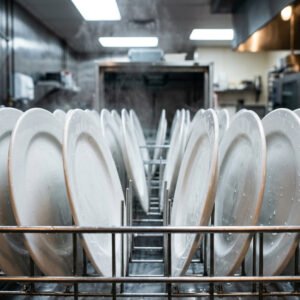
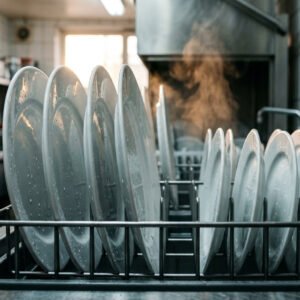
The dinnerware in the hospitality business has to endure repeated dishwashing cycles. It’s constantly under stress and moves between the kitchen and dining room, where it is stacked, carried, and passes through the high-temperature commercial dishwashing cycles.
At times, the whole cycle is carried out multiple times a day, which increases the stress on the plate glaze. Hence, the wholesale dinnerware manufacturer you select must understand the conditions of hospitality dining and must be able to work on the rim thickness, weight, and other structural elements, so the plates can perform for longer without wear.
OEM and ODM Production Capabilities
Another thing to check is that the manufacturer must be able to support OEM and ODM production models.
When they have the ability to work on both models, they will be better able to guide the hospitality brands through the development process, so it will be easier to decide which process suits them best.
Also, having both capabilities under one roof simplifies custom tableware production. The restaurant owners don’t have to coordinate with multiple vendors for designing, finishing, and manufacturing. The dinnerware is also produced within a shorter time and remains consistent through the years.
Production Capacity and Consistency
Most hospitality brands have long-term growth strategies. They may be looking at multi-location expansion, renovations, and periodic refresh cycles. Hence, production capacity and supply continuity are very important to consider when selecting a custom dinnerware manufacturer.
A reliable wholesale OEM or ODM partner must have the capability to handle scalable production volumes. They must maintain detailed production records, such as mold codes, firing temperatures, thickness, logo placements, and surface finishes. This way, future reorders will match the original designs.
For hotels and restaurants that makes replenishing inventory years later easier and without any visible differences in shape, tone, or branding.
Quality Assurance and Food Safety Standards
Professional manufacturers such as Brett also strictly adhere to the quality control systems throughout their production cycle. The plates are inspected for integrity, glaze, and dimensions before they leave the factory.
They also ensure the dinnerware meets the Food Safety Standards per the FDA, especially for lead and cadmium leaching limits. This way, the manufactured fleet is safe for long-term use and food contact.
Global Logistics and Hospitality Supply Support
Another area where professional manufacturers excel in hospitality is that they manage the export-grade packaging, especially for fragile ceramics. They use reinforced cartons and internal protective inserts, and pallet configuration to minimize damage during transit.
They also coordinate international shipping documentation, customs compliance, labeling requirements, and freight arrangements for smooth cross-border deliveries.
As a result, tableware arrives safely, on schedule, and ready for immediate deployment.
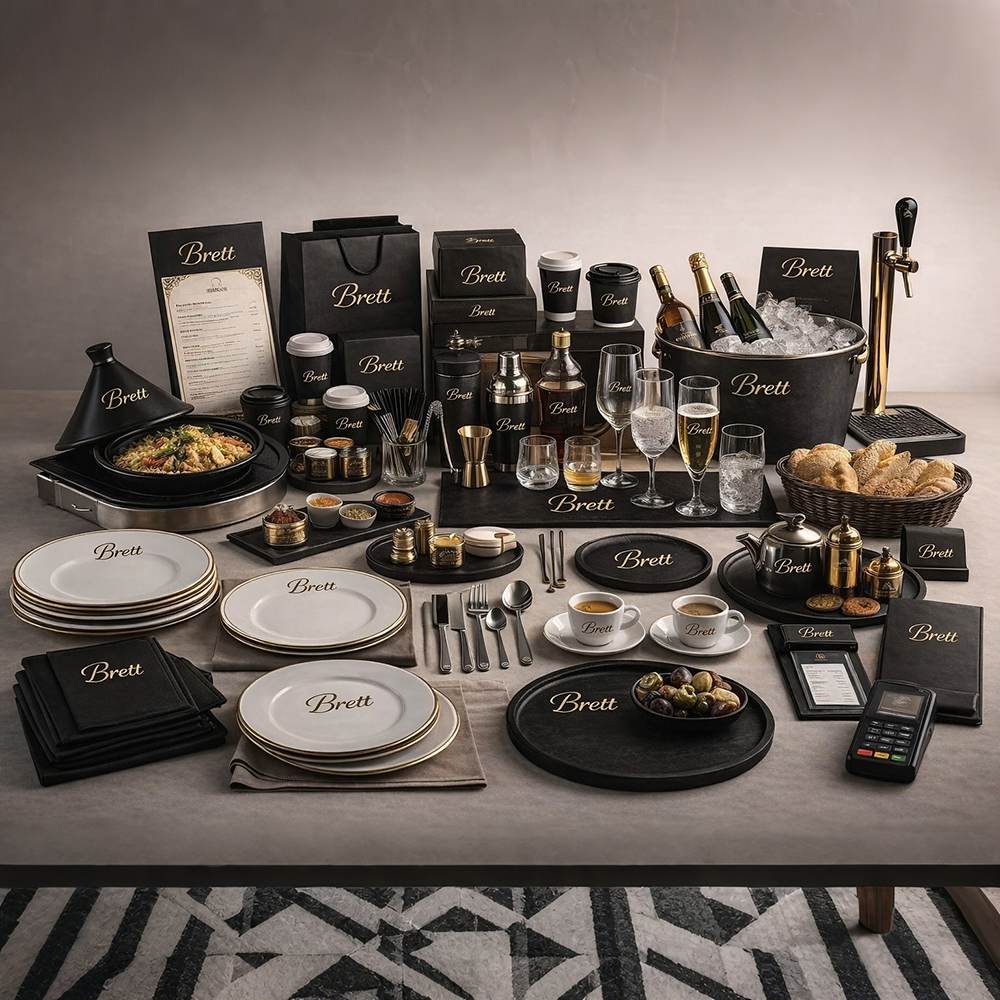
Tableware Materials Guide for Private Label Production
Material | Body Composition | Porosity | Chip Resistance | Impact Resistance | Stacking Performance | Best For | Brand Positioning |
Porcelain | Fired at ~1200–1400°C. Vitrified ceramic body | Very low | High (especially with reinforced rims) | High under normal service | Very Good | Luxury hotels, international chains, fine dining | Classic premium |
Stoneware | High-temp fired denser body | Low to moderate | High | High structural strength | Good | Casual dining, buffet concepts | Contemporary |
Bone China | Fine clay and bone ash composition. High vitrification | Very low | Depends on thickness | Depends on thickness and design | Moderate | Ultra-luxury hotels, executive dining | Luxury |
New Bone China | Improved formulation compared to traditional bone china | Very low | High | Better rim durability than Bone China | Good | Premium multi-outlet hospitality brands | Premium |
How Materials Impact Hospitality Operations
In hospitality, the choice of material is a performance decision. It determines how well the dinnerware can survive daily stacking, high-temp washing, and constant handling.
Porcelain
Porcelain is widely used in hospitality, white-label tableware, private label, and custom production programs. Produced from refined clay mixtures and fired at temperatures often exceeding 1200°C, Custom Porcelain Dinnerware develops a dense ceramic body that works exceptionally well in commercial environments.
The material is strong enough to handle repeated dishwasher cycles, is resistant to staining, and is capable of supporting a range of glaze finishes. Since brands want specific colors, rim profiles, or textures to match their interior design, porcelain is the preferred choice for large-scale custom tableware production programs.
Bone China
Bone china is usually used in high-end hospitality environments such as luxury hotels and premium restaurants. The composition of bone ash makes it lighter in weight and gives it a more translucent look.
Hence, the plates look thin and more elegant than traditional porcelain. Hospitality brands looking for a more sophisticated presentation style find Custom Bone China Dinnerware a more premium choice.
Stoneware
Stoneware dinnerware has become increasingly popular in contemporary restaurants and boutique hospitality concepts. The material, too, is fired at high temperatures as porcelain, which makes it strong and durable.
Unique dining concepts love the material for its rustic textures and earthy glaze finishes. Chefs also prefer stoneware for its appearance, which complements modern plating trends. It’s common to see matte glazes and dark tones in the collection. Explore Brett’s Black Ceramic Dinnerware Set.
New Bone China
New bone china looks like traditional bone china but offers improved structural performance. It is formulated to have high translucency and a lightweight profile.
If we compare the material to standard bone china, new bone china has better chip resistance and improved strength, making it more suitable for frequent handling in commercial environments.
This material is practical yet elegant, which allows brands the flexibility to maintain a premium style while meeting the demands of daily service cycles. Learn more about New Bone China here: The Rise of New Bone China: How Alumina Replaces Bone Ash in Modern Dinnerware.
Conclusion
In the world of hospitality, every plate is a stage where every dish performs. Behind that stage lies the manufacturing. That decides the strength of the rim, the durability, the weight, the color, the size, and the ability to survive thousands of service cycles without losing its form.
A well-designed dinnerware program ensures that presentation, durability, and brand identity remain consistent whenever restaurants serve at one location or another. Make the right choice with Brett, your custom dinnerware manufacturer for dinnerware engineered for real hospitality performance.