CBM means cubic meters. The CBM of the dinnerware order is obtained by multiplying the carton length, width, and height in meters and then multiplying by the number of cartons. Approximate usable space: a 20ft: 33CBM, 40ft: 67CBM (roughly 90% usable in a 40ft high cube = 76CBM). Dinnerware is dense, so weight is also a consideration; rated payload is approximately 26 to 28 tonnes, with road limits possibly being reduced. Use the calculator below to help you determine the CBMs and then consult your supplier to get carton size, gross weight, and the number of pieces per carton before ordering.
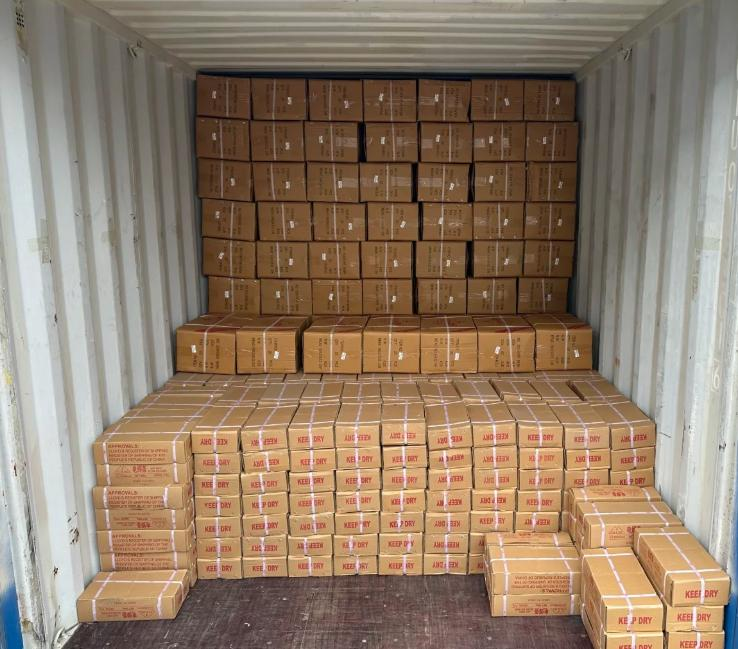
There’s one question that determines your freight bill before ordering in bulk: how much dinnerware will fit in a container? It is not a one-size-fits-all solution, as the answer will not be a single number. This will depend on how big your carton is, how heavy your carton is, and which limit you hit first: volume or weight.
Ceramics are heavy and brittle, and cannot be handled like lighter materials such as cushions and paper cups. This is a guide explaining how CBM works for dinnerware, and also has a free CBM calculator to determine how many cartons will fit in a 20ft or 40ft container by volume and weight.
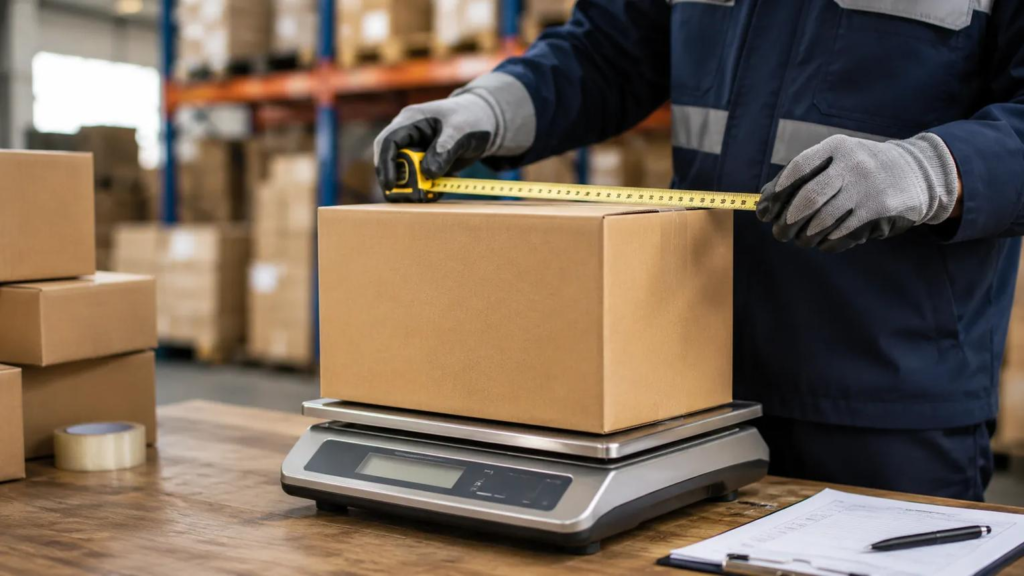
Table of Contents
Container Sizes at a Glance
These are standard figures. Your shipping line may quote slightly different ones, so confirm them with your freight forwarder.
Container | Internal volume | Typical rated payload | Usually used for |
20ft standard | About 33 CBM | About 28 tonnes | Smaller orders and very heavy goods |
40ft standard | About 67 CBM | About 26 tonnes | Most bulk dinnerware orders |
40ft high cube | About 76 CBM | About 26 tonnes | Lighter, bulkier goods, such as melamine |
One CBM (cubic meter) is a space of 1 m by 1 m by 1 m. It’s the unit freight uses to measure volume. Our guide to importing dinnerware from China covers the wider shipping process, including timelines and customs.
Why Dinnerware Is Different From Other Cargo
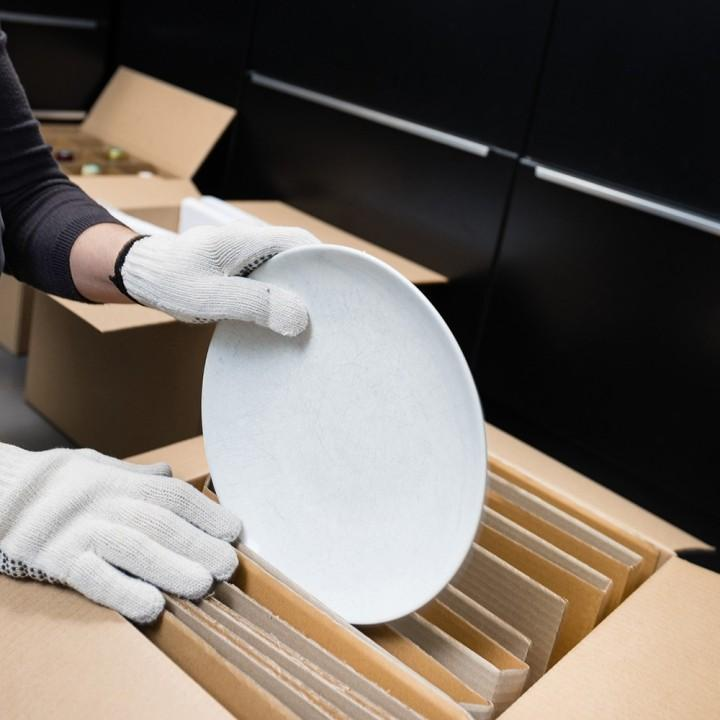
Light goods usually fill a container’s space long before they reach its weight limit. Ceramics are the opposite. A carton of plates is heavy for its size, so a full container can approach its payload limit before the space runs out.
There are three reasons for this.
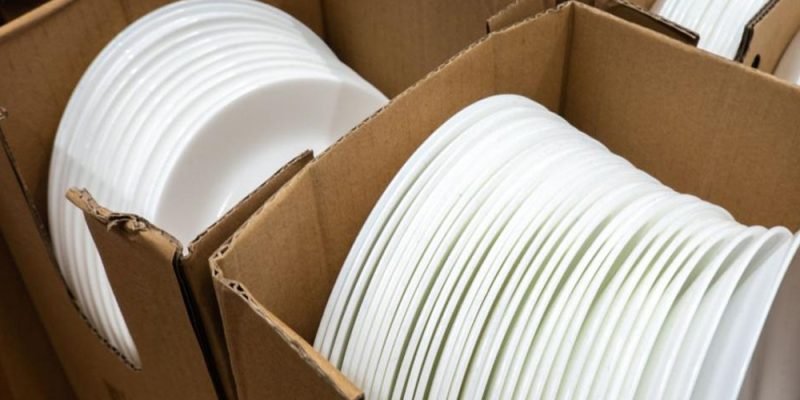
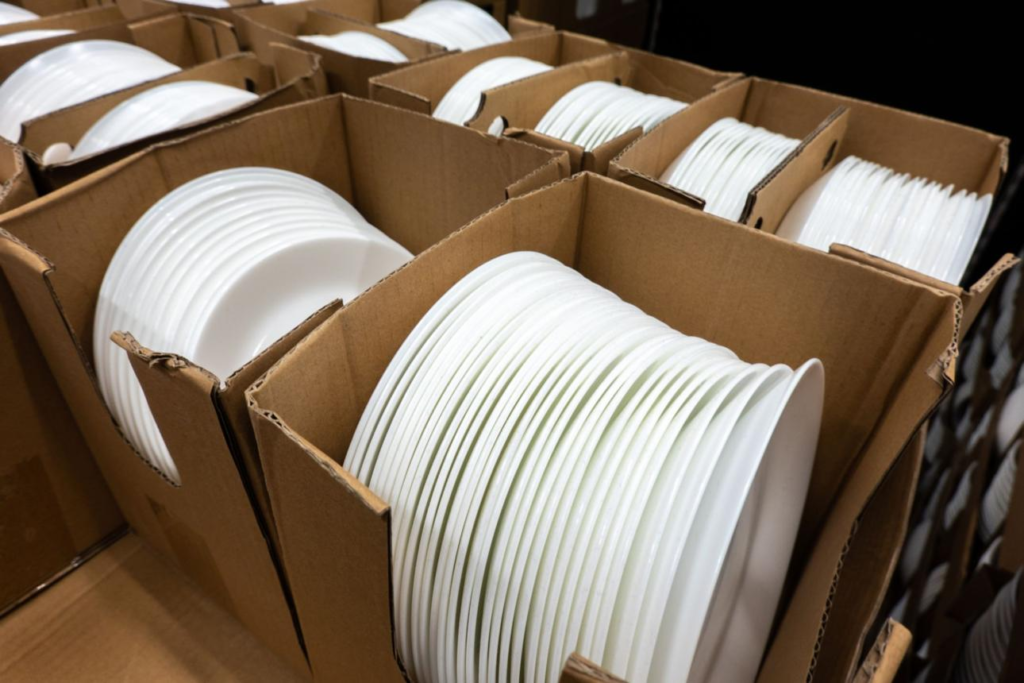
First, fragility. Dinnerware needs dividers, inner boxes, or foam, and that packing takes up space. A carton that looks small on a spec sheet may be larger once it’s packed for export.
Second, stacking. When stacking heavy cartons on top of each other, one cannot stack as tall as light ones, since the bottom one will be crushed.
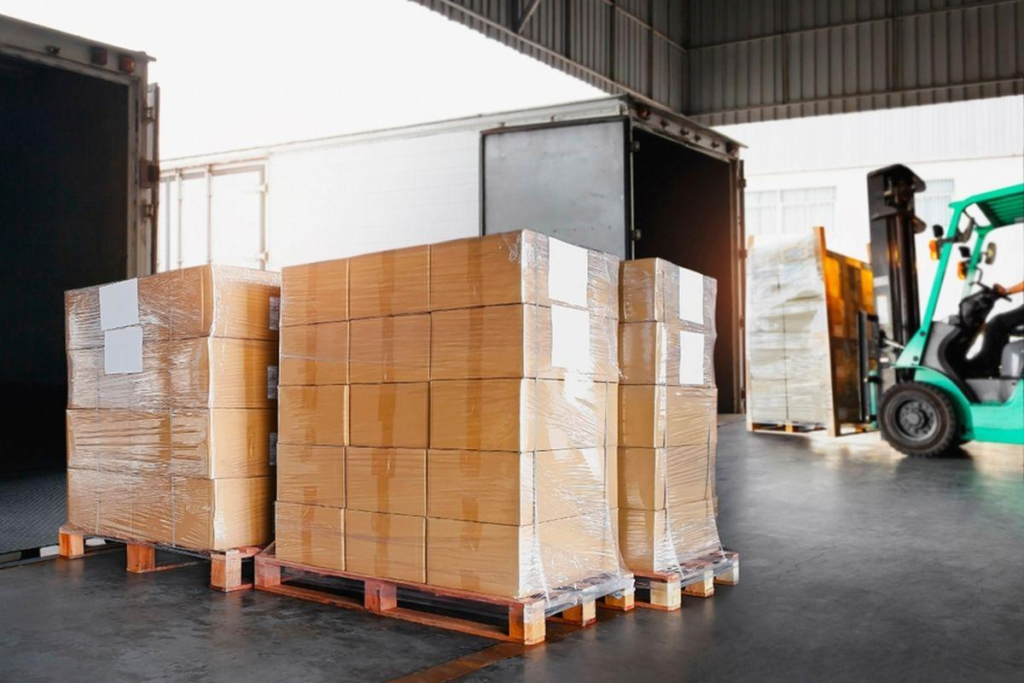
Third, pallets. Putting cartons on pallets protects them and speeds up unloading, but pallets take up floor space and height. Palletized loads usually carry fewer cartons than floor-loaded ones.
How to Calculate CBM for a Dinnerware Order
Your supplier will provide you with the following numbers on each product: carton size, gross carton weight, and pieces per carton. Then it is just simple mathematics.
Step | Formula | What you get |
1. Carton volume | Length x width x height in meters | CBM per carton |
2. Order volume | CBM per carton x number of cartons | Total CBM |
3. Order weight | Gross weight per carton x number of cartons | Total kg |
4. Container check | Compare total CBM and kg with the container’s limits | Which limit you hit first |
If the carton is measured in centimeters, then multiply the three numbers and then divide by 1,000,000. For example, a carton measuring 58 x 30 x 28 cm is 48,720 cubic centimeters, or 0.0487 CBM.
Free CBM Calculator for Dinnerware
Run the numbers in your own order by using the CBM calculator below. Enter carton information from the supplier, and it will display the total CBM, the total weight, and the number of cartons in each container.
Input | What to enter |
Carton length, width, and height (cm) | From your supplier’s packing data |
Gross weight per carton (kg) | The packed carton weight, not the net weight of the plates |
Pieces per carton | How many plates, bowls, or cups are in one carton |
Pieces you want to order | Your target quantity |
The calculator verifies the limits for a 20ft, 40ft and 40ft high cube container. If the Limit column mentions Weight, then your cartons are heavy enough to be loaded by weight, not space.
It assumes that 90 percent of the space is usable and applies standard payload figures, which you may adjust in Advanced settings. This is an approximation and will need to be verified with your freight forwarder.
Worked Example: Plates in a 20ft and a 40ft Container
The table below is for illustrative purposes only. Not a Brett quote and yours will be different. It assumes a carton of 24 plates (27 cm), packed in two stacks of 12, measuring 58 x 30 x 28 cm (0.0487 CBM). It can be reproduced in the calculator above.
Item | 20ft container | 40ft container |
Usable volume (about 90 percent) | About 30 CBM | About 61 CBM |
Cartons that fit by volume | About 613 | About 1,250 |
Plates in total | About 14,700 | About 30,000 |
Total weight, porcelain at 14 kg per carton | About 8.6 tonnes | About 17.5 tonnes |
Total weight, heavy stoneware at 21 kg per carton | About 12.9 tonnes | About 26.3 tonnes |
What limits the load | Volume in both cases | Volume for porcelain. Heavy stoneware is right at the weight limit |
It’s the pattern that’s more important than the numbers. The container is full first, as the weight of a porcelain carton is around 290kg per CBM. Heavyweight stoneware cartons are approximately 430kg per CBM, making a full 40ft container approach its weight limit. So it’s important to always check the volume and weight!
20ft vs 40ft: Which Container Should You Choose?
Situation | Better choice | Why |
Heavy stoneware or thick commercial porcelain | Two 20ft containers, or a lighter load in a 40ft | Weight can reach the limit before the space is full |
Large mixed order of plates, bowls, and cups | 40ft standard | Lower cost per CBM than two 20ft containers |
Light, bulky items such as melamine | 40ft high cube | Volume is the limit, so the extra height helps |
Smaller order of about 15 CBM or less | LCL or a 20ft | A full 40ft would be mostly empty |
The cheapest option on paper isn’t always the cheapest in practice. Check the road weight limit at your destination too. Trucks often can’t legally carry a container’s full rated payload, so your forwarder may tell you to cap the load below it.
FCL vs LCL for Dinnerware
FCL is Full Container Load, which is the price for the full load of the container. LCL (Less than container load) means your cartons are not the only ones in the container; you are paying by volume.
Option | Suits | Watch out for |
FCL | Orders large enough to fill most of a container | Paying for empty space if the order is too small |
LCL | Smaller trial orders and mixed samples | More handling, which raises the breakage risk, and a higher cost per CBM |
FCL is typically more cost-effective than LCL at around the 13-15 CBM mark. This will depend on the season and the route; enquire from your forwarder.
LCL freight is also typically calculated based on the largest of the CBM or tonne weight. Volume is the key factor in the price for most dinnerware cartons.
Palletized or Floor-Loaded Cartons?
Method | Advantages | Disadvantages |
Palletized | Protects cartons, and faster to unload with a forklift | Takes up space, so fewer cartons fit |
Floor-loaded | Fits more cartons in the same container | Slower to unload, and more handling by hand |
It all depends on your warehouse. When you have a loading dock and a forklift, pallets will typically save time and cause less damage. Otherwise, the only viable option may be floor loading. Our guide on what to avoid when buying dinnerware includes the storage and handling checks that buyers tend to miss.
What to Ask Your Supplier Before You Order
Quality freight planning begins at the factory. Here is our hotel tableware procurement checklist for the complete RFQ. To load, add these questions.
Question | Why it matters |
What are the carton dimensions for each item? | You need them to calculate CBM |
What is the gross weight of each carton? | You need it to check the payload limit |
How many pieces are in each carton? | It turns cartons into plates, bowls, and cups |
How is each carton packed (dividers, inner boxes, foam)? | Packing affects both size and breakage risk |
Is the order packed on pallets or floor-loaded? | It changes how many cartons fit |
Can you send a packing list with CBM and weight per item? | It lets you check the load before it ships |
Also ask how many pieces you should order, not only how many fit. Our guide on how many plates a restaurant needs covers quantities per seat, and our commercial dinnerware guide covers the breakage buffer to add on top.
Common Mistakes When Planning Container Loads
The first is that volume is being measured and not weight. A half-filled carton may not be the correct size if the cartons are very heavy.
The second is taking into account 100 percent of the container as usable. Plan for about 90 percent real capacity because of gaps, stacking limitations and pallets.
The third one is to order pieces instead of cartons. However, if you order 1000 plates, each carton of 24 plates results in over ordering and/or part carton. Buy cartons of the product in full.
The fourth is a lack of direction in life. A container allowed at the port may not be able to be transported over the road; check the weight limitations with the forwarder before placing the order.
How Brett Supports Bulk Orders
We offer bulk quantities of hotel and restaurant dinnerware. Contact our team and request the carton size, gross weight, and carton quantities for each product you are interested in ordering before placing your order. Our dinnerware conforms to the SGS and TUV standards and complies with EC No.1935/2004, and our hotel tableware sample approval guide includes what to inspect before mass production.
Frequently Asked Questions
How much dinnerware fits in a 40ft container?
It will be determined by carton size and weight. A 40ft container, for example, can store approximately 30 000 porcelain dinner plates, 24 per carton. Call your supplier to obtain carton data and obtain your actual number.
How many CBM are in a 40ft container?
Approximately 67 CBM internal capacity and approximately 76 CBM high cube. Expect to have about 90% usable.
What does CBM mean in shipping?
CBM is an abbreviation for cubic meter, which is a unit of volume. It is obtained by multiplying length, width, and height in meters.
Is there a free CBM calculator for dinnerware?
Yes. The calculator in this guide takes your carton size, weight, pieces per carton, and order quantity. It displays the total CBM, total weight, and the number of cartons in 20ft, 40ft, and 40ft high cube.
What is the weight limit of a shipping container?
Standard 20ft and 40ft containers have a rated payload of about 26 to 28 tonnes. Road limits at the destination can be lower, so confirm with your forwarder.
Is FCL or LCL better for dinnerware?
FCL is for bigger volumes and may be more economical from approximately 13 to 15 CBM. LCL is ideal for smaller orders and has more handling, increasing breakage risk.
Should dinnerware be shipped on pallets?
Pallets help to protect cartons and increase unloading speed, but they decrease the number of cartons that fit. Select in accordance with the kinds of warehouse equipment.
Can I mix different products in one container?
Yes. A lot of buyers purchase plates, bowls, and cups within the same container. Place the heaviest cartons at the bottom and verify the total load vs. the load capacity.
Conclusion
The honest answer to how much dinnerware fits in a container is that it depends on your cartons. Use the CBM calculator to work out the volume and weight of your order, and check the result against both limits. For light porcelain, the space usually runs out first. For heavy stoneware, the weight can.
Ask your supplier for carton data early, order in full cartons, and plan on about 90 percent of the container. Then confirm the road weight limit with your forwarder, so the plan works at the destination as well as the port.
We provide bulk dinnerware for restaurants and hotels, documented with SGS, TUV, EC No. 1935/2004, FDA, LFGB, ISO 9001, BSCI and Sedex on request. Contact us at CBHORECA or WhatsApp +86 13535413512 to request carton details for your next carton order.