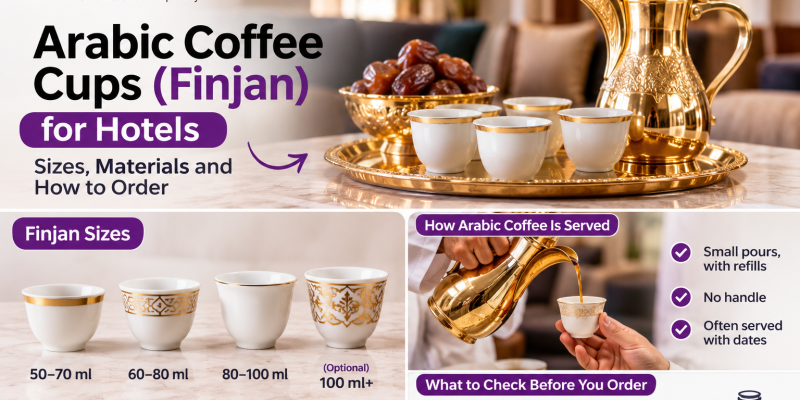
Many Middle Eastern hotels have a small cup of coffee as a welcome sign. The small cup for drinking is called a finjan, which is usually unhandled and is made for frequent refilling during the visit. The choice of the right Arabic coffee cups is important because the cup can affect how the coffee is served.
In this guide, you’ll find out what a “finjan” is, the different sizes, which materials work best in a hotel service, and important things to look for before you order. For tea and coffee sets in general, see our guide to choosing tea sets for hotels, restaurants, and cafés.
A finjan is the small, usually handleless cup used for Arabic coffee, often called a qahwa or gahwa cup. There is no universal size. Sources commonly describe it as about 50 to 100 ml, and the cup is only partially filled and refilled. For hotels, choose by service style and local habit, check ratings for any metallic decoration, test cups with hot coffee in the hand, and order enough pieces for service, washing, and breakage.
Table of Contents
What Is a Finjan?
Arabic coffee is served in a small cup called a finjan. It usually has no handle, and you grip the cup with your fingers. It is also known as a “cawa cup” or “gahwa cup” depending on the region and the seller.
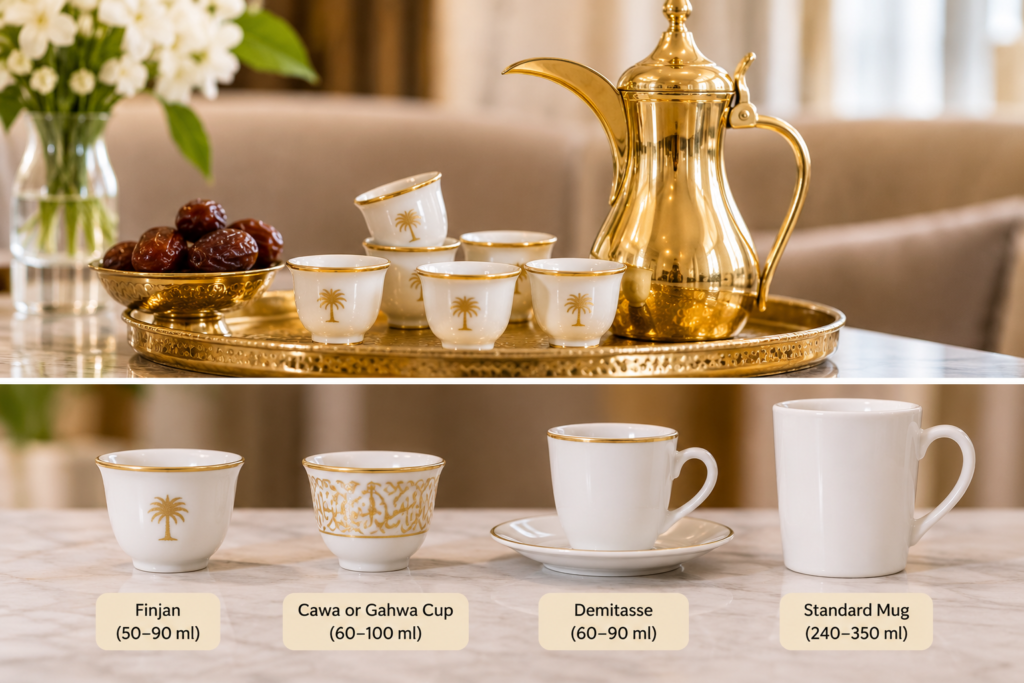
The only place where buyers get confused is the capacity. No standard, but various ranges are reported by sources. The table indicates some of the commonly mentioned numbers; check with your own food and beverage team.
Term | What it is | Commonly quoted capacity |
Finjan | A small, usually handleless cup for Arabic coffee. The word is also used for Turkish coffee cups in some regions | About 50 to 90 ml |
Cawa or gahwa cup | Another name for the Arabic coffee cup, often with decorated or gold-rimmed designs | About 60 to 100 ml |
Demitasse | A small coffee cup, usually with a handle, made for espresso | About 60 to 90 ml |
Standard mug | Not traditional for Arabic coffee | About 240 to 350 ml |
How Arabic Coffee Is Served, and Why It Shapes the Cup
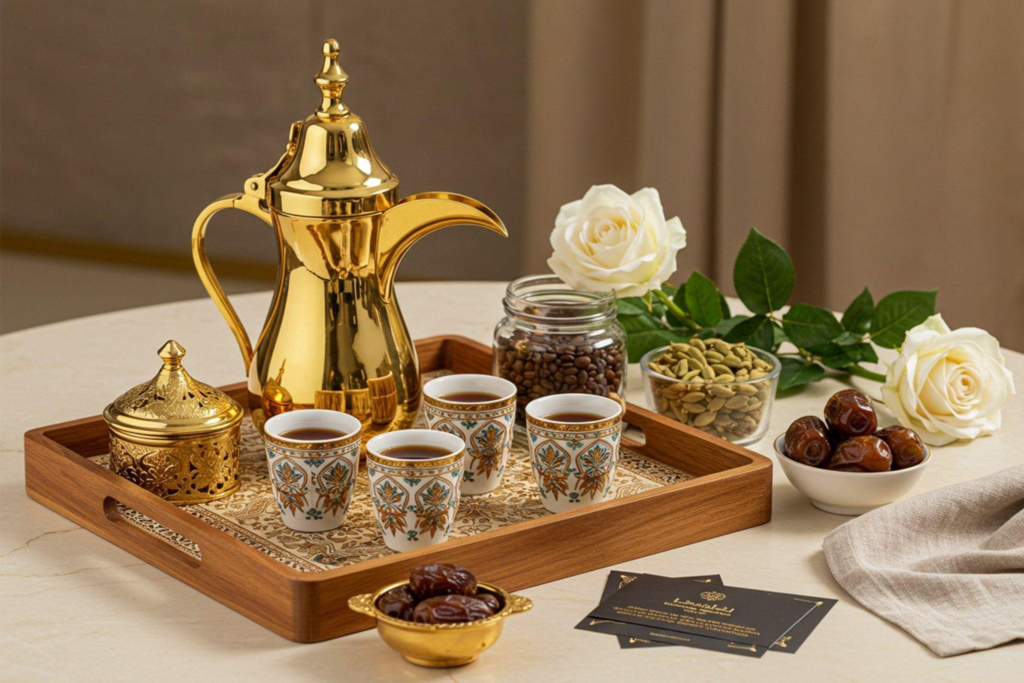
Arabic coffee is a sign of hospitality, and UNESCO has recognised it as intangible cultural heritage. It is mostly brewed and served in a pot called a dallah, which is long-spouted, in small portions and refilled by the host.
Each family and each country has its own custom, so use the table below as a guide. The idea is the impact each habit has on the cup you purchase.
Service habit | What it means for the cup |
Small, partly filled pours with repeated refills | A small cup, and a base that stays stable on a tray |
Poured from a long-spouted dallah | An opening wide enough to pour into cleanly |
Held in the fingers without a handle | Thin enough to hold comfortably, and not too hot in the hand |
Guests signal when they have had enough, often by gently shaking the cup | A light cup that handles easily |
Served on a tray, often with dates | Cups that stack and carry well, with or without saucers |
Finjan Sizes: What Capacity Should You Order?
When a supplier quotes a capacity, it’s usually the brimful volume, which is what the cup holds when filled to the top. A Finjan is poured much lower than that. Some sources describe a pour of about a third of the cup, so a cup rated at 80 ml may serve far less.
Service style | What to consider | Capacity direction |
Traditional welcome service | Frequent small pours and refills | Toward the smaller end, about 50 to 80 ml |
Lobby or arrival service | A balance of tradition and ease of handling | About 60 to 100 ml |
Events and banquets | Many cups at once, with fast washing and restocking | A standard size that suits your trays and racks |
Restaurants serving mixed coffee styles | Guests may expect a handle for espresso | A handled cup alongside the finjan |
Always use real pours for testing. Fill to normal level, give to staff member and test with hot coffee.
Materials for Hotel Finjan Cups
The material is important because coffee leaves distinct stains when drunk through Arabic cups. A dense body absorbs little water and will not stain easily. Our guide to vitrified porcelain explains what to look for.
Material | Strengths | Watch out for |
Fully vitrified porcelain | Dense, strong, and a good fit for daily commercial washing | Thin rims can chip if stacked carelessly |
Bone china | Light and fine, and popular for luxury service | Gold or platinum decoration may need hand washing |
Stoneware | Sturdy, with a more rustic look | Heavier, and usually thicker walls that feel less delicate |
Glass | Shows the colour of the coffee | Heat in the hand, and breakage |
Our comparison of bone china vs porcelain explains the differences for hospitality use.
Designs and Decoration.
Finjan cups range from plain white to gold-rimmed, painted, and calligraphy designs.
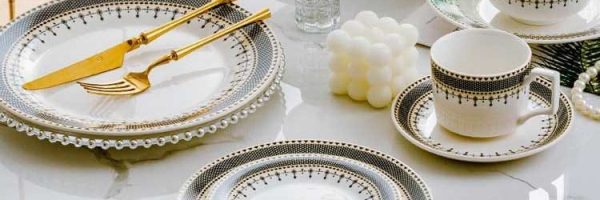
For example, a set of Arabian-style porcelain coffee cups and saucers features high-fired white porcelain with Middle Eastern designs such as camel designs, geometric patterns, and Arabic calligraphy.
Metals require attention to decoration. If it’s not labeled microwave-safe, it’s not microwave-safe, as our guide on gold-rimmed plates and microwaves reveals. For Brett bone china with real gold or platinum decoration, we recommend washing by hand in warm water to help the decoration last longer. All Brett ranges are otherwise dishwasher safe.
Arabic Coffee Cup Sets: Sets of 6 and 12 vs Ordering by the Piece
Typical retail sets of Arabic coffee cups are 6 or 12, and 12 is common. They are frequently boxed, and sometimes come with saucers. Hotels can either purchase sets or order individually.
Option | Best for | Watch out for |
Set of 6 or 12 | Small venues, boutique properties, and gift or retail sets | Fixed quantities, and packaging that suits retail more than daily service |
Ordered by the piece | Hotels and restaurants with high-volume service | You need to plan counts, packing, and replacements yourself |
The Rest of the Service: Pots, Trays, and Saucers
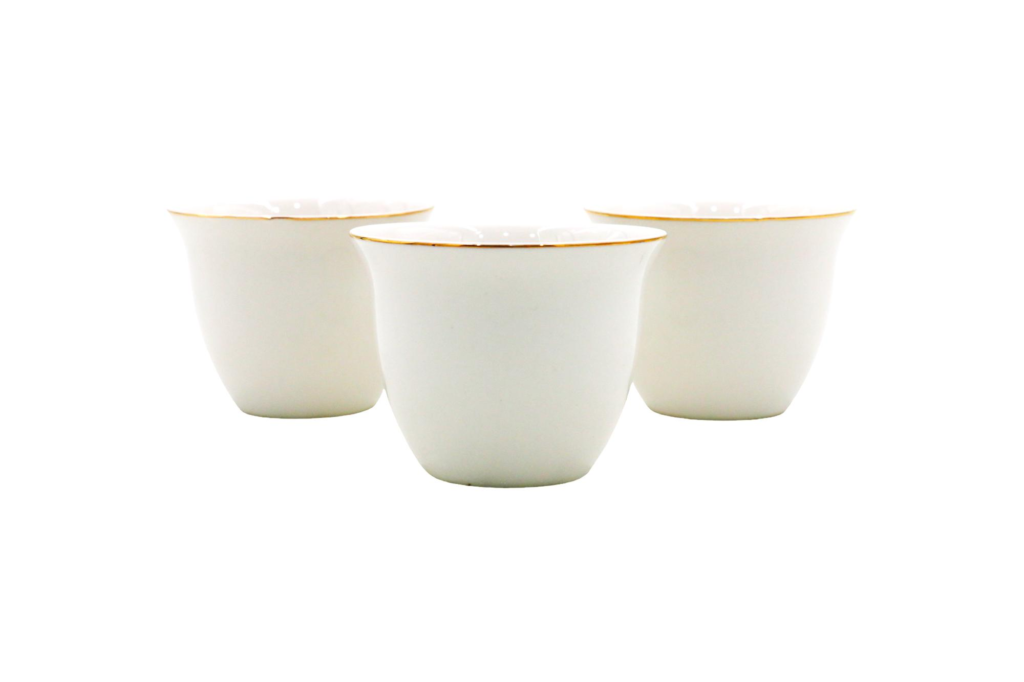
The cups are only part of the service. A complete setup usually includes a pot, a tray, and a dish for dates, and saucers are optional. Ask us which ceramic pieces we can supply with your cups, and see our guide to hotel catering tableware in the Middle East for how hotels combine custom and stock pieces.
How Many Finjan Cups Does a Hotel Need?
Arabic coffee is refilled often, so cups cycle quickly. A simple way to plan is to count the guests you serve at the same time, then add cups for washing and a reserve for breakage. The numbers below are an illustration, not a fixed rule.
Peak guests at one time | Cups in service | Washing batch | Reserve | Total to hold |
20 | 20 | 20 | 10 | 50 |
40 | 40 | 40 | 20 | 140 |
80 | 80 | 80 | 40 | 200 |
Small cups chip at the rim, so plan a breakage buffer from the start. Our commercial dinnerware guide covers replacement planning.
What to Check Before You Order
Check | Why it matters |
Brimful capacity and your normal pour | A cup rated at 80 ml serves far less when partly filled |
Heat in the hand | Handleless cups must be comfortable with hot coffee |
Rim and wall thickness | A fine rim feels refined, but it still needs to resist chipping |
Base stability | Small cups tip easily on a moving tray |
Stain resistance | Ask for the water absorption report for the exact range |
Dishwasher rating and decoration durability | Cups go through commercial washing every day |
Matching on reorders | Replacements should match the cups you already own |
Test samples in real service before you approve an order. Our hotel tableware sample approval guide explains how.
Custom Finjan Cups for Hotels
A great number of hotels request Finjan cups with a logo, a signature colour, a gold rim, or a calligraphy design. Our hospitality ranges are manufactured in our own factory and can be customized into shapes, sizes, colours, logos, patterns, and packages, with samples for approval prior to bulk production. The minimum order will vary by product and customisation level, so please request the minimum order for your design. Check out our custom dinnerware page to see how it’s done!
A set of coffee cups designed in Arabic and with a hotel logo for approval. Alt text: Custom Finjan Cup Set with a Hotel Logo. File name: custom-finjan-cups-hotel-logo.jpg]
The following are some common mistakes to avoid when purchasing Arabic coffee cups.
Common Mistakes When Buying Arabic Coffee Cups
The first is when you purchase something because you like the way it looks. A cup that burns the hand and/or tips in the tray won’t serve its purpose.
The second is mixing up brimful with the actual pour. Test with the same level of fill as usual.
The third is neglecting to take care of the decoration. Gold and platinum require an appropriate washing process.
Frequently Asked Questions
What is a finjan?
A finjan is a tiny, typically handleless cup that is used to drink Arabic coffee. They are held in the hands and poured in small quantities, which the host restocks. In some parts of the world, the term is also applied to Turkish coffee cups.
What size is an Arabic coffee cup?
There is no standard size. The sources report roughly half a cup, or 50 to 100 ml, brimful, and the cup is typically only partly filled. Double-check with food and beverage staff and try it out with actual pours.
Why are Arabic coffee cups handleless?
It is traditional to carry the small cup in the fingers. Small cup sizes make the cup easy to hold. Always test a sample with hot coffee, as the heat in the hand differs from design to design.
What is the difference between a finjan and a demitasse?
The Arabic coffee cup is called A finjan; it is small and often lacks a handle. A demitasse is a small cup typically with a handle designed for holding espresso. They both have similar capabilities, but different forms and customs.
How full should you fill a finjan?
Usually only partly. A source says that a drink is about a third of a cup, and that they are offered frequently. There are local variations, and you should check your usual fill level using a sample.
What material is best for hotel Arabic coffee cups?
Fully vitrified porcelain is a strong all-round choice for daily commercial use, and bone china suits finer settings. Ask for water absorption and durability reports for the exact range, since Arabic coffee stains.
How many cups are in an Arabic coffee set?
Retail sets commonly come in 6 or 12 cups, sometimes with saucers. Hotels usually order by the piece in the quantity their service needs, so ask for a quote by quantity as well as by set.
Can Finjan cups go in the dishwasher?
All Brett ranges are dishwasher safe. The one exception is bone china with real gold or platinum decoration, where we recommend washing by hand in warm water to help the decoration last longer.
How many finjan cups should a hotel order?
Count the guests you serve at once, then add cups for the washing cycle and a breakage reserve. Because Arabic coffee is refilled often, cups cycle quickly, so plan generously.
Do Arabic coffee cups stain?
Arabic coffee can stain cups, especially if left to dry. A dense, low-absorption body resists it better, so rinse soon after service and ask for the water absorption report for your range.
Can I order custom finjan cups with a logo?
Yes. Customization includes shape, size, colour, logo, pattern, and packaging, with samples approved before bulk production. Ask our team for the minimum order for your design.
Conclusion
The right Arabic coffee cups are small, comfortable in the hand, durable in the dishwasher, and matched to how your hotel serves coffee. Capacity, material, decoration, and replacement planning all matter more than the look alone.
Test samples with real pours, check ratings for any metallic decoration, and order enough cups for service, washing, and breakage.
We supply hospitality coffee cups and dinnerware for hotels and restaurants. Test reports and compliance documents are available on request. Reach our team at ann@chinabrett.com or WhatsApp +86 13535413512 to discuss Arabic coffee cups for your next order.