When hotel buyers see two firing temperatures on a spec sheet, they wonder which one is important. The difference in these terms is important and it helps you to select the right range for each of the outlets at Brett.
It describes the two firing routes, the production of ceramics in Chaozhou, the application of Reactive Glaze, and what to ask before ordering. Also demonstrates how Brett’s own factory/customization fits in.
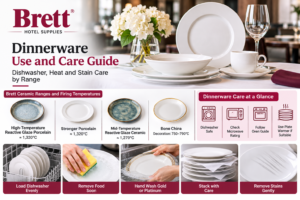
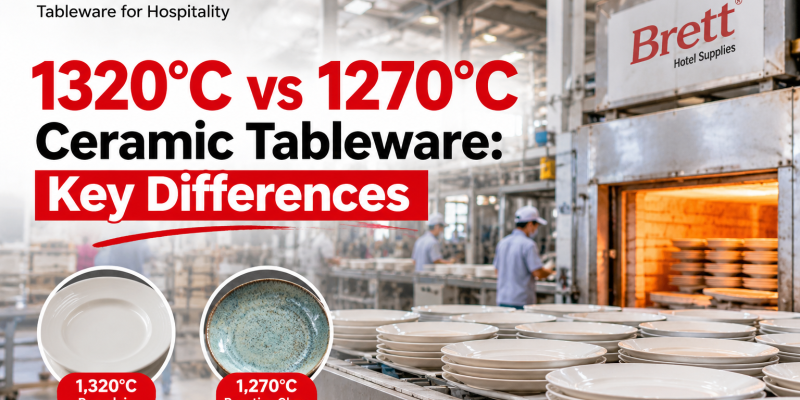
Brett’s 1,320°C ranges are high-temperature porcelain, and its 1,270°C range is mid-temperature reactive glaze ceramic. The gap affects how the body vitrifies, but water absorption, strength, and durability must be confirmed by laboratory tests. Reactive glaze is used at both temperatures, so it isn’t the dividing line.
Table of Contents
The Two Firing Routes Side by Side
Brett’s hospitality ranges are heated at two main temperatures, namely: approximately 1320°C for high temperature porcelain and approximately 1270°C for mid-temperature reactive glaze ceramic.
| 1,320°C high-temperature porcelain | 1,270°C mid-temperature ceramic |
Firing temperature | Approximately 1,320°C | Approximately 1,270°C |
Brett ranges | Reactive glaze porcelain, and alumina-reinforced Stronger Porcelain | Mid-temperature reactive glaze ceramic |
Body | Porcelain. The Stronger Porcelain body contains alumina | Ceramic body fired at mid-temperature |
Appearance | Distinctive glaze colours and gradients (reactive glaze), or a white body (Stronger Porcelain) | Unique glaze colours, textures, and decorative effects |
Typical applications | Premium hotels, fine-dining restaurants, luxury hospitality, and commercial hotels and restaurants | Restaurants, boutique hotels, and contemporary dining concepts |
Water absorption | Confirm by laboratory test | Confirm by laboratory test |
Dishwasher | Dishwasher safe | Dishwasher safe |
Be aware of what the table doesn’t state. It does not state which way is the better choice. Both are for Hospitality.
What Firing Temperature Actually Does
Firing turns a shaped, glazed piece into hard ceramic. A higher firing temperature helps a body vitrify, which means it becomes dense and less porous. For more information, see our guide to vitrified porcelain.
There is only one input, but it is temperature. The body formula, glaze, and method of construction also affect the absorption, strength, and durability of the piece. Higher temperature does not indicate less water absorption and vice versa and lower temperature does not indicate a weaker piece, and vice versa. This is the reason why the 50°C difference reading should be taken in conjunction with test results.
Our guide on what to avoid when buying dinnerware explains why buyers should ask for test data, not just a material name.
How Chaozhou Ceramic Tableware Is Made
Ceramics have been produced in Chaozhou, Guangdong since the Tang dynasty. Research published suggests that production grew to a very large scale during the Northern Song period, and it is reported now to be one of the largest ceramic production centres in China, with daily-use ceramics the main product. Since the modern period, the Fengxi region turned into a significant production centre porcelain.
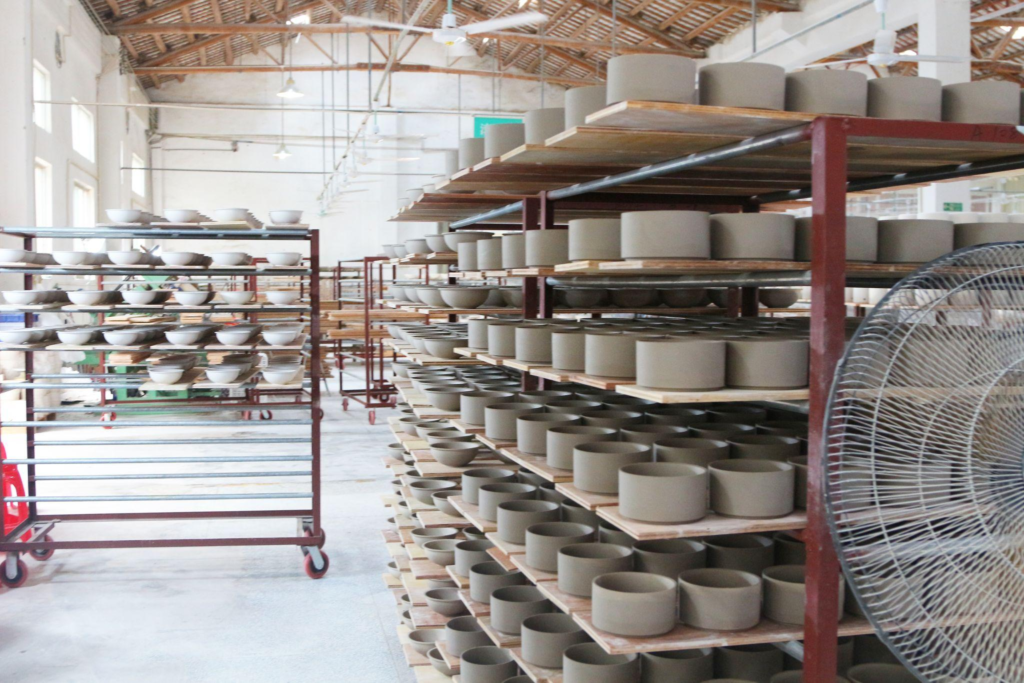
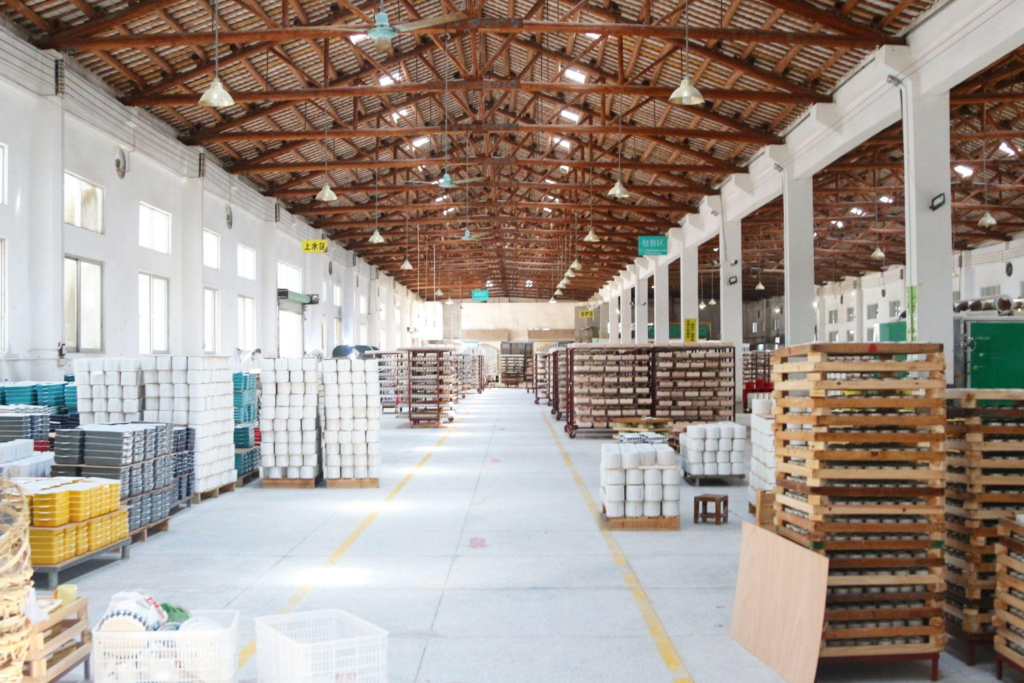
Brett’s factory is in the Changmei Industrial Zone in Fengxi, Chaozhou, where we make our hospitality ranges.
Stage | What happens | Where the two routes differ |
Body preparation | Raw materials are blended into the ceramic body | Stronger Porcelain adds alumina to its body |
Forming and drying | The body is shaped and dried before glazing | Same stages for both routes |
Glazing | Glaze is applied, including reactive glaze for special colour effects | Both routes can use reactive glaze |
Firing | Pieces are fired in a kiln | Approximately 1,320°C or approximately 1,270°C |
Decoration and inspection | Patterns and logos are applied, then pieces are checked and packed | Decoration method depends on the product |
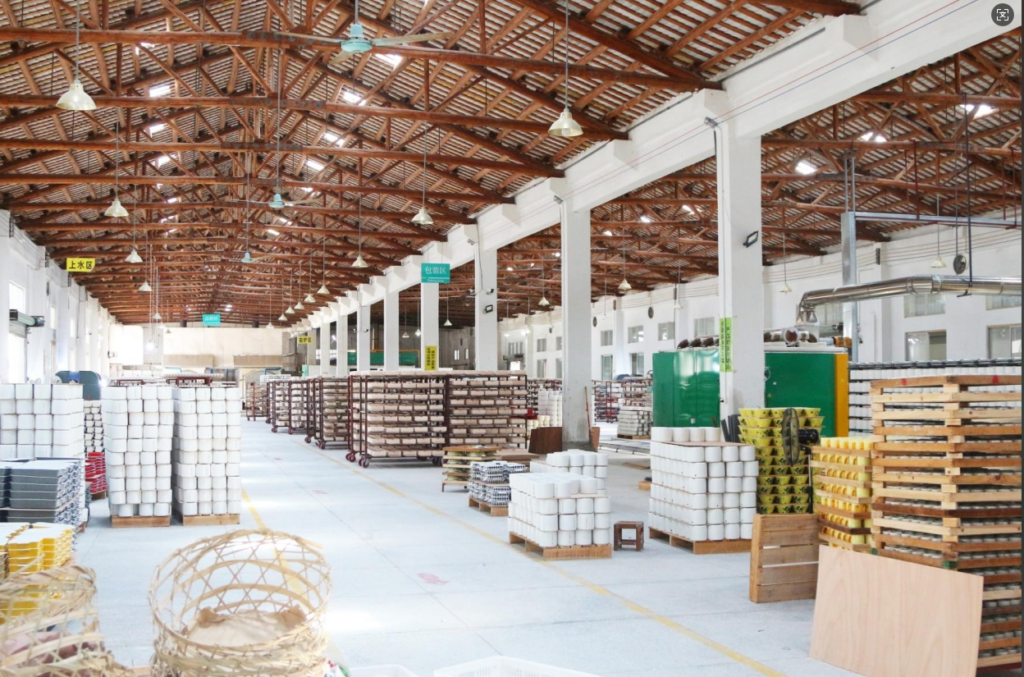
1,320°C High-Temperature Porcelain: Two Brett Ranges
Brett produces two hotel and restaurant ranges of porcelain at a temperature of around 1320°C. One is dedicated to unique reactive glaze colours and the other is for a white body with alumina reinforcement.
Reactive Glaze Porcelain
Brett’s high-temperature reactive glaze porcelain is fired at approximately 1,320°C. Reactive glaze creates distinctive colours, gradients, and surface variations during firing, and each piece is slightly different. It suits premium hotels, fine-dining restaurants, and luxury hospitality projects. Our reactive glaze dinnerware guide covers design, safety, and care.
Alumina-Reinforced Stronger Porcelain
Stronger Porcelain is Brett’s product positioning for its alumina-reinforced white porcelain, also fired at approximately 1,320°C. Alumina is a hard mineral added to the body to improve mechanical performance, and the range is designed for commercial hotels, restaurants, and demanding foodservice.
The strength depends on the formula and the manufacturing process, and should be backed by test data. Before making comparisons with standard porcelain, inquire about flexural strength, impact resistance and edge chipping.
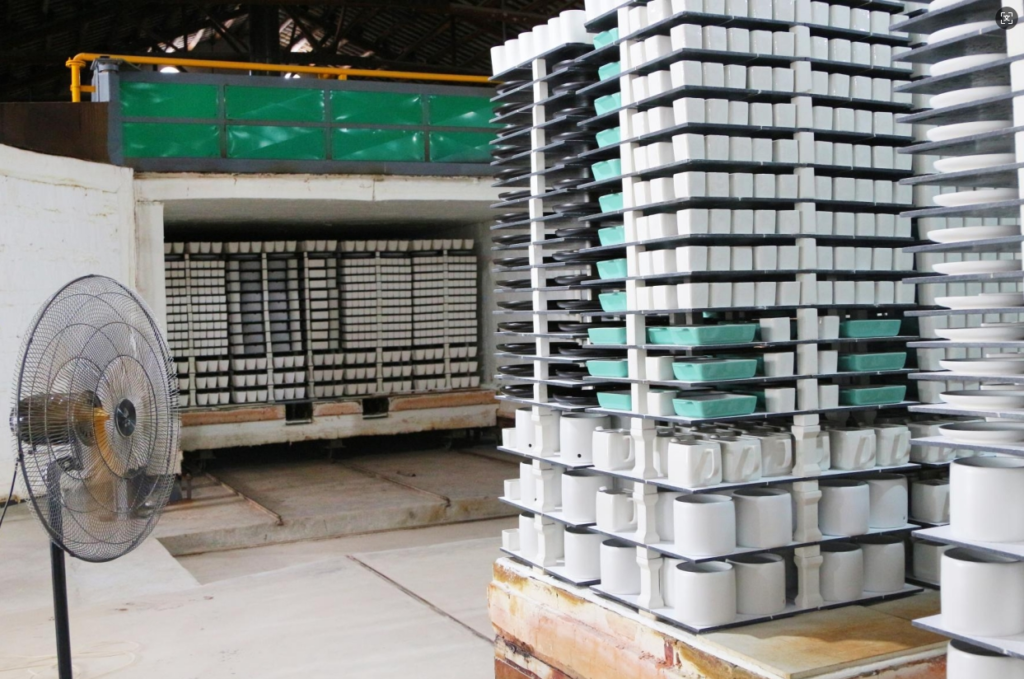
1,270°C Mid-Temperature Reactive Glaze Ceramic
The firing temperature of the ceramic is around 1270°C, which is considered as a medium-temperature firing. It provides distinctive glaze colors, textures and decorative effects and is a great choice for restaurants, boutique hotels and modern dining ideas.
Each piece will look slightly differently when using a Reactive glaze, with variations in colour and texture of the surface. The firing temperature cannot be relied upon to determine water absorption – it should be verified in the laboratory.
Reactive Glaze Isn't the Dividing Line
This is the most common mistake. Reactive glaze is another term for glaze effect and firing technique; Brett uses it at both temperatures. Is not a separate water absorption class and will not indicate the firing route of a product.
When you consider the two routes, take into account the firing temperature, the body, and the test results. The glaze effect is a choice of design, and it can be used in combination with both.
Water Absorption: What the Standards Say
The percentage of water which is absorbed by a ceramic body under test conditions is called the water absorption rate. The lower rate is usually a more compact, less porous body. For tableware, there are three references.
Standard | What it covers | Water absorption |
GB/T 3532-2022 | Daily-use porcelain ware | Fine porcelain 0.5% or less. Ordinary porcelain 1.0% or less. Stoneware 5.0% or less |
GB/T 3299 | Test method for water absorption of daily-use ceramics | Defines how it is measured. It is not a limit |
ISO 5644:2024 | Porcelain tableware | Porcelain body below 0.5%, by the specified test method |
Water absorption is only part of quality. Hotels should also consider mechanical strength, thermal shock resistance, glaze durability, dishwasher resistance, lead and cadmium release, and edge strength. A firing temperature isn’t a water absorption figure, so ask for the laboratory report for the exact range.
Which Route Suits Which Outlet?
Use Brett’s typical applications as a starting point, and confirm with samples and test results.
Outlet | Routes to consider | What to check |
Luxury hotel or fine dining | Reactive glaze porcelain at 1,320°C | Colour consistency, and agreed variation between pieces |
Commercial hotel or busy restaurant | Stronger Porcelain at 1,320°C | Strength, impact, and edge chipping data |
Boutique hotel or contemporary restaurant | Reactive glaze ceramic at 1,270°C | Water absorption report, and the look of the glaze |
Weddings and banquets | Bone china, and the routes above | Decoration durability, and gold or platinum care |
For bone china with real gold or platinum decoration, we recommend washing by hand in warm water to help the decoration last longer. All Brett ranges are otherwise dishwasher safe. See our comparison of bone china vs porcelain for the material differences.
What to Ask For Before You Order
Ask for | Why it matters |
Water absorption rate for the exact range | Shows how dense the body is |
Flexural strength, impact resistance, and edge chipping | Shows how it handles knocks and daily handling |
Thermal shock resistance | Shows how it copes with sudden temperature changes |
Dishwasher, glaze, and decoration durability | Shows how the finish holds up to commercial washing |
Lead and cadmium release for each body and decoration type | Colours, overglaze decoration, and gold need checking separately |
Our lead-free ceramic dinnerware guide covers food safety standards for hotels, and our hotel tableware sample approval guide explains how to test samples before you commit.
Brett's Factory and Customization
Brett, also known as China Brett and Brett Hotel Supplies, is a hospitality tableware manufacturer. We make our ranges in our own factory in Fengxi, Chaozhou, and we can explain how each range is made, fired, and tested. See our custom dinnerware page for the process.
Customization is associated with firing. The choice of firing route depends on a design, which may be appropriate for one colour or a combination of colours, one or more reactive glazes, or a decoration technique; consider materials at the beginning of a project, not after it has been created.
Common Mistakes When Comparing Firing Temperatures
The first is assuming that the bigger the number the better. One, temperature and it should be supported by test results.
The second one is viewing the reactive glaze as a quality grade. This is a ‘glaze’ effect, seen at both temperatures.
The third is to take a claim without a report. When a supplier provides the water absorption percentage, request the laboratory report used to determine the percentage.
Frequently Asked Questions
What is high-temperature porcelain?
Brett’s high-temperature porcelain is a porcelain that is fired at around 1,320°C, such as reactive glaze porcelain and alumina-reinforced Stronger Porcelain. The high firing helps the body vitrify, which means it becomes dense and less porous,, but performance should still be confirmed by laboratory tests.
What is the difference between 1320°C and 1270°C ceramic?
The main difference is the firing temperature and body. The high-temperature porcelain is fired at 1,320°C at Brett, while the mid-temperature reactive glaze ceramic is fired at 1,270°C at Brett. This gap has an impact on the body vitrification, but the absorption of water and strength should be verified by tests and not taken for granted based on the number.
Is 1320°C porcelain better than 1270°C ceramic?
Not automatically. Both routes are created for hotel. The best answer is based on the outlet, the desired appearance, and test reports showing the range of strength, water absorption and durability by laboratories, rather than the ranking of the temperatures.
Does a higher firing temperature mean lower water absorption?
Not automatically. The higher the temperature, the easier it is to get a body to vitrify; however, the water absorption is also dependent on the body formula and the method of making the piece. Verify by laboratory report for the range, according to the standard method of testing for ceramics of daily use.
Is reactive glaze only available at 1270°C?
No. Brett applies reactive glaze at two different firing temperatures, 1320°C and 1270°C, but it is not a glaze class or a water absorption class, it is a glaze effect and firing technique that produces colour gradients and surface variation.
What is Stronger Porcelain?
Approximately 1,320°C fired, stronger porcelain is Brett’s product positioning for alumina-reinforced white porcelain, which is reinforced with a hard mineral to gain in mechanical performance and should be backed up with flexural strength, impact and edge chipping testing.
Is 1270°C ceramic suitable for hotels?
It is ideal for restaurants, boutique hotels and modern restaurant ideas. When using the hotel, check water absorption and durability of the dishwasher and glaze with laboratory report for the specified range and approve samples before bulk production.
What water absorption rate should porcelain have?
According to GB/T 3532-2022, the absorption rate of the stoneware should be 5.0% or less, ordinary porcelain should be 1.0% or less, and the fine porcelain should be 0.5% or less. According to ISO 5644:2024, the body water absorption of porcelain is less than 0.5%. GB/T 3299 is the standard for the test method of daily-use ceramics.
Are both firing routes dishwasher safe?
Yes, all of the Brett ranges are dishwasher safe. This is the reason we recommend hand washing, with warm water only, of any bone china pieces with real gold or platinum decoration, the only exception being this type of bone china.
Can I customize hotel tableware at Brett?
Yes. The customization option included are shape, size, colour, logo, pattern and packaging elements and are all approved in samples before bulk production. Minimum orders are based on the product and the amount of customization; if you need to know the minimum order for your design, please ask our staff.
Conclusion
In reality, there is a difference between the high-temperature porcelain at 1,320°C and the mid-temperature ceramic at 1,270°C, but it is not a ranking. Each works in different outlets and each one should be evaluated based on the tests, not solely by the count.
Keep firing route away from the glaze effect and order samples for approval before ordering; request lab reports. How hotel ranges compare on evidence.
We make hotel and restaurant dinnerware in our own factory. Reports and data on compliance are available upon request. Feel free to contact our team at +86 13535413512 or ann@chinabrett.com to share your next project needs and discuss materials, firing and customization.