Think about a fairly common scenario when it’s almost 10 p.m. and a hotel guest orders a late-night dinner. They ask for seared salmon, perhaps, with a side of roasted vegetables and, of course, a glass of decanted Cabernet Sauvignon.
The order arrives from the kitchen in pristine condition. It’s sizzling hot and garnished to perfection. However, this is where the journey begins for the server.
This very presentable dish leaves the kitchen, goes through the service corridor, over long stretches of carpet, and into the elevator. From there, it goes up fourteen floors, down along the hallway, and finally reaches the guest’s door.
And this is just before the meal. Once the guest is finished, the same plate will wait in the corridor for hours before being retrieved and washed to be part of the cycle again.
This journey is the very reason why restaurant dinner plates and room service plates must be specified.
A restaurant dinner plate just has to travel from the kitchen to the dining area. Whereas hotel room service equipment has to travel all the way to the room, ensuring the food remains hot, and the serveware remains unchipped.
Why Room Service Tableware Needs Its Own Selection Criteria
Unfortunately, most restaurants, hotel operators, and procurement teams categorize hotel room service equipment under general hotel supplies. They order the same restaurant dinnerware for the in-room service, with the same specs and notes for the vendor. Although that works aesthetically, operationally, it’s a blind spot.
Room service is more of a logistical operation. Even though it falls under the broad umbrella of hospitality, the difference lies in the stress and environment that hotel room service equipment experiences.
Let’s learn the key reasons why room service tableware should have its own selection criteria.
Transportation
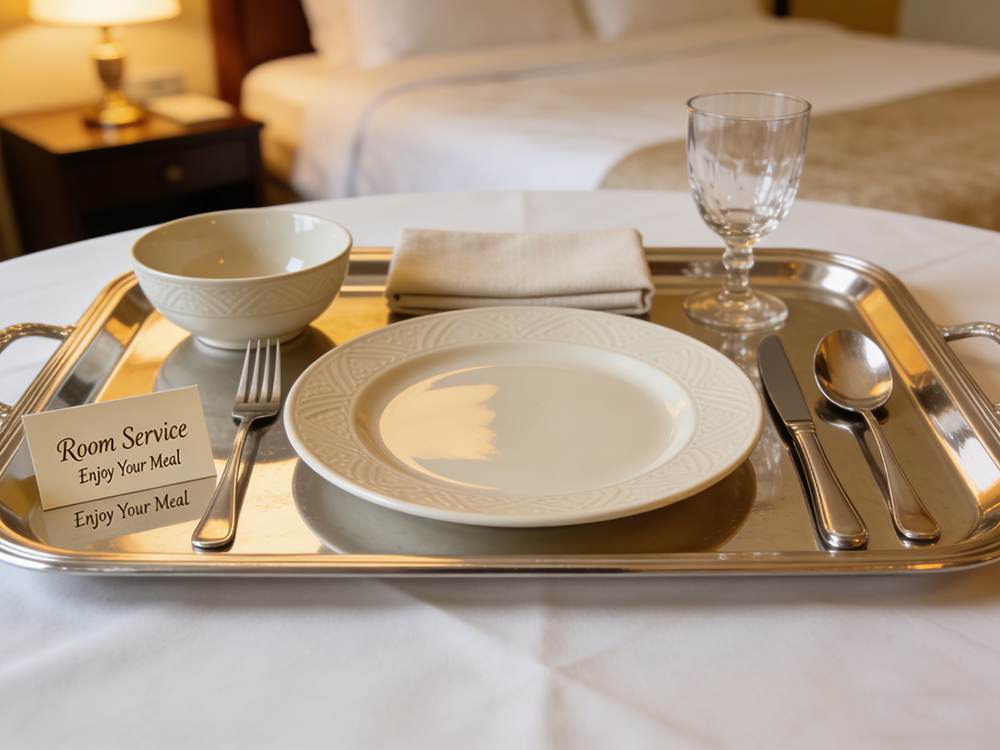
The standard in-room serving includes an entrée plate, a side plate, a bowl, glassware, cutlery, condiments, and linen. This makes up around 4 to 6 pieces of ceramics other than beverage servings.
Add in the coffee pot or wine bottle, sugar caddies, sauce boats, and butter dishes, and the weight and number of dinnerware pieces just add up.
If you use heavy, premium-looking dinnerware such as bone china or reinforced porcelain in the restaurant and the same for in-room service, imagine the multiplied weight that will be carried through the corridors and elevators.
That makes the task not just physically demanding but also requires tray stability. As a result, the risk of drops and staff fatigue increases.
Trolley Vibrations
Most multicourse meals are taken to the rooms through wheel trolleys. That, however, is a task in itself as the wheel trolley has to travel over carpet seams, elevator thresholds, uneven flooring, and the elevated jolts.
Each of these factors has a micro impact on the dishes. Although subtle in isolation, the impact multiplies when the same cycle is repeated hundreds of times a week. Months or years later, the rim starts chipping off, and the glaze gets stressed, and you need to order replacements.
Holding-Time Gap
The travel time for a dinner plate from the kitchen to the restaurant dining area is roughly around 2-4 minutes. Compare that with the time it takes from the kitchen to the guest’s door, which can be 10-20+ minutes. The time gap increases further when there are long corridors or in high-rise hotels with multiple floors.
This duration and distance are the core factors that change everything when it comes to serving.
You want to serve the meal while it’s hot, but also make it easy for the serving staff by using lightweight material. This is where we must make the trade-off. A thin plate may be easy to carry, but it loses heat quickly. Whereas a heavy plate retains the heat but adds to the carrying weight.
Bone China Dinnerware is worth exploring in this regard, as the material is light, reducing tray fatigue. Also, Porcelain Dinnerware is a good option as it retains heat consistently, ensuring the food is served piping hot.
Recovery Cycle
If we talk about the recovery cycle, restaurant dining circles around the kitchen, the serving table, the dishwasher, and back to service.
This room service cycle is much longer. The dinnerware leaves the kitchen, goes to the tray staging area, onto the elevator, corridor, and finally lands in the guest room. Even after completing the long trip, the journey is far from over.
After use, it lands in the hallway, sitting there waiting to be collected. Once the housekeeping staff comes, they stack it up, take it all the way back to the dishwasher, and return it to the restaging area to re-enter the cycle.
In other words, hotel room service equipment faces more exposure, with more stacking and handling time. This waiting time adds another challenge, requiring the dishes to be strong enough to withstand aggressive commercial dishwashing.
Material Selection for Hotel Room Service Equipment
Material / Type | Durability | Presentation | Logistics Considerations | Hotel Tier Fit |
Reinforced Porcelain | High | Medium-High. It has a good visual weight. | Heavier than bone china, but stable on trays. | 4-Star and Luxury Backup |
Bone China | Medium | Very High: It’s translucent and has a tactile luxury feel | Lighter and reduces fatigue | 5-Star Luxury |
Melamine | Very High | Low-Medium: Lacks luxury perception | Very lightweight and easy to stack | Select-Service / High-Volume / Breakfast Operations |
Stainless Steel (Cloches, Coffee Pots, Condiments) | High | Medium-High: Polished, gives the premium reveal moment | The weight must be manageable for the tray or trolley | All Tiers |
When we choose dinnerware for restaurants, concepts, or dining areas, we often prioritize aesthetics. We opt for dinnerware that looks inviting and also photographs well on social media.
However, when procuring dinnerware for hotel rooms, the number one factor must be sturdiness. It must survive the jumps and jolts through the elevator and hallways. Although the fact remains that the plates must look exquisite and still make the serving look appealing, the priority remains simple: it must be strong.
Reinforced Or Hotel-Grade Porcelain
Hotel-grade porcelain offers structural strength within budget. If your hotel runs on consistent volume and you need more predictability in the replacement budget, it is one of the smartest choices to make.
The material also handles the trolley vibrations better than other thin-walled ceramics. However, the only downside is that it doesn’t have the same translucency or prestige as bone china. Learn more about Bone China vs Porcelain Dinnerware.
Key features of hotel-grade porcelain are:
- Reinforced rims that prevent micro-impact chipping
- High alumina content to give it structural density
- Strong glaze that tolerates aggressive commercial dishwashing
- Good balance between weight and durability
- Retains heat
- Survives repeated stacking
Bone China
Bone China, being much lighter than porcelain, is a good choice if you’re looking to reduce server fatigue. If you have a multi-story property, or there’s a longer wait time in the corridors and elevators, bone china has better carrying stability compared to porcelain.
As far as aesthetics go, the dinnerware material is translucent under hotel lighting and has a luxury profile, making it more suitable for five-star hotels.
The downside, however, is that bone china chips faster, especially under repetitive cycles. It’s less to do with the quality but more so because the material is thin compared to porcelain.
That means you’ll need to plan for more frequent replacements.
Melamine
Melamine Dinnerware, though, can be a practical workhorse, but it doesn’t have a place, nor is it welcomed in every setting. Best, keep it for continental breakfast room service tray setups, for poolside deliveries, or select services.
Being extremely lightweight and impact-resistant, melamine has the lowest replacement cost. It is virtually unbreakable, and that very factor makes it ideal for transportation and long-serving cycles.
However, it does come with downsides or risks. For starters, there’s the heat warping risk. Melamine is not suitable for high-temperature plating or microwaving. It’s also not cloche compatible.
Other than that, melamine isn’t really suitable for luxury room service. Compared to the premium porcelain and bone china alternatives, it doesn’t convey the same premium presentation.
Stainless Steel
Room service is less about presentation and more about regulating the food service while moving through elevators and corridors. The aesthetic finish may get you the attention, but it’s the infrastructure that makes the experience worthwhile for the guest.
So the equipment for room service should include essential stainless steel cloches or domes, double-walled coffee and tea pots, sugar bowls, and butter dishes, along with the main dinnerware. They protect the food, retain heat, and ensure every dish reaches the guest perfectly.
Compliance and Safety
In luxury, it may capture the attention, but compliance with the safety regulations is non-negotiable. Every piece of room service dinnerware must meet sanitation standards, performance, durability, and food contact safety standards, such as those from NSF International.
In the U.S., hotels must also follow FDA Food Code regulations.
NSF-certified ceramics and stainless steel pieces are built to withstand high-temperature dishwashing cycles, typically 150–180°F. This ensures guest safety and protects the long-term durability of the dinnerware.
Tray Setup and Trolley Compatibility
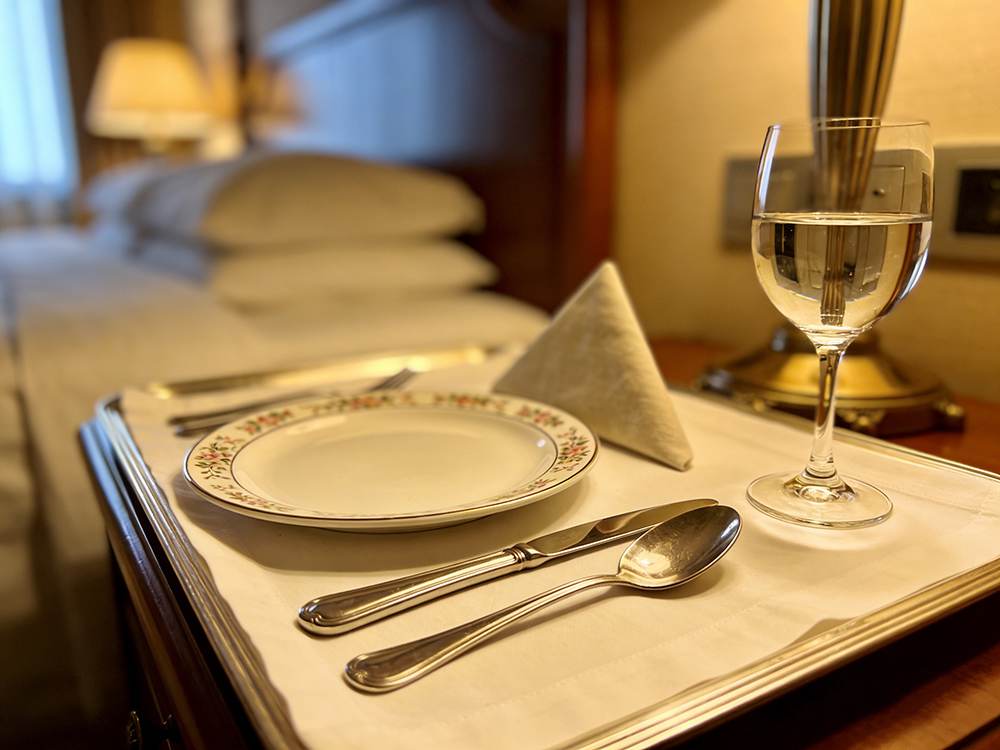
Another important factor for in-room service is the tray area. It’s like the operating canvas for your dinnerware. Since most service trays measure around 20-24 inches in width and are 14-18 inches deep, that gives you a service area between 280 and 432 square inches.
You can place a 12-inch restaurant plate, a 6.5-inch side plate, maybe a 3-inch ramekin, some cutlery, and folded linen. That’ll leave some space for a 10-12 oz glass, a cup of coffee, and a saucer. But that’s about it.
Anything beyond that, including even a condiment dish on the tray now, will just make it crowded and hard to carry.
Another thing to note here is that trays are dominated by width, while trolleys are ruled by height. Most commercial room service trolleys have a shelf clearance of 12 to 16 inches between the tiers. Although that is sufficient for the main courses and dishes, it’s entirely another story for cloches.
You need 4 to 6 inches additional above the plate height for the cloche. If the space is tight on the trolley, the domes will tilt, and the plates may slide off the centre. For detailed sizing standards, refer to Dinnerware Sizing Guide: Plate Sizes & Portions for Hospitality.
Ideally, before finalizing the hotel room equipment, physically test a fully loaded trolley. Run it across corridors and elevators at real operating speed. Notice the plate shift and see if the whole setup looks compatible from an operational view.
Presentation that Elevates the In-Room Dining Experience
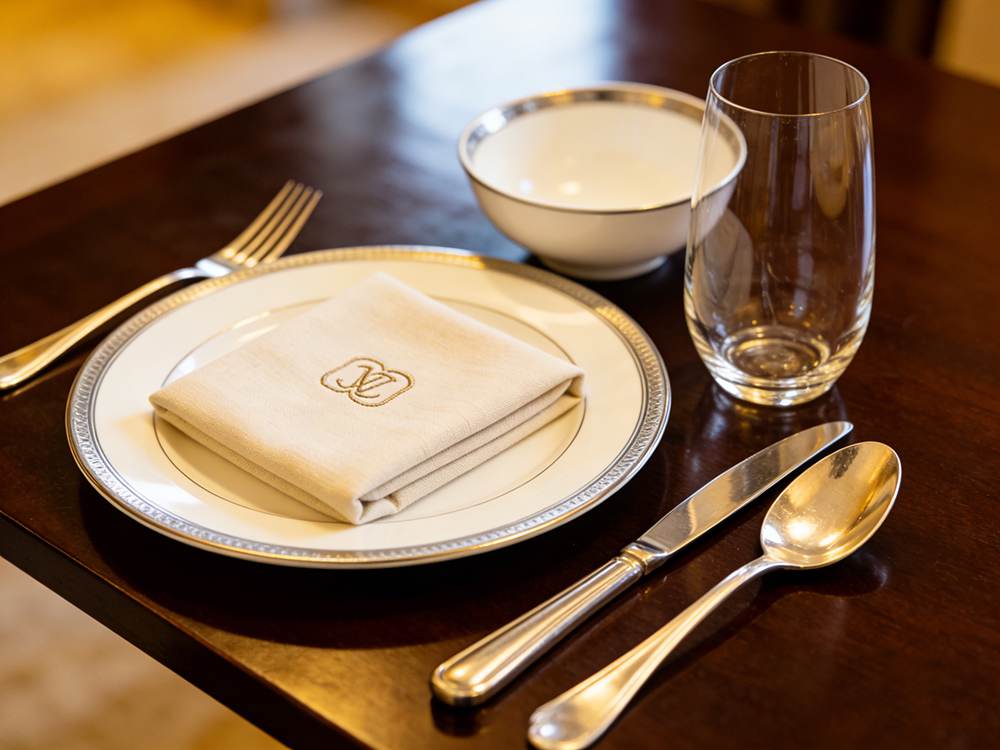
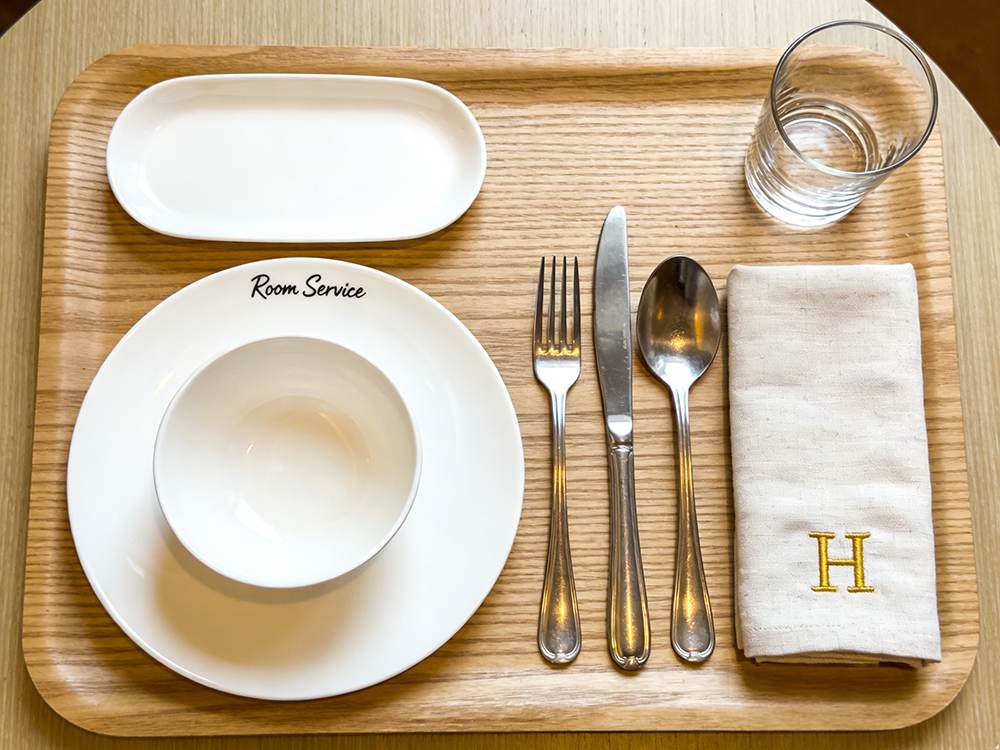
In room service, even though serving food warm and intact is the priority, the dinnerware must be coordinated. When your tray liners match the plate patterns, it speaks volumes in terms of luxury.
You can procure Custom Restaurant Dinnerware with printed logos and place monogrammed butter dishes along with logo-embossed ramekins to create a branded in-room dining experience for your guests.
The idea is to make the whole set feel thoughtfully put together. To the guest, this leaves the impression that the hotel went the extra mile to create a refined ambience, even within the room. This attention to detail is what justifies the premium price.
Room Service Tableware by Hotel Tier
The choice of dinnerware material also depends on the hotel tier being served. A five-star flagship property and a four-star or select-service hotel both have different service expectations. And so, each must select the most appropriate tableware for their guests.
Luxury Tier for 5-Star Properties
In five-star hotels, in-room serving is not an additional service. Rather, it is an extension of the restaurant itself. Here, bone china wins for being exquisite and of premium quality.
Also, it has all the properties we need for in-room dining dinnerware. It’s light, looks translucent under the suite’s lightning, and feels refined, speaking of true luxury. For an in-depth look at its composition and performance characteristics, check out the guide What Is Bone China Dinnerware Made Of?
Upscale Tier for 4-Star Properties
For 4-star properties, we need a blend of durability and presentation. Usually, reinforced porcelain with elevated glaze provides the look and resilience we need. It can withstand repeated corridor waiting, transportation, and high-temperature dishwashing. Plus, it looks elegant and has an optimal weight for staff to carry.
Select bone china can also be used for VIP suites and premium categories in this tier.
Select-Service Or High-Volume Properties
In a select-service environment, the room service is more practical. The primary dinnerware material is usually porcelain, and melamine can be used for breakfast and special deliveries outside the normal cycle, such as poolside orders.
The core priority is that the dishes must be able to withstand frequent stacking, elevator transitions, and fit the limited capacity of small dishwashers.
Conclusion
An in-room service is like having the entire dining room travel to the guest. There are no distractions, no crowds, and the grandeur of the lobby. That makes every detail count. The right room service equipment doesn’t just carry food, but it ensures the guest experiences every dish hot and flawless.
Ultimately, room service isn’t just about food delivery. It’s a branded hospitality moment. Quality dinnerware from Brett, combined with operationally sound logistics, can turn a simple meal into a memorable experience.
Remember, once you knock on the guest’s door, there’s no room for a second impression.