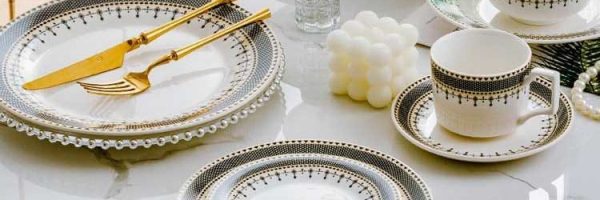
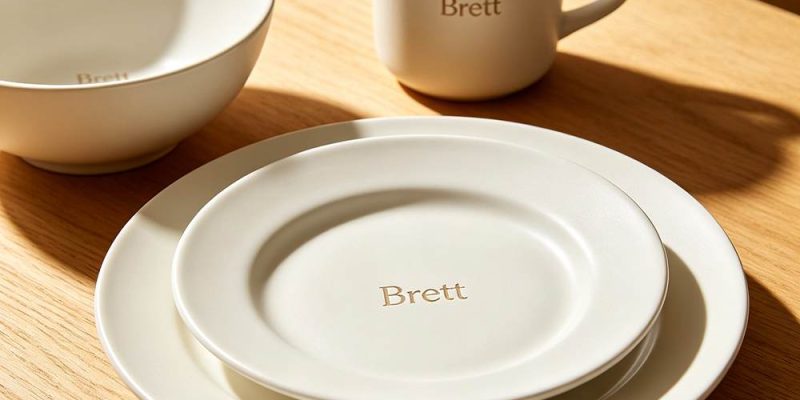
Some hospitality brands live on the billboards, while others live on their menus.
But the best hospitality brands? They live on their tables and dinner plates!
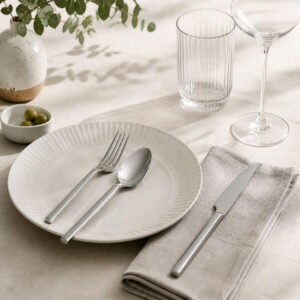
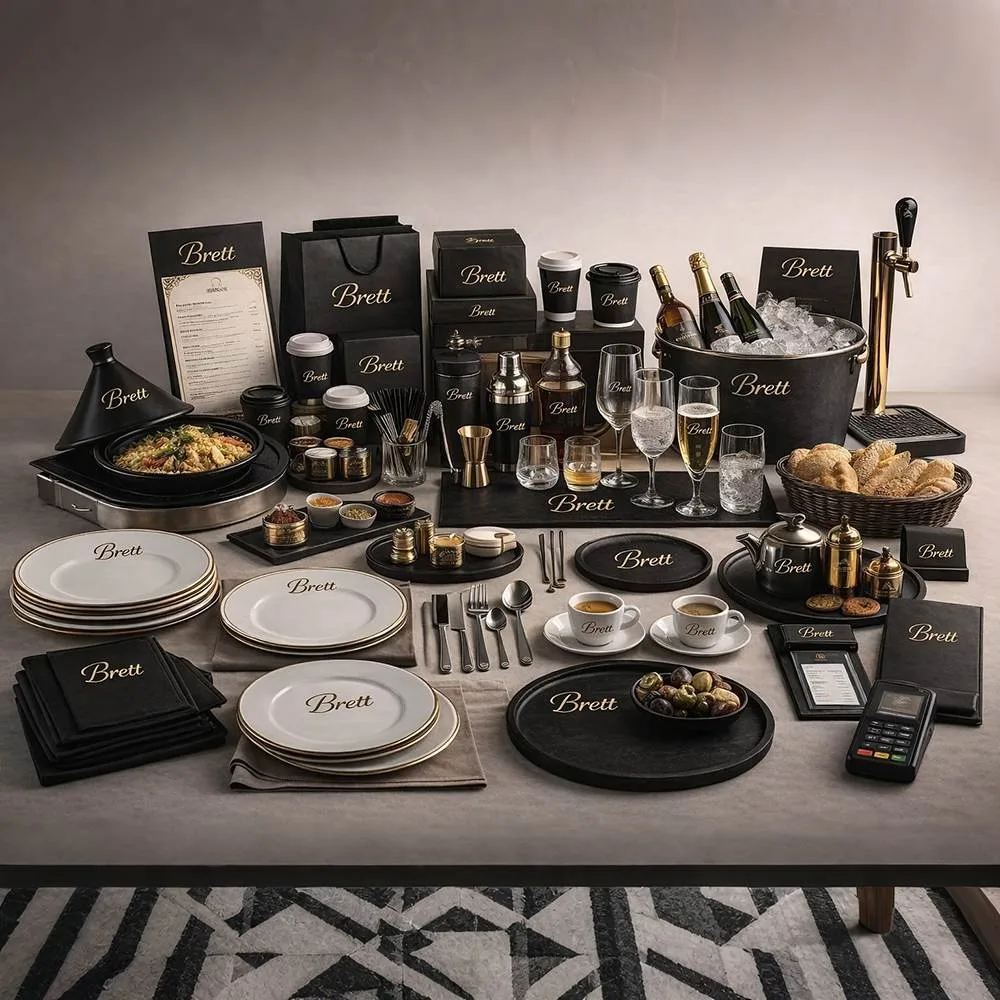
Private label dinnerware isn’t just about placing logos or branding elements on Porcelain Dinnerware. It’s about turning every table into an experience for every guest that they remember and cherish. It’s about getting them to know your brand even before they order their food.
Designing the right tableware to create such an experience is the tricky part. A simple branded plate has to undergo a complex journey to make it all the way to the dinnerware fleet. There are OEM design decisions, glaze chemistry, and FDA food contact compliance standards that must be met. Then, come the branding elements that make the dinnerware truly yours.
What Private Label Dinnerware Means
For most brands, private label dinnerware simply means having a logo on a plate. But in the true sense, it’s like building a mini manufacturing ecosystem around the brand’s identity.
For the hospitality business, it means designing tableware around the OEM/ODM structure. It includes everything from how the dinnerware is produced, fired, finished, and certified.
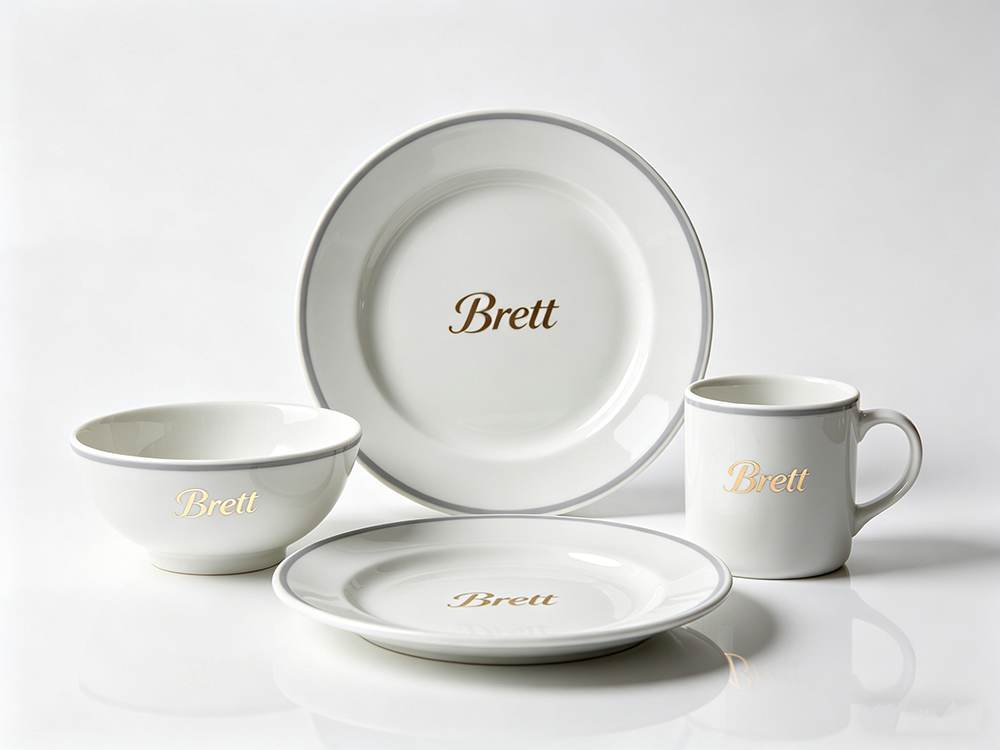
It includes a custom logo application, either by decal, glaze, or embossing. Explore more on Ways to Print Your Logo on Plates.
Private labeling doesn’t stop at design or logos. It extends into the technical lifecycle of the product, and that includes material selection, the firing process, glaze finish, and, of course, compliance and certification.
It’s no wonder private label dinnerware is your brand architecture. And that architecture has to stay consistent, where every reorder must match the previous batch in performance and appearance.
The level of manufacturing precision is what separates true private label dinnerware from basic logo application.
The Private Label Production Flow
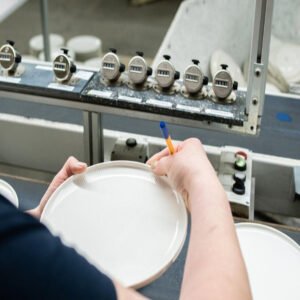
Behind every branded plate in a hotel, a whole process is involved that is much unlike the retail ordering process. Here’s the step-by-step private label production process.
The Brand Brief
For private label dinnerware, a brand brief is designed that includes the hotel’s F&B positioning and brand guidelines. You have to give the manufacturer the design, branding elements to be placed, and other precision requirements. The factory then translates the information into mold compatibility, kiln firing, and glaze chemistry.
How compatible the design is with all these manufacturing steps can determine whether the MOQ stays low or can be scaled.
Mold Selection or Mold Creation
The production process usually involves two paths: OEM vs ODM.
Learn more about Custom Dinnerware for Hotels & Restaurants: OEM vs ODM Explained.
While ODM is faster, as it works with existing plate shapes, molds, and proven designs, OEM gives you more flexibility in terms of customization.
Most brands take the ODM route because it offers faster sampling and lower MOQs, but true private label dinnerware is unique in every sense. It stands out from the competition in terms of glaze finish, size, color, pattern, logo, and overall form.
For the manufacturer, that means creating a new mold, making structural engineering adjustments, and calibrating for shrinkage, as ceramics, particularly porcelain, often shrink by 8–12% during the kiln firing stage. But that’s what makes the process expensive, as well.
Sampling and Prototype Firing
Before mass production begins in a factory, the sample pieces are fired in kiln batches. The glaze reactions are tested, and so is the logo durability.
In ceramics, the sampling stage is very important, as firing at high temperatures can alter ceramic behavior. In fact, as per the Journal of the European Ceramic Society, firing consistency is one of the strongest predictors of structural durability and glaze stability in porcelain and stoneware systems.
Branding Application
Next, the branding elements are applied. These are mostly done via decal firing in hospitality environments, where the logo is printed and then fired into the glaze layer.
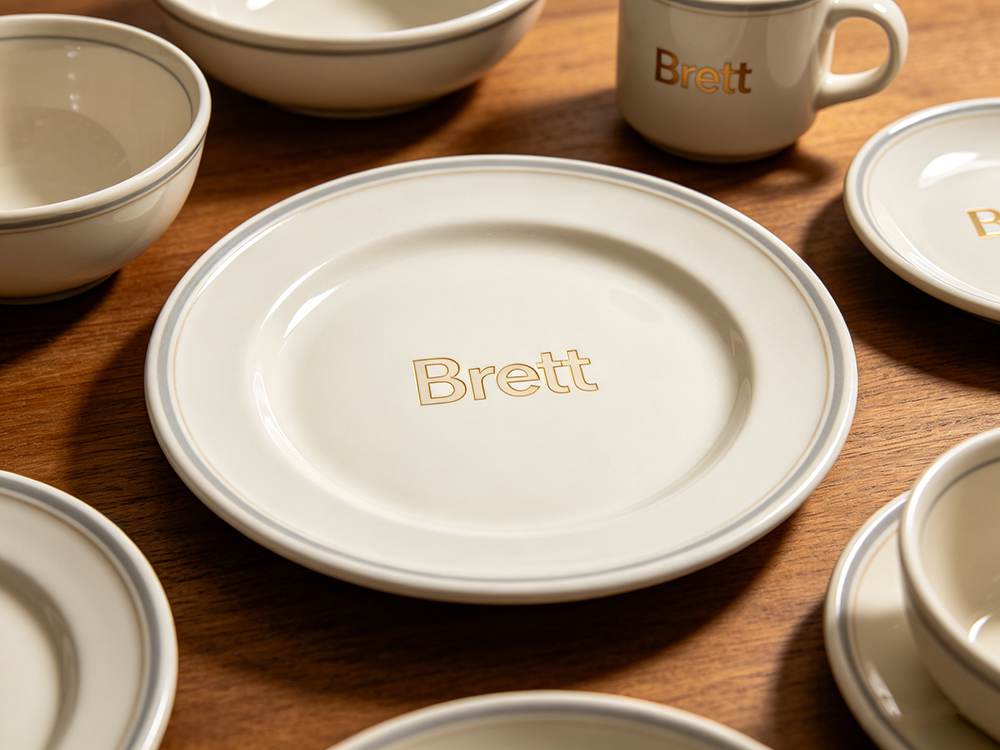
There are also options like underglaze printing, which come at a slightly higher cost but also have higher durability. Then there’s embossed mold branding where the logo is physically formed into the ceramic body.
Each method has unique kiln cycle requirements, defect risk rates, and MOQ thresholds. This is also where another important factor comes into play; learn more about why the glaze changes color in the kiln.
Compliance and Food-Safety
Private label dinnerware in hotels must comply with the U.S. Food and Drug Administration food-contact material standards (CFR Title 21) and the EU Regulation 1935/2004 for food-contact safety.
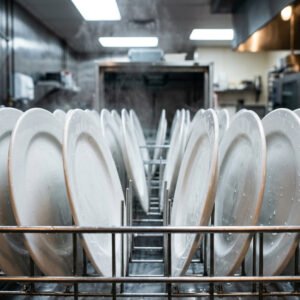
Both frameworks ensure there’s no harmful migration of lead or cadmium in the food. Apart from that, they also require the dinnerware glaze to stay stable under heat and acidity, and be safe for repeated dishwasher exposure.
Why Private Label Dinnerware Is a Manufacturing Strategy
OEM ceramic suppliers structure private label production around three key processes: kiln efficiency, mold amortization, and glaze batch stability. So the question is not whether the manufacturer can fit your brand logo onto the dinnerware, but rather if they can produce private-label dinnerware specific to your identity.
Manufacturers like Brett support private label programs by aligning hotel branding with their existing mold libraries, reducing tooling costs via shared production bases, consolidating SKUs across multiple properties, and optimizing kiln runs.
Kiln-driven Cost Structure
One of the most expensive stages of the ceramics production process is firing. Most industrial kilns for vitrified hotelware and porcelain operate in the range of 1200-1300°C, where materials undergo sintering and vitrification.
Since the kilns require full load efficiency to be cost-effective, manufacturers try to optimize production by maximizing kiln utilization. They schedule compatible products together and reduce empty spaces as much as they can.
Batch-Based Manufacturing
Ceramic production is batch-controlled. Each stage, including forming, drying, glazing, and firing, must follow tightly controlled parameters to avoid structural or visual defects in the final pieces.
This is critical because even small variations in humidity, drying time, or firing ramp rates can lead to warping, pinholing, crawling, or uneven gloss levels. To avoid it, manufacturers standardize production into controlled kiln batches where all pieces share the same thermal and chemical conditions.
Tooling (Mold) Amortization
Molds are usually made from plaster or engineered materials and are used repeatedly across production runs. These are not just production tools. These are the capital assets that define the geometry, thickness, and functional behavior of the final product.
To reduce the costs, manufacturers often reuse mold families across multiple SKUs or client programs, particularly in ODM setups. This way, the tooling cost can be amortized over large production volumes, instead of being absorbed by a single order.
Glaze and Material Stability
Glaze performance is one of the most sensitive areas in ceramic production because it depends on precise chemistry and controlled firing behavior. Even minor changes in raw material sourcing, mixing ratios, or kiln atmosphere can affect the final output.
Since consistency is crucial for hospitality dinnerware, the manufacturers have to ensure every future order matches the original in gloss level, color tone, surface texture, and stain and scratch resistance.
To achieve the same, manufacturers use standardized glaze recipes and tightly controlled firing curves.
Standardization vs Customization Balance
OEM and ODM systems simply exist to balance two competing requirements, i.e., brand differentiation vs industrial repeatability. Customization features are usually applied to the rim profile and edge design. There may also be a difference in weight and thickness, surface finish, such as matte, gloss, reactive glaze, etc., and branding elements.
However, these customizations must still operate within standardized production constraints such as kiln capacity, drying time limits, and mold geometry feasibility.
Scaling
Private label production systems are designed around repeatability across time, not just customization at the point of design. The key requirement is that a product ordered today must match a reorder placed months or years later.
This requires stable mold systems, repeatable firing, controlled glaze chemistry, and strict QA thresholds. So, scalability is less about increasing design variety and more about maintaining process consistency across repeated manufacturing cycles.
Why MOQ Increases With Branding Complexity (And How Hotels Strategically Reduce It)
When procuring private-label dinnerware, every branding decision you make multiplies the production complexity. This complexity scales in kiln cycles, mold adjustments, glaze batches, and defect risk. As a result, dinnerware minimum order quantity (MOQ) rises just as branding becomes more customized.
Manufacturers don’t calculate the MOQ based on the design effort. They calculate it based on the efficiency of their production cycles.
So when a hotel adds multiple logo colors, asks for gold rim detailing, or has multiple SKUs per outlet, it leads to additional production runs. Each additional color in a decal or glaze requires separate firing conditions. It also increases kiln scheduling complexity.
Similarly, when hotels move beyond stock shapes, they need to create new molds, calibrate for shrinkage, and re-fire prototypes (often multiple times). As a result, MOQ jumps from 3,000 to 10,000+ units.
How Hotel Groups Build Collections
Here’s how successful hospitality chains build their inventory and place orders for private-label dinnerware.
Core Vs Specialized Inventory
Successful hospitality groups do not ask for 50 unique SKUs for every property. Instead, they build a core collection. That serves as their standardized base and comprises about 70-80% of their inventory.
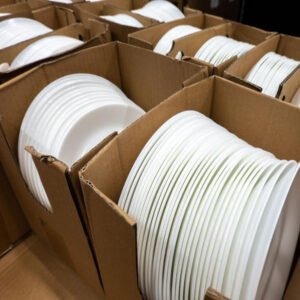
The dinner plates, side plates, bowls, mugs, and core flatware are chosen as a standard, so it stays the same across all properties. The orders are centralized, so there are no delays, and large OEM batches can easily be produced by the manufacturer.
Around 20-30% of their inventory is specialized. That includes the accent plates, signature glazes, logo-decal variations, and seasonal pieces. These have a more flexible MOQ structure since they are ordered in a lower volume.
OEM Mold Strategy
Scaling private-label dinnerware across properties depends highly on mold strategy. There are shared mold systems that are scalable. In this system, we reuse the plate shapes, bowl geometries, and cup structures.
What changes here is the branding and surface specification. This gives us consistent production cycles with lower MOQ per SKU. The replacement supply chain also stays stable.
The other model is the unique mold per property. Here, the hotels order custom plate shapes, proportions, and glaze systems.
The process is not kiln-efficient, and there’s higher defect variability, too. Plus, the MOQs increase sharply. Which is why most production setups push for shared molds, and brands, to prefer the model as long as specialty isn’t a requisite.
Smarter Forecasts
Use the base demand per property, including the buffer for breakage and losses. In fact, many hospitality restaurants use centralized inventory systems and a controlled distribution across properties to reduce the storage cost and MOQ pressures.

Common Mistakes Hotels Make in Private Label Dinnerware Programs
Most private label dinnerware failures don’t happen during the design phase. They happen much later, during stages like when branding meets kiln physics. In fact, the mistakes are usually invisible until the first shipment arrives, or at times only show up when the second reorder doesn’t match the first.
Here are the common mistakes to watch out for:
- Avoid going for too many SKUs, with multiple plate shapes, accents, or versions. This will only lead to higher MOQs per SKU and defect variability risk.
- Make sure the order aligns with the kiln batches. Otherwise, you have to bear the costs of partial loads or face delays as they wait to combine your order with other production runs for kiln efficiency.
- Place one order for multiple properties instead of placing independent orders. This will ensure there are no variations in SKUs and you deliver a uniform guest experience across locations.
- Instead of prioritizing aesthetics, choose production efficiency. Unique or complex designs will only lead to higher MOQs and lead times, and also to operationally inefficient production.
- Always plan for breakage and operational losses. Ideally, keep a buffer of 10-20%.
Private Label Dinnerware: Not a Product, A Complete Brand System
Private label dinnerware is never just about branding. It’s about whether your brand can survive real-world hospitality conditions, including kilns, dishwashers, and service pressures.
When done right, it becomes a full brand system, not just a plate with a logo, but a consistent experience for every guest, every time.
If you’re ready to move beyond simple sourcing and wish to build dinnerware that actually performs, Brett can help turn your private label idea into a production-ready system built for your brand.
Frequently Asked Questions
1. What is private label dinnerware?
Private label dinnerware is ceramic tableware manufactured by an OEM supplier and branded for a specific hotel, restaurant, or hospitality group. It can include custom logos, colors, shapes, or embossing.
Unlike retail dinnerware, it is designed for bulk production under controlled manufacturing systems.
2. Is private-label dinnerware only for luxury hotels?
No. Although luxury hotels use private-label dinnerware for branding, it is also used by mid-range hotels, restaurant chains, resorts, and catering groups.
The dinnerware works best for operational scale and brand consistency across properties.
3. Can hotels customize dinnerware with their logo?
Yes, hotels can customize dinnerware with their logo via decal printing, underglaze decoration, or embossed molds to apply branding. These methods are fired or integrated into ceramic production.
4. How long does private label dinnerware production take?
Private-label dinnerware production timelines range from four to ten weeks, depending on the level of customization. Stock molds with logo decals work faster, while fully custom OEM shapes require mold creation, sampling, kiln testing, and batch validation, and hence, take longer to produce.