
A guest orders a cappuccino and gets it in a mug built for filter coffee. The drink looks thin, cools fast, and the foam has nowhere to sit. The quality of the coffee was good. The cup was wrong. In the case of hotels, the size of the coffee cup determines what it looks like, the time it will take to keep it warm, and the number of cups to purchase.
It presents typical sizes of coffee in ounces and millilitres, the answer to the question of the average size of the coffee cup, and it indicates which cup is appropriate for each outlet. It also includes information about shapes, materials, saucers, quantities, and what to look for before ordering. If you’re also serving tea, view our guide to choosing tea sets for hotels, restaurants and cafés.
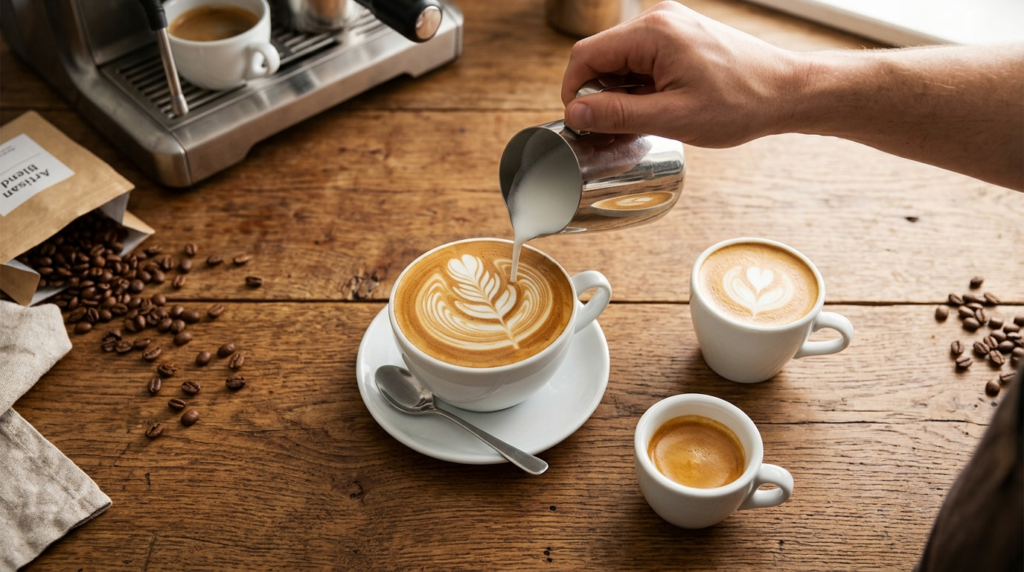
The sizes of coffee are typically 2 oz to 16 oz, while a typical espresso cup holds up to 2 to 3 oz (60 to 90 ml). The typical size of a cappuccino or flat white cup is 5-6 oz/150-180 ml. Latte cups hold about 8 to 12 oz (240 to 350 ml). The average coffee mug size is 8 to 12 oz (240 to 355 ml), while diner mugs reach 12 to 16 oz. These are commonly quoted figures, and sizes vary by café and brand. Always test a sample at your normal pour before ordering.
Table of Contents
Coffee Cup Sizes Chart: Ounces and Millilitres
The sizes below represent a general guide and will vary from café to café, country to country and cup maker to cup maker. They are to be used correctly to match each drink on your menu with a cup.
Whatever coffee sizes are on your menu, a cup’s listed capacity is usually brimful, meaning filled to the lip. The real pour is always lower, which is why the next section matters as much as the chart.
Drink | Ounces | Millilitres | Typical cup |
Espresso | 2 to 3 oz | 60 to 90 ml | Demitasse |
Double espresso | 3 to 4 oz | 90 to 120 ml | Large demitasse |
Cortado | 3 to 5 oz | 90 to 150 ml | Small handled cup |
Cappuccino | 5 to 6 oz | 150 to 180 ml | Wide, rounded cup |
Flat white | 5 to 6 oz | 150 to 180 ml | Tulip or small round cup |
Latte | 8 to 12 oz | 240 to 350 ml | Large cup or bowl |
Americano or filter coffee | 8 to 12 oz | 240 to 355 ml | Standard mug |
Large mug or diner mug | 12 to 16 oz | 355 to 475 ml | Heavy mug |
Ounces to Millilitres: Quick Conversion
There are approximately 29.6 ml in a US fluid ounce. You can use the table below to change any size on your menu.
Suppliers tend to round, so the size of a cup that is specified as 240 ml and one that is specified as 8 oz is generally the same.
Ounces | Millilitres (approx.) |
2 oz | 59 ml |
3 oz | 89 ml |
4 oz | 118 ml |
6 oz | 177 ml |
8 oz | 237 ml |
10 oz | 296 ml |
12 oz | 355 ml |
16 oz | 473 ml |
What Is the Average Coffee Mug Size?
On average, the size of a coffee mug is 8 to 12 oz (240 to 355 ml). That is the range where most hotels will find mugs and breakfast service.
Not all mugs are created equal within that range, and so the two types listed below have different behaviors while in use.
Standard Mug: 8 to 12 oz
The regular coffee cup for filter coffee, Americano, and room service. A 10 oz mug is a safe middle ground for most breakfast rooms since it will contain a full cup but not appear empty to the people who come in and won’t spill on a tray.
Diner and Large Mug: 12 to 16 oz
If you are serving a self-serve buffet or in a casual restaurant, where guests will keep taking drink after drink, then you should use large mugs. They also weigh more, have a slower cooling rate for the coffee and require more space in racks and cabinets. Before you commit, make sure your dishwasher racks and storage are capable of accommodating them.
Coffee Sizes: Takeaway vs Ceramic Cups
Takeaway coffee sizes typically are small, medium and large, measuring approximately 8oz., 12oz., and 16oz. A large number of hotels that serve “grab and go” coffee also mix them up with “sitting down” coffee.
A ceramic cup should be the same size as the drink that the guest ordered not a takeout size. A 12 oz cup of takeout coffee with latte foam just reaching the rim is better in a 10 oz cup.
Brimful Capacity vs Real Pour
Suppliers give you the capacity to the lip. But a guest is never given a full cup, as it will spill when he or she arrives at the table.
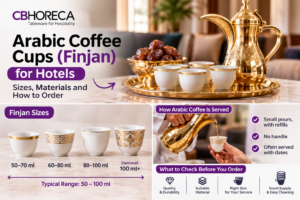
Leave about 1 to 2 cm below the rim and choose a cup size that suits your normal pour. Our Arabic coffee cup guide covers the same point for very small cups. The same is true for very small cups in our upcoming Arabic coffee cup guide.
Which Cup Size for Which Outlet?
The optimal size will depend on the ways it is served. The table provides a guideline for each outlet and should be verified by your F&B staff with the menu.
Outlet | Suggested cup | What to check |
Breakfast buffet | Standard mug, 8 to 12 oz | Stackability and refill speed |
Room service | Cup and saucer, 6 to 8 oz, or a lidded pot set | Heat retention and tray stability |
Lobby café | Cappuccino cup, 5 to 6 oz, and latte cup, 8 to 12 oz | Wide rim for foam and latte art |
Meeting and banquet | Standard cup and saucer, 6 to 8 oz | Fast refills and matching sets |
Specialty or espresso bar | Demitasse, 2 to 3 oz | Thick walls to hold heat |
Cups, Saucers, and Matching Sets
A saucer traps drips, supports a spoon and prevents damage to the table. It also contributes to cost and to the load of the dishwasher – decide per outlet.
Saucers are worth the extra cost in fine dining, banquet service, and room service. They’re not as likely to be found in high-traffic self-service areas, where a mug is quicker to stack and wash.
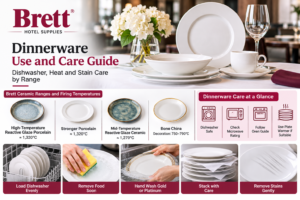
Ensure that each cup is balanced on its saucer. A well-fitting pair will not slide on a moving tray. Whenever possible, order cups and saucers from the same range and from the same production batch to ensure that colour and glaze match. See our restaurant dinnerware buying guide.
Cup Shapes and Wall Thickness
Shapes affect the behavior of coffee in the cup. The thickness of the walls will affect the way that the drink remains hot and that is important when it comes to smaller drinks.
Shape | Best for | Why |
Straight-sided demitasse | Espresso | Keeps crema and heat in a small volume |
Wide, rounded cup | Cappuccino and latte | Gives space for foam and milk art |
Tulip cup | Flat white and cortado | Narrow top holds aroma and heat |
Straight mug | Filter coffee and Americano | Easy to stack and refill |
Thick walls keep a small espresso hot for longer, while a thin, fine cup suits a cappuccino that is drunk quickly. For daily hotel use, fully vitrified porcelain is the usual choice because it is dense and copes with commercial washing. Our guide to what vitrified porcelain is explains the term. Bone china is lighter and finer, and suits luxury service.
Latte Art and Cup Shape
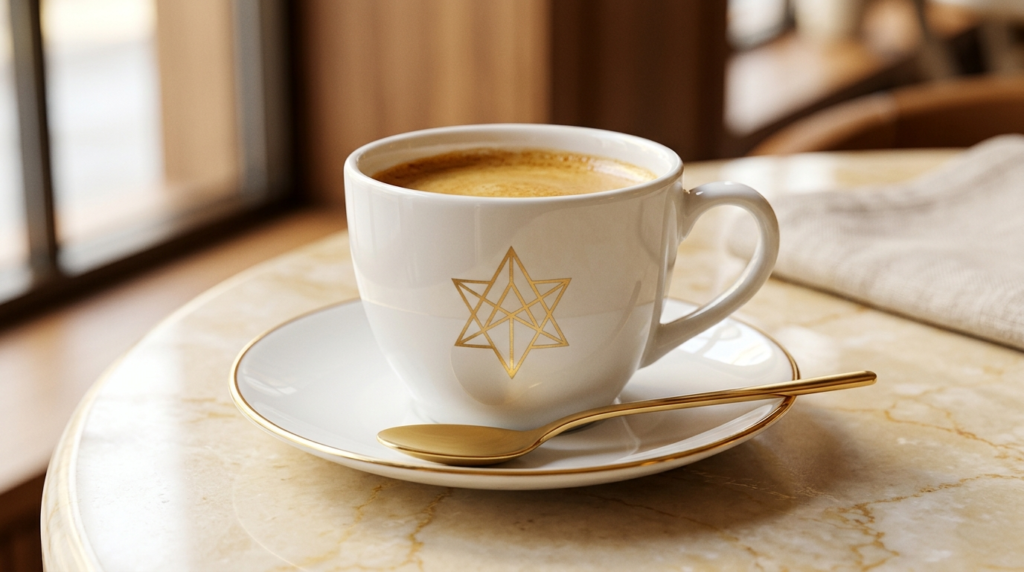
If your baristas create latte art, the cup is a part of the latte. A wide, shallow bowl gives the pattern room to spread, while a narrow, deep cup makes it harder to read.
A smooth, slightly curved inner wall helps milk flow into the coffee. A curved rim that sticks out makes it easier to drink from and displays the foam. Ask for a sample and let your barista pour into it before you approve the shape.
How Cup Size Affects Portions and Coffee Cost
A cup sets the portion before the barista does. Staff tends to fill the cup when it is larger than the required recipe, and use more milk and coffee per cup than intended.
Pairing each cup with a recipe helps to ensure a consistent portion per outlet and shift. For instance, a cappuccino is 6 oz. and a latte is 10 oz., so it should be apparent each time. This is also simpler to train than a rule for fill lines.
How Many Coffee Cups Does a Hotel Need?
This count is based on the number of cups each outlet utilizes and isn’t based on a formula. Breakfast cups are cleared off quickly and then returned, and room service cups can sit in rooms for hours.
Outlet | How cups cycle | Planning note |
Breakfast buffet | Refilled often, washed in large batches | Hold enough for guests seated plus a full wash batch |
Room service | Leave the kitchen and return later | Count cups out in rooms, not just those on the shelf |
Lobby café | Fast turnover through the day | Plan for peak hours, and keep spares for chips |
Banquet and meetings | Whole room served at once | Match the event size, with a spare cup for every few tables |
Add a breakage reserve for every outlet. Our hotel tableware sample approval guide explains how to test samples before you commit to a quantity.
What to Check Before You Order Coffee Cups
Use this checklist when you compare coffee cup samples from different suppliers. Each point affects how the cup performs in daily service.
Check | Why it matters |
Handle fit | Guests should hold the cup easily with two fingers |
Wall thickness | Affects heat retention and how the rim feels |
Inner shape | Affects foam, art, and how the coffee pours |
Saucer fit | The cup should sit steadily and not slide on a tray |
Stack height | Affects storage and rack space |
Dishwasher rating | Cups go through commercial washing every day |
Matching on reorders | Replacements should match cups you already own |
Custom Coffee Cups for Hotels
Hotels often request a logo or signature colour for coffee cups. Our hospitality ranges are produced in our own factory in Fengxi, Chaozhou; they can be customized according to shape, size, colour, logo, pattern, and packaging. Samples are approved before bulk production; minimum orders will depend on the product. Ask for the figure for your design. Start with our ceramic dinnerware range.
Common Mistakes When Choosing Coffee Cups
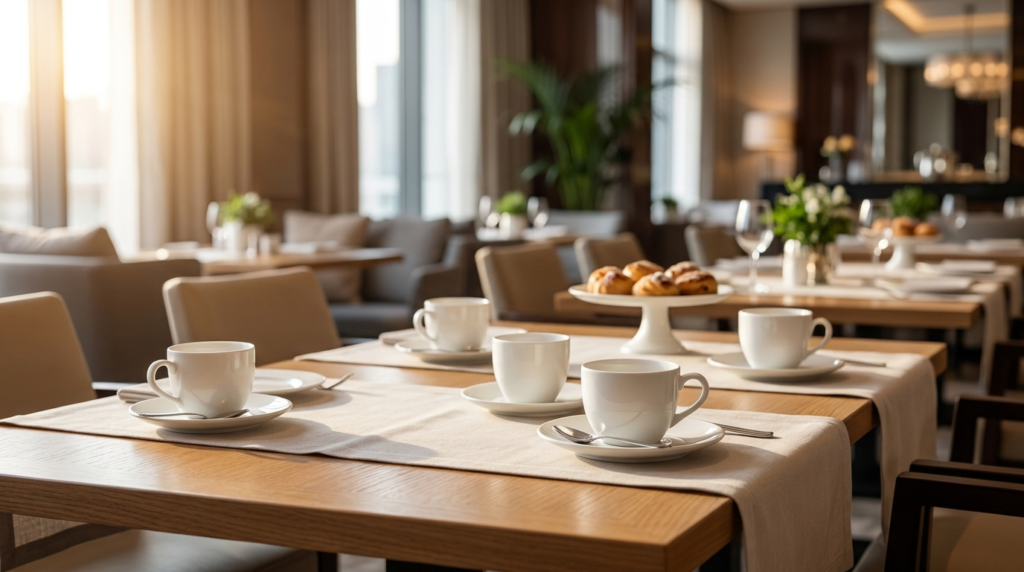
The first is using one size for every drink. A single mug for espresso, latte, and filter coffee serves none of them well.
The second is to serve espresso in thin cups. It loses heat quickly, and a small drink cools fast.
The third is choosing a cup that does not fit its saucer. It rattles on the tray and spills at the table.
The fourth is ordering the cup before testing it with a real pour. Comfort of foams, fill level, and handles is only apparent when in use.
Frequently Asked Questions
What are the standard coffee cup sizes?
Espresso: 2-3 oz, Cappuccino and Flat White: 5-6 oz, Latte: 8-12 oz, Standard mug: 8 to 12 oz. Variations in size depend on the type and brand of the café.
What is the average coffee mug size?
The average size of a coffee cup is 8- 12 oz, 240-355ml. Diner and large mugs run 12 to 16 oz
How many ml are in a cup of coffee?
The average size of an 8 oz cup is 237 ml. Mugs usually hold more, so a 10 to 12 oz mug is about 296 to 355 ml.
What size coffee mug is best for hotel rooms?
A mug with a capacity of 10 to 12 oz is a good option. Carries a full cup and fits standard room trays.
Can coffee cups with gold trim go in the dishwasher?
Except bone china with real gold or platinum decoration, all of the Brett ranges can be put in a dishwasher. Unless marked, metallic trim is not microwave safe.
Conclusion
The right coffee cup complements the coffee, the outlet and the way your team serves. Determine the size and shape for each recipe, pour a sample to confirm and maintain a breakage reserve.
We make coffee cups and dinnerware for hotels and restaurants. Test reports and compliance documents can be provided upon request. For discussing size, custom design, or quantity, please contact our team: ann@chinabrett.com or WhatsApp +86 13535413512.