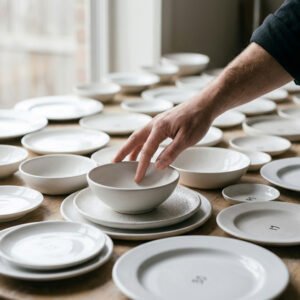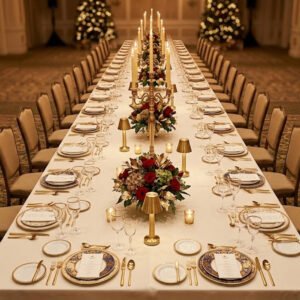

Before ordering hotel tableware from China, every F&B manager must check material grade and composition, food contact certifications, water absorption rate, edge impact test data, firing temperature, minimum order quantity, sample approval process, pattern continuity guarantee and lead time. Missing any of these specifications before placing an order creates expensive problems after delivery, and most suppliers will not provide the information unless you ask.
What Hotel Tableware Procurement Specification Actually Means
Hotel tableware procurement specification is a written document that defines the exact material, performance, certifications, quality standards and commercial terms that a supplier must fulfill before the production starts.
There are 3 layers of specification for hotel tableware. The first is material specification: the ceramic grade, composition, firing temperature and physical performance standards that your tableware needs to adhere to. The second is supplier qualification — the certifications, production capability and quality control systems your supplier must demonstrate before you commit to production. The third is commercial specification, the MOQ, sample approval process, delivery time, and pattern continuity and payment terms that safeguard your procurement from cost overruns and delivery failures.
At Brett, we have been providing hotel-grade ceramic tableware to hotels in over 80 countries since 1998. This checklist is based on 26 years of experience — and on the questions that make the difference between a successful hotel tableware purchase and a costly mistake.
The Procurement Risk
Hotels that do not define performance criteria are prone to higher breakage rates, irregular replacements and higher replacement costs during the course of the tableware program. The difference in replacement costs between specified and unspecified procurement of a five F&B hotel with 200 rooms is usually USD 15,000 to 40,000 per year, not including the table presentation variability that occurs with mixed inventory.

Table of Contents
Material Specification Checklist
The most common mistakes made when purchasing tableware for hotels are in material specification. The terms used in the hotel tableware market are not consistent — the terms “commercial grade”, “hotel quality” and “professional series” are marketing terms and not material terms. These are the specs which really dictate performance:
Ceramic Material Type
Explicitly designate the type of ceramic: vitrified porcelain, strengthened porcelain (alumina-reinforced), bone china, stoneware or new bone china. They all have different performance qualities, price ranges and usage. Vitrified porcelain or alumina-reinforced strengthened porcelain is the right specification for high volume 5-star hotel applications. Bone china can be used for high-end dining purposes, but in small quantities. Stoneware is suitable for “boutique” or casual dining concepts in hotels.
Water Absorption Rate
Request ASTM C373 or similar water absorption rate documented. The value of 0.5% or less should be obtained by vitrified hotel porcelain. The absorption of semi-vitrified stoneware is usually between 2-3%. Non-vitrified earthenware absorbs 8-12%. The high water absorption poses hygiene issues — bacteria can not be completely removed by commercial dishwasher cycles and can accumulate in the pores of non-vitrified ceramics. This is a major warning sign if a supplier doesn’t have documented water absorption data.
Firing Temperature
Ask for documented firing temperature. The mechanical strength of alumina-reinforced strengthened porcelain is achieved through the crystal structure formation, which needs to be activated by firing above 1,300°C, usually 1,200°C to 1,400°C. Identical looking ceramic pieces can have vastly different performance characteristics when fired at different temperatures. Underfired porcelain is similar to the vitrified hotel porcelain, but cannot withstand commercial service.
Alumina Content (for Strengthened Porcelain)
When requesting the use of strengthened porcelain, ask for the percentage of alumina as a manufacturing specification. Brett’s enhanced porcelain has been tested at 30% aluminium oxide which equates to 9.8 times the edge impact resistance of standard household porcelain, per DIN-EN-12980 testing. Performance is directly proportional to alumina percentages, with lower percentages resulting in lower performance. If a supplier cannot provide the alumina content in the form of documentation, then it is not supplying genuine strengthened porcelain.
Edge Impact Resistance
Ask for edge impact test results in DIN-EN-12980 or BS EN 12980 standard — the European industry standard for edge impact resistance of hotel porcelain. The results should be presented in Joules and carried out by an accredited independent testing laboratory, such as Bureau Veritas or Lucideon. The most operationally relevant durability measurement is edge impact resistance as nearly all service related breakages start at an edge: stacking contact, bus tub impacts, dishwasher rack collision.
Glaze Hardness
Ask for the hardness of glaze in Mohs scale units. The minimum hardness of hotel porcelain glaze is 6 Mohs. Glaze softer than 6 Mohs will be affected by cutlery abrasion, which is the grey scratching on the surface of plates and is impossible to polish away. One of the most popular reasons for the replacement of tableware in hotel use.

Certification and Food Safety Checklist
Food contact certification is a non-negotiable requirement for hotel tableware procurement. These are the certifications to request before placing any order:
Food Contact Certifications
- FDA compliance— required for US-market properties. Request FDA food contact material documentation to CFR Title 21 standards
- EU food contact compliance— required for European market properties. Request documentation to EU Regulation 1935/2004
- ISO 9001— quality management system certification demonstrating consistent production processes
- ISO 22000— food safety management system certification
- ISO 14001— environmental management certification, increasingly required for hotel ESG procurement reporting
- BSCI or Sedex— social compliance audit certification, required by many international hotel groups
Thermal Shock Resistance
Ask for a thermal shock resistance rating (DOCUMENTED). Standard hotel porcelain can withstand moderate thermal cycling for table service in the oven, or for cook and chill or convection oven regeneration. Bone china is not suitable for use in ovens and has a low thermal shock resistance. Brett’s alumina-reinforced strengthened porcelain is capable of withstanding thermal shock to 200°C, so it can be used for all the standard hotel F&B temperature service protocols.
Pattern Continuity Capability
Ask the supplier to provide in writing that they keep production records and glaze formulas in their archives for all current client patterns. Brett’s production record system provides a complete record of all active client specifications, making it possible to have the same orders placed years after the originals are made. Suppliers that cannot guarantee it only exacerbate the table presentation inconsistency issues with each replacement order.
Quality Control Documentation
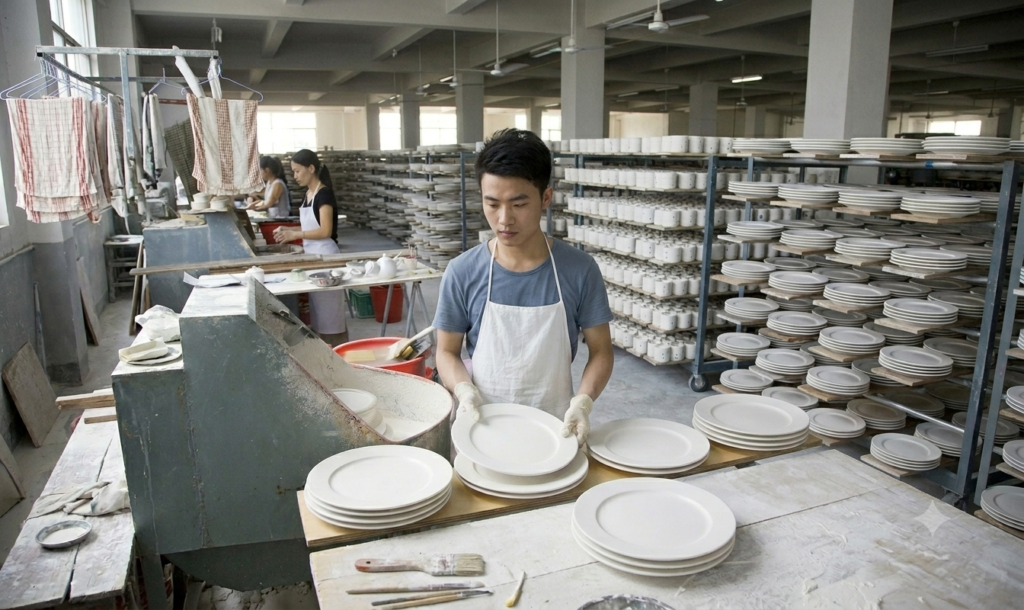
- Ask the supplier to share their internal quality control process, including the number of defects accepted, the points where they are inspected and the criteria for rejecting the product.
- Ensure that the supplier performs pre-shipment inspection for all orders (with their internal QC or third party inspection)
- Ask for a sample defect rate report from similar hotel orders (The industry standard for commercial hotel table ware is less than 3% defect rate on delivery)
Sample and Pre-Production Checklist
The sample approval process is the most important safeguard against getting a production that is not exactly what you want. The following are the steps that cannot be altered:
Physical Sample Requirements
- Before approving tableware production, ask for physical samples — do not approve tableware based on photos or 3D images alone.
- Test samples in actual service environment: stack, test in commercial dishwasher, evaluate glaze after 50 cycles, test edge resistance with your bus tub equipment.
- Ask for samples from actual production runs and not from special showroom stock — production samples must be produced on the same equipment and from the same materials as the order.
- Keep approved samples on hand as reference samples (signed and dated by both parties) to compare with delivery —
- If you are using a custom shape or a custom glaze, order a pre-production sample production of 50-100 pieces before placing a full production order.
Golden Sample Protocol
A golden sample is a physical sample from your approved sample set that will be kept at the factory as the standard for your order. Ask for a written guarantee that there will be a golden sample stored in the factory during your production.
Commercial and Delivery Checklist
Commercial specification safeguards your procurement budget and time. These are the conditions to be agreed to by writing before ordering hotel tableware:
Minimum Order Quantity
Confirm MOQ per item — not per order. When it comes to hotel tableware procurement, it’s usually the case that you need more of one item than the other, such as more dinner plates than soup bowls, more teacups than serving platters. For properties that require asymmetric quantities through a complete tableware set, a supplier that provides at least 300 pieces per item is a problem to budget and inventory. Brett’s hotel ceramic tableware is available from 50 pieces up to 300 pieces per item depending on the specification, and can be used for boutique properties and can be scaled up for large hotel groups.
Lead Time and Buffer Stock
- Documented production lead time, 45 to 90 days is standard for Chinese hotel porcelain.
- Allow 2-4 weeks for international freight and customs clearance.
- Make an initial order of 10-15% over your calculated requirement, this will ensure that you have replacement stock on hand at the same specification as your opening stock.
- Start procurement process 6-9 months prior to opening or program launch for custom specifications and 3-4 months for standard specifications.
Payment Terms and Quality Guarantees
- The standard terms of payment for hotel tableware orders are 30-50% deposit, and the remainder before shipment or on delivery.
- Ask for written quality guarantee with defect rate acceptance criteria and supplier’s process to deal with defective delivery
- Confirm pre-shipment inspection rights: either to inspect the factory before you ship or to obtain a third party inspection report from the factory.
The Complete Specification Comparison Table
This table is intended to be used as a reference for what you should specify and what is considered a “red flag” response from a supplier:
Specification | What to Request | Red Flag Response |
Water absorption rate | ASTM C373 — 0.5% or lower for vitrified porcelain | No test data available or rate above 1% |
Firing temperature | Documented range — 1,200°C to 1,400°C for vitrified porcelain | Cannot confirm or below 1,200°C |
Edge impact resistance | DIN-EN-12980 results from accredited body | No test data or unverified claims |
Food contact certification | FDA and/or EU 1935/2004 compliance documentation | Cannot provide documentation |
Factory verification | Third-party factory audit report | Refuses audit or cannot confirm manufacturing status |
Pattern continuity | Written confirmation of archived production records and glaze formulas | Cannot guarantee future batch matching |
Sample protocol | Physical production samples with golden sample retained at factory | Only photo samples or no golden sample retention |
Defect rate | Below 3% defect rate commitment with replacement guarantee | No defect rate data or no replacement policy |
Common Supplier Red Flags Before Ordering Hotel Tableware from China
The experienced hotel procurement team understands that the response to the specification request is as important as the specification itself. These are the red flags that identify procurement risk prior to the first piece being ordered:
Red Flag | What It Means | Action |
No test reports available | Performance claims cannot be verified | Request documentation or walk away |
Photos only — no physical samples | Production quality may differ significantly from images | Insist on physical samples before committing |
Refuses factory audit | Likely a trading company not a manufacturer | Commission third-party audit or find another supplier |
Cannot confirm firing temperature | Porcelain may be underfired and will fail under commercial use | Require documented specification or walk away |
No pattern continuity guarantee | Replacement pieces may not match opening inventory | Get written commitment or walk away |
No food contact certification | Tableware may not meet market legal requirements | Non-negotiable — require before ordering |
100% upfront payment required | High-risk commercial arrangement | Standard terms are 30 to 50% deposit only |
No defect rate data provided | Quality consistency is unknown | Require written defect rate commitment before ordering |

How Brett Supports Hotel Tableware Procurement
Brett has been manufacturing and supplying hotel-grade ceramic tableware to properties across more than 80 countries since 1998 — over 26 years of experience from our manufacturing base in Chaozhou, the ceramic capital of China, with our showroom and office in Dongguan, Guangdong Province.
Our clients include Four Seasons, Shangri-La, Fairmont, Raffles, Wynn, Sheraton, Hyatt, Marriott and Crowne Plaza properties as well as Michelin Guide restaurants and Black Pearl Restaurant Guide destinations in Europe, the United States and the Middle East. Brett also provides catering for companies, banquet operations and wedding events around the world.
What Brett Provides Against This Checklist
- Water absorption documentation— vitrified body at 0.5% or lower, available on request
- Firing temperature documentation— all products fired above 1,200°C, alumina-reinforced strengthened porcelain above 1,300°C
- DIN-EN-12980 edge impact test results— verified by Bureau Veritas and Lucideon
- Full certification suite— FDA, ISO 9001, ISO 22000, ISO 14001, BSCI and Sedex
- Pattern continuity guarantee— archived production records and glaze formulas for all active client specifications
- Physical sample protocol— golden sample retained at factory for all custom orders
- OEM and ODM capability— custom shapes, glaze colors and branded pieces from 50 pieces per item MOQ
Customize your exclusive hotel tableware solutions with Brett — quotes, catalogs and samples available. Contact us today at ann@chinabrett.com or WhatsApp +86 13535413512.
FAQ
How far in advance should I start hotel tableware procurement from China?
Standard specifications should start procurement 3-4 months prior to the requirement date for a 45-90 day production lead time and 2-4 weeks for international freight and customs clearance. If you are looking for custom shapes, exclusive glaze colors, or branded products — start 6-9 months prior to your opening or program launch date. Always place an initial order for 10-15% buffer stock to make sure you have replacement stock at your exact opening specification.
What is the minimum order quantity for hotel tableware from China?
The minimum order quantities are different for each supplier and specification. MOQs for standard porcelain ranges in hotels begin with 200 to 500 pieces per item of the product. Custom Specifications: MOQs are typically 300-500 pieces per item. The range of Brett’s hotel ceramic tableware is available from 50 up to 300 pieces per item, depending on specification, making it available to both boutique luxury properties and large hotel groups.
What certifications should hotel tableware from China carry?
Food contact compliance in the United States from the FDA and EU Regulation 1935/2004 should be at minimum, ISO 9001 certification for quality management and ISO 22000 food safety management certification should be included. ISO 14001 environmental management and BSCI or Sedex social compliance documentation are becoming more and more vital for properties that are required to report on environmental, social, and governance (ESG).
How do I ensure replacement orders match my opening tableware inventory?
At Brett, we maintain complete production documentation for all active client specifications, ensuring replacement orders delivered years after the original are identical to the opening inventory in shape, glaze color and surface finish.
What is a golden sample and why does it matter for hotel tableware orders?
A golden sample is a solid sample from your approved sample set that is stored at the factory as a reference sample for the entire order. It is used as a basis for quality control during the manufacturing process and also as a standard to decide if delivered goods conform to approved specifications in case of any dispute. Before committing to production, request written confirmation that a golden sample will be retained at the factory and clearly identified as the production standard. This requirement eliminates the most common cause of delivery versus specification disputes.
How can I verify that a Chinese tableware supplier is a genuine manufacturer rather than a trading company?
Ask the supplier for their business registration paperwork and ensure that it includes manufacturing as a registered business activity. Have a factory audit carried out by a recognised third party inspection firm like SGS, Bureau Veritas or Asia Quality Focus – a visit to the factory is preferable, but a virtual tour is acceptable as a minimum. Ask for documentation of production equipment, kiln specifications and quality control checkpoints. Trading companies that resell production from nonverified factories are unlikely to be able to supply this documentation and will usually decline to provide it.
Conclusion
The key to a successful hotel tableware procurement program is almost always documentation requested prior to production, not problems discovered upon delivery, when ordering hotel tableware from China.
Write the specification of material grade, water absorption rate, firing temperature and edge impact resistance. Before giving an order, verify food contact certifications, factory verification and pattern continuity. Request samples and ask for a sample that is kept at the factory. And confirm all commercial terms, MOQ per item, lead time, buffer stock and defect rate guarantee in your purchase agreement.
If you do these things regularly, your hotel tableware program will provide you with the presentation and procurement predictability you need. Contact us now at cbhoreca Your exclusive hotel tableware solutions are customized with Brett, quotes, catalogs and samples available.