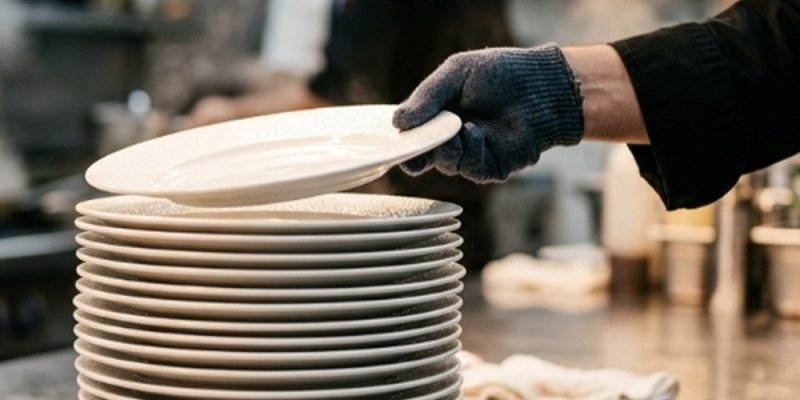
A hotel needs roughly 3 to 4 dinner plates per restaurant seat, 1.4 to 1.5 times the maximum cover count for banquet service, and 4 to 6 ceramic pieces per active room-service cover plus a property-wide buffer of 25 to 35 percent on top of that combined total to absorb breakage, simultaneous service across outlets, and replacement lead time. There is no single number that corresponds to all properties, and there is no single number that will suit all property types. This guide breaks the math down outlet by outlet, then shows how to combine it into one property-wide order.
Table of Contents
Why Hotel Tableware Quantity Planning Is Different From a Single Restaurant
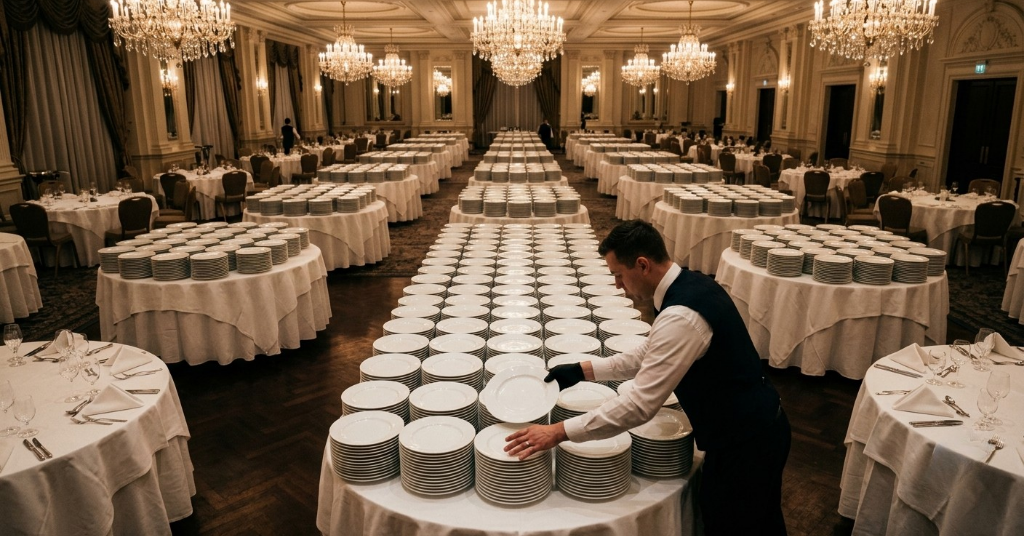
Most tableware quantity guidance online is written for single, standalone restaurants. A hotel property rarely works that way. For instance, a 10-inch dinner plate could be used in the main restaurant, the banquet hall, and a room-service dinner plate on the 9th floor simultaneously, all taken from the same wash and store system.
It’s in that overlap that most open-day procurement orders go astray. If the hotel does not treat the days of the banquet peak separately, or treat the longer recovery time for room service, the hotel will have fewer rooms available for dinner and will have full rooms at the same time, the first weekend after the wedding.
The Core Number: Why Hotels Plan Tableware Differently from Restaurants
The industry baseline is the 3:1 rule: three plates per seat — one in active use, one in the wash cycle, and one in reserve or cooling after the dishwasher. Under this rule, a 100-seat restaurant is allowed to have approximately 300 plates that serve as dinner plates in circulation. The number of restaurants that are well-documented is just that. What has changed in the hotel is that the 3:1 ratio needs to be carried out independently for three different types of service environments, and then reconciled, where these different environments do not behave in the same manner: the main restaurant, banquet and event space, and room service. Each has its own individual cover-count logic, recovery cycle, and buffer percentage.
Restaurant and À La Carte Outlets — The 3:1 Baseline
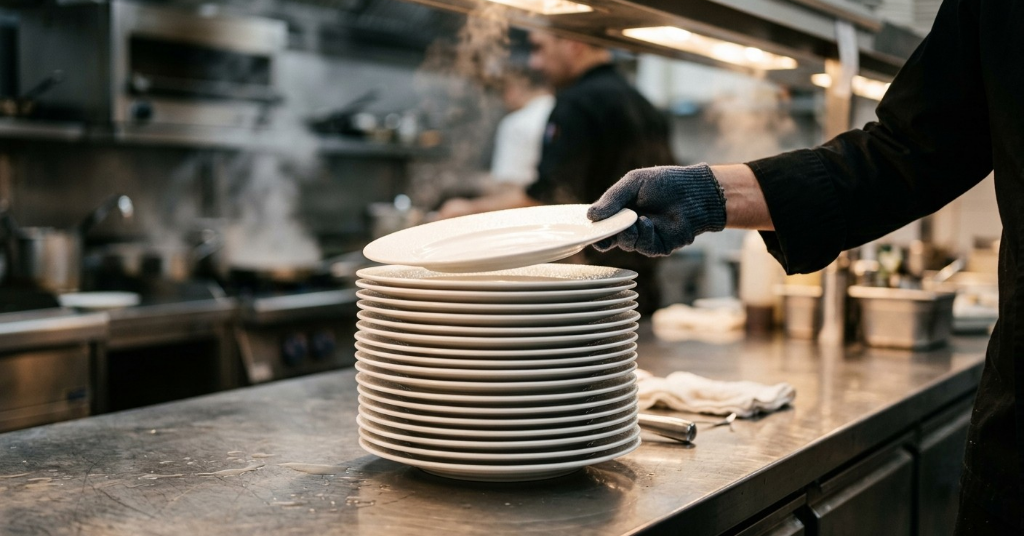
A great rule of thumb for a hotel’s primary restaurant or any à la carte outlet is the 3:1:1.5-2 rule: 3 plates of food, 1.5-2 side or salad plates, and 1.5-2 bowls of food per meal (depending on the number of soup or pasta items on the menu). A 150-seat hotel restaurant, for instance, might consider 450 dinner plates, 225 to 300 side plates and 225 to 300 bowls as its starting inventory, not to mention any banquet or room service draw.
As with a stand-alone restaurant, the combined seat count of every outlet drawing from that shared stock needs to be used in the calculation, not just the primary dining room because the same pattern is being used at both locations.
Banquet and Event Space — Plan for the Peak, Not the Average
The multiplier effect of banquet table ware planning is not the same as other multiplier effects due to its failure mode. A restaurant is not very happy to be a little understaffed on a Tuesday Lunch. This is a clear and immediate service failure that is readily apparent to everyone in the hall simultaneously: No dinner plates in a banquet hall at a 400-cover gala dinner.
The standard planning formula multiplies maximum simultaneous cover count by 1.4 for dinner plates, 1.3 for side plates, and 1.25 for bowls, and then adding 30-40% to account for breakage, simultaneous setup and takedown, and same-day double booking. This equates to about 700 to 750 dinner plates for a 500-cover banquet, versus 500 dinner plates on event day, which are actually “borrowed” from the restaurant’s dinner plate inventory.
This is also one of the reasons why most multi-outlet hotels have separate specs for tableware for banquet and fine dining, durability, stackability and weight for the rapid clearing of the banquet room work against the presentation and tactile cues of a good plate for the restaurant or fine-dining room. Usually, only a single compromise pattern is used for both purposes, a compromise for the first use, but not a compromise for the second, or vice versa.
Room Service — Why the Same Plate Count Per Cover Doesn't Apply
The area that most procurement plans don’t anticipate is room service; the cover count appears small compared to the restaurant or banquet area. It’s not the volume that’s miscalculated; it’s the recovery cycle. If you’re looking at the durability of this outlet, you have to read our hotel room service tableware guide (this one is only about quantity).
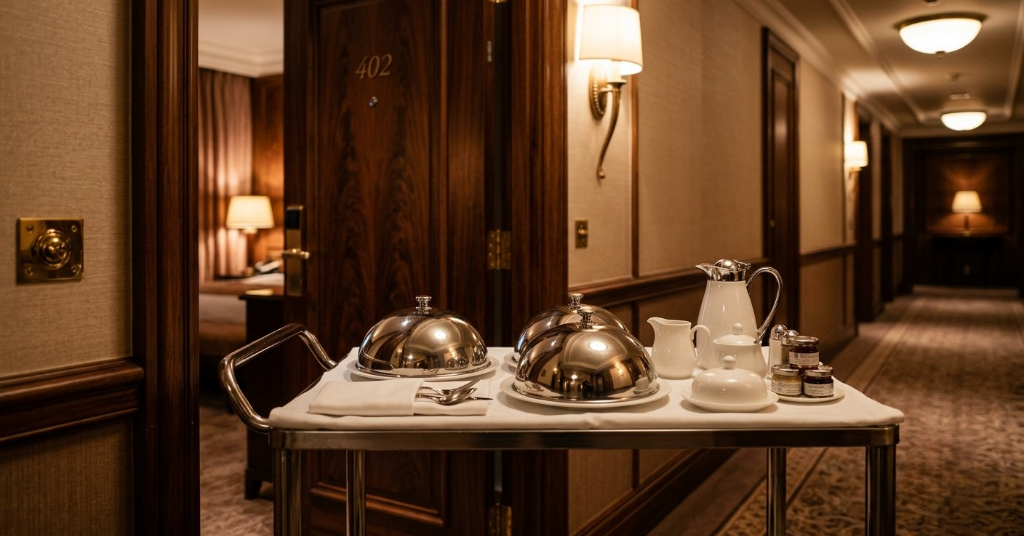
Before even counting glassware and flatware, a standard in-room meal requires 4-6 ceramic pieces per person: an entrée plate, a side plate, and a bowl, and sometimes a coffee pot, a sauce boat, or a butter dish. Each of those items takes a much longer time to recover in the recovery cycle compared to a restaurant. A few minutes, and a restaurant plate is on the table once more. A room-service plate is brought from the kitchen, put on a room service plate or trolley, sent up a service elevator, put down a hallway, into a guest room, and then onto a hall table until housekeeping picks it up again in the next room service cycle, usually a multi-hour cycle, not a multi-minute one.
Due to this longer cycle, room-service par stock should be based upon the maximum number of trays or trolleys that can be in use at the same time, rather than just the number of rooms. For a centralized room service system in a hotel with only one pantry in proximity to the kitchen, the hotel should have a sufficient number of plates on hand to meet the peak and concurrent order window for the busiest day of the week (usually breakfast), plus a generous margin to allow the housekeeping collection round to be slower than the room service order cycle without delaying the outgoing service.
Putting It Together — A Worked Example for a 200-Room, Multi-Outlet Hotel
Let’s do the three outlet calculations for a representative property: a 200-room hotel with one 150-cover restaurant, a banquet space that has a 400-cover maximum, and central room service.
- Restaurant (150 seats, 3:1 rule) — approximately 450 dinner plates, 225 to 300 side plates, 225 to 300 bowls
- Banquet (400-cover maximum, 1.4x formula) — approximately 560 dinner plates, 520 side plates, 500 bowls, and a separate stock of banquet plates.
- Room service (estimated 60 concurrent breakfast covers, 5 pieces per cover) — about 300 ceramic pieces rotating in room service.
- Property-wide buffer (30%) — added on top of the combined total to account for breakage, replacement lead time and the fact that the restaurant, the banquet and a heavy room service day are likely to occur on the same day.
When the property opens, that opening dinner party is going to come in with about 1,700 to 1,850 pieces, compared to roughly 450 pieces using a simple 3/1 calculation on the restaurant. What is often a surprise for most first-time visitors to hotels is the following: The restaurant math is correct, but it is just one-third of the draw of the property.
Building in the Right Buffer — and Why It's Not the Same Across Materials
The buffer percentage above the base calculation should take into account the replacement rate and the amount of forgiveness in handling the material daily. A 30 to 40 percent opening buffer is the norm, and porcelain and vitrified hotel-grade dinnerware has an average 50-150 percent replacement rate per year, depending on the size of the volume and the degree of handling discipline. But engineered melamine is more forgiving – replacement rate is about 10-20 percent per year – so it is the practical option for high-turnover banquet and pool service situations where is less buffer. The other extreme is bone china, which lasts for a longer time because of its controlled use in fine dining, but because of its poor resistance to banquet-speed handling, it is a poor choice for that application, no matter how large the buffer is.
Also, at this point, the selection of material and quantity planning directly influence each other: If a material is put in an outlet that is not intended for it, e.g., bone china in banquet service, then it will consume its buffer stock significantly beyond the expected percentage, regardless of how it was ordered up front.
Quantity Planning Reference Table by Outlet Type
Outlet | Base Formula | Recommended Buffer | Recovery Cycle |
Restaurant / à la carte | 3 plates per seat (3:1 rule) | 20-30% | Minutes |
Banquet/events | Max covers x 1.4 (dinner) | 30-40% | Same-day, rapid |
Room service | 4-6 pieces per cover | 25-35% | Hours |
Property-wide total | Sum of all outlets | +25-35% combined | Mixed |
How Brett Supports Multi-Outlet Tableware Procurement
Since 1998, Brett has provided ceramic tableware to hotels in over 80 countries from our manufacturing center in the ceramic capital of China – Chaozhou, with our showroom and office in Dongguan, Guangdong Province.
Our clients are Four Seasons, Shangri-La, Fairmont, Raffles, Wynn, Sheraton, Hyatt, and Marriott properties, Michelin Guide restaurants, and Black Pearl Restaurant Guide restaurants in Europe, the USA, and the Middle East. Brett also serves catering companies, banquet operations and wedding events worldwide.
For multi-outlet properties that are planning an order for an entire opening, we can work directly from your seat counts, banquet capacity, and volume of room service to create a tableware specification that will meet your actual needs for handling, whether it’s vitrified porcelain or alumina-reinforced strengthened porcelain for restaurant/banquet service, and material recommendations to suit your room service recovery cycle. Our MOQ structure goes from 50 to 300 pieces per item (asymmetrical), as actually needed in a property-wide order, instead of having to conform every outlet to one MOQ – minimum order quantity – that is only flat per piece.
FAQ
How many dinner plates does a 150-room hotel need?
The number and type of F&B outlets, not the room count itself. For a 150-room hotel with a 100- to 150-seat restaurant and no banquet space, a minimum of 300 to 450 dinner plates is required, with 20 to 30 percent on hand. Any property offering banquet or room service has additional room service draws, which are added separately, and a property with all three outlets may need 1,000 or more dinner plates at opening time, even at 150 rooms.
What is the 3:1 rule for hotel tableware?
The 3:1 rule is the industry benchmark for restaurant and à la carte dinnerware planning, which indicates that one plate is in use, one plate is in the wash, and one is in storage per seat. It will prevent a property from being served on a rushed or wet plate during rush hours. It applies to the single outlet situation of restaurants, and it must be calculated separately for a hotel banquet and/or room service volume.
Do banquet halls need more tableware than restaurants of the same size?
Yes, proportionally. The banquet service is based upon maximum simultaneous cover count times 1.4, the dinner plate figure, not 3:1, because each person will be fed at the same time, and there is no wash and return during service as there is for a restaurant. A 400-cover banquet capacity typically requires 560 or more dinner plates in dedicated stock.
How much tableware does room service actually use?
The number of ceramic pieces on a room service set is 4 to 6 for each cover, but it is the number of times the cover is recovered, not the number of pieces, that dictates the planning. The number of rooms in use does not necessarily determine the number of trays to stock for room service. The number of par stocks should be based on the number of tables that can be expected to be in use concurrently at your peak service time, not total rooms.
Should restaurant, banquet, and room-service tableware share the same inventory?
Even if the pattern is the same, most multi-outlet properties are better served with a separate stock per outlet as opposed to one stock that serves all outlets. Service at banquets requires durability and stackability over presentation; service at restaurants requires presentation; service in rooms requires withstanding the long, slow handling cycles through elevators and corridors. When one is shared across all three, it’s typically the room service outlet with the longest recovery time that slowly empties stock from the others without attracting notice, in high-traffic times.
How big a buffer should a hotel order above its calculated tableware total?
Vitrified porcelain or strengthened porcelain typically requires a 25- to 35-percent margin over the combined restaurant, banquet, and room-service expenses for a property-wide buffer. This encompasses the realistic replacement rate for porcelain dinnerware of 50 – 150 percent based on how it is used and the possibility of several outlets reaching their peak use at the same time. Since engineered melamine requires replacement at a lower rate, 10% – 20%, it can operate with a lower buffer.
Conclusion
Getting the hotel tableware quantity right comes down to treating each outlet’s math separately before combining it. For restaurant & à la carte service, the 3:1 rule (3 plates per seat) includes a 20-30% buffer. For any banquet or event, the maximum count is multiplied by 1.4 for dinner plates, and there is a 30-40 percent buffer to account for same-day, rapid-turnover risk. The number of pieces required to service the room depends on how many trays can be used at any one time, not on the number of rooms, and should be in the range of 4-6. The overall total is determined by the sum of the three outlets plus an additional 25% to 35% buffer, and shouldn’t be applied as one single spec for the property as a whole.
The two most frequent and costly procurement pitfalls—over- or under-ordering a restaurant seat count and ordering too few or too many items because of a single shared pattern that doesn’t meet the handling needs of any one outlet—are avoided by the properties that get it right at opening. If you want to learn more about the relationship between material and outlet assignment, please refer to our guide to hotel tableware durability and alumina-reinforced strengthened porcelain, and for the full specification checklist to use once your quantities are set, see our hotel tableware procurement checklist.
Customize your exclusive hotel tableware solutions with Brett, quotes, catalogs and samples available. Contact us today at cbhoreca.