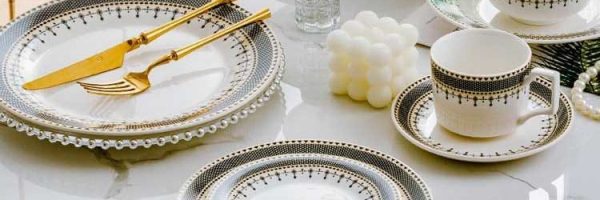
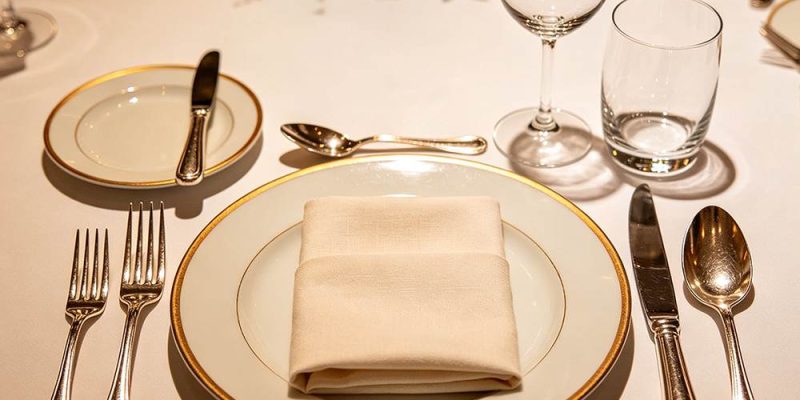
When we think of a banquet dinnerware setup, we usually picture floral arrangements, fancy dinnerware, and complementary silverware.
However, setting a banquet table is as much about design and ambience as it is about operational functionality.
Lizzie Post, the co-president of the Emily Post Institute, noted that table settings do much more than just look elegant. They actually send out the signal about the kind of food that’s about to be served. It sets the perception and expectations straight. For instance, if you see a soup bowl and spoon, soup is definitely on the menu!
In this guide, let’s talk about formal and casual placements, plated versus buffet strategies, and essential equipment needed for the perfect banquet table setup.
Formal Banquet Place Setting: The Emily Post Standard
A formal banquet setup cannot be based on a basic checklist with just the essentials laid out on the table. It must be precisely and intentionally coordinated in a way that the plates, flatware, and glassware all come together.
The Emily Post Institute sets the standard for formal banquet place setting. Following it can guarantee every component on the table has a purpose and a place.
Charger Plate
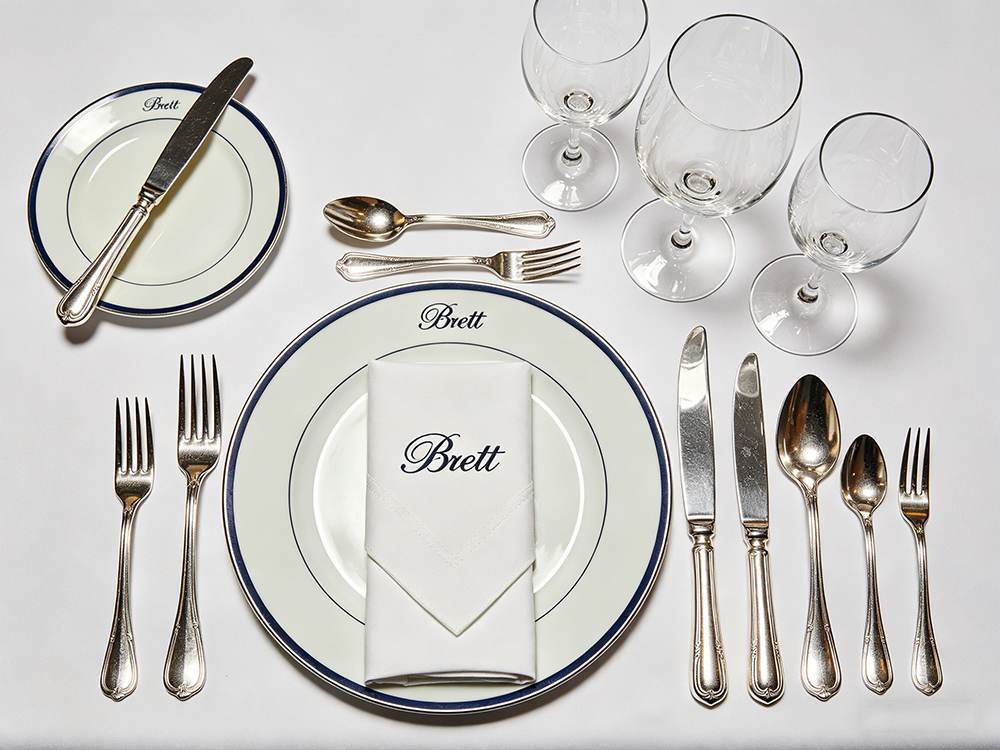
Right in the center of the formal banquet place setting, the charger or service plate is placed.
What Is a Charger Plate? A charger (or service plate) is a large underplate used during pre-entrée courses. It should stay on the table through the first courses, like appetizers or soup, and is only removed when the entrée is served. At that point, it is swapped with the dinner plate.
This is not your base decorative dinnerware, but just there to keep things functional. The idea is to ensure the guest always has a base plate in front of them during early courses.
The charger is 12–14 inches in diameter, whereas the dinner plate is around an inch or so less, about 10–11 inches.
Flatware: Outside-In Rule
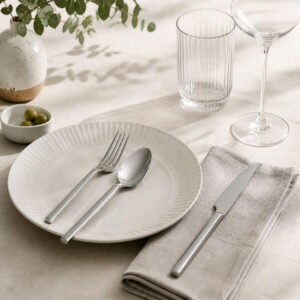
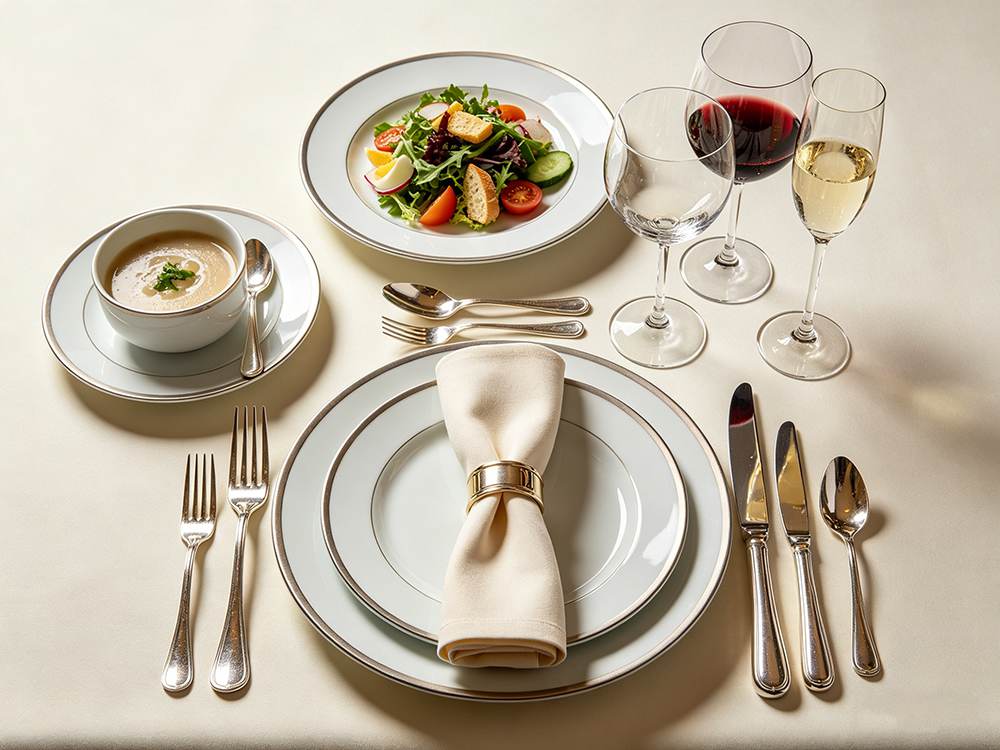
The cardinal rule, as per Emily Post, is that the utensils must be placed in the order of use. That is, they go from the outside to the inside.
Forks must be placed on the left of the plate, knives and spoons on the right. Whereas the blades must always face the plate.
There is an exception, though, the oyster fork must sit on the right as per convention.
A maximum of three utensils must be placed on each side of the plate. For all additional courses, fresh flatware should be served with each dish.
The dessert utensils rest horizontally above the plate, with the fork handle left and the spoon handle right. Explore more about flatware selection here: Commercial Flatware Selection Guide: Materials, Weights, and Durability for Restaurants.
Glassware
The glasses are positioned above and slightly to the right of the knives. Banquet settings usually include water and one or two wines. The water goblets sit first, with wine glasses arranged to their right in the order of service.
Bread Plate, Napkin, and Finishing Touches
The bread plates are placed on the upper left above the forks, the butter knife goes diagonal, with the handle on the right, and the blade down. Napkins are either on the charger or to the left. For banquets, a decorative fold on the charger is the standard.
As per industry practice, utensil bottoms are aligned at 1 inch from the table edge, for professional precision.
Table settings are expected to feature high-quality materials such as china, glassware, and stainless steel. Disposable plastic should be avoided in guest-facing service. Read more about dinnerware selection in our guide: Banquet Hall Dinnerware: Selecting Durable, Elegant Tableware for Events.
Plated Service vs Buffet Service: How the Setup Differs
In a commercial banquet, plated and buffet service are completely different. They change the dinnerware setup, staffing requirements, and also have unique equipment needs.
Getting them right is what keeps the service flowing.
Plated or Seated Banquet Setup
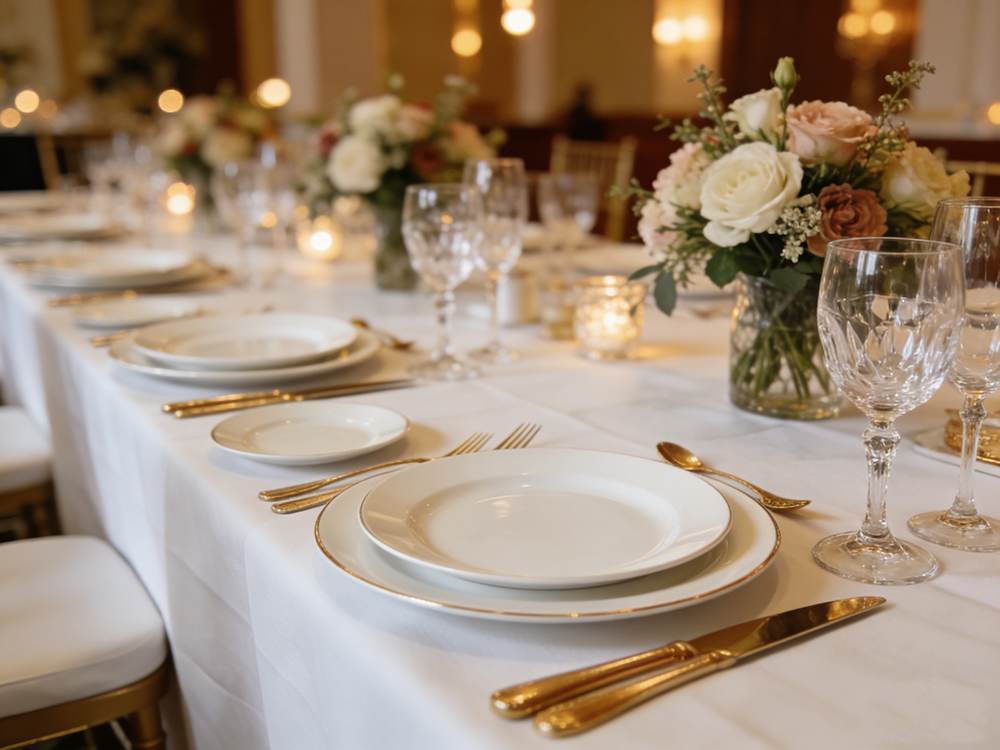
For a plated service, we need a full formal place setting at each seat. That means there must be a charger, flatware, glassware, a bread plate, and a napkin. The courses are delivered in a sequence by the service staff.
The flatware is either pre-set for each course or brought in as needed. This style eliminates the need for chafing dishes or buffet stations, but it requires a higher staffing of around one server per 15–20 guests.
Because multiple courses are served at the table, each place setting requires more flatware per guest, which can make inventory management complex. The staff must coordinate the timing and placement of utensils and plates to maintain flow, so that each course arrives at the correct temperature and in the right order.
Buffet Banquet Setup
Buffet service simplifies the tabletop setup. The dinner plates may be stacked at the buffet station or placed at each seat. Whereas, flatware and napkins are positioned at the buffet end. This way, the guests can serve themselves without having to hold the utensils.
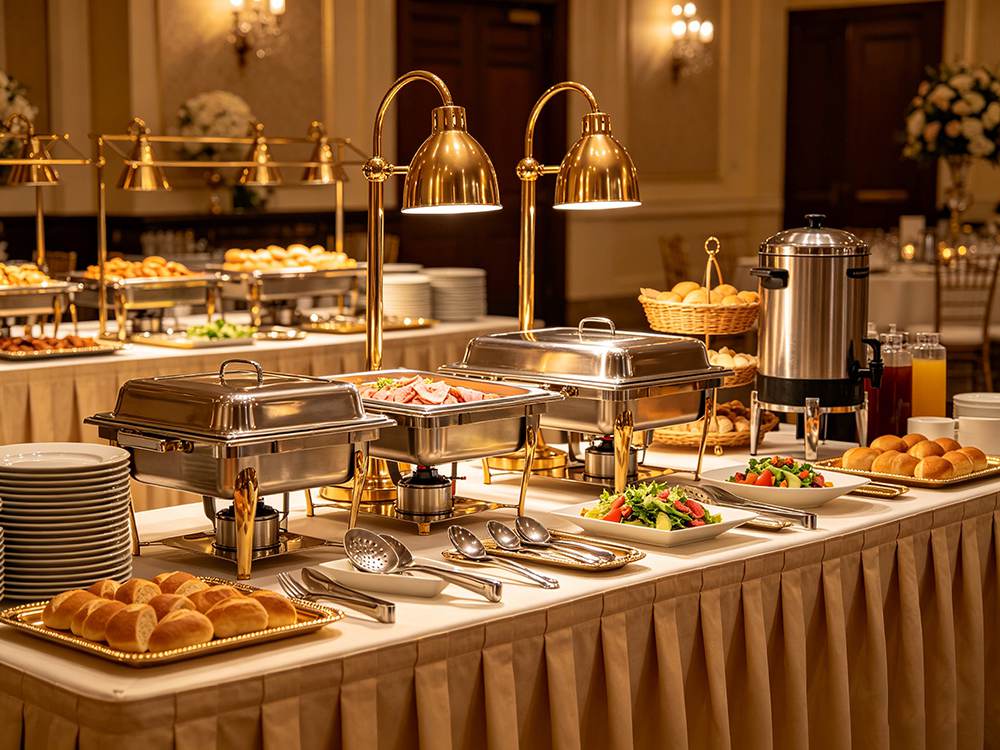
The buffet station also includes specialized equipment, i.e., chafing dishes. These are full-size, 8–9 qt for entrées, then there are serving platters, serving utensils, plate stacks, and fuel or warming trays.
Food safety, however, is critical here. As per the USDA FSIS guideline, hot foods should be maintained at 140°F (60°C) or above and cold foods at 40°F (4°C) or below.
Staffing requirements are lower in a buffet setup than in plated service. Usually, one server per 25–30 guests is enough as the guests self-serve.
Dinnerware Inventory Planning: How Much Do You Actually Need?
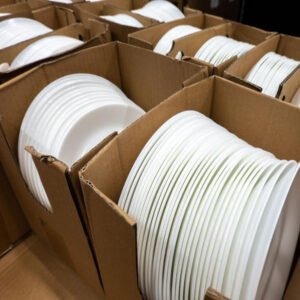
A successful banquet service doesn’t begin when the first guest arrives. It starts in the storeroom. Banquet dinnerware checklist planning ensures there’s enough plates, flatware, and glassware for every course and every guest throughout the service.
The Buffer Rule
As per industry-wide practice, it is best to keep approximately a 20% buffer for extra dinner plates, soup bowls, dessert plates, glassware, and flatware beyond the guest count for essential items. This will cover accidental drops, losses, and last-minute attendees.
Flatware Planning for Plated Service
For a 3-course plated banquet, you should keep a minimum of 3 forks, 2 knives, and 2 spoons per guest. For 200 guests, that’s like 600 forks, and adding the buffer of 20% makes it around 720 forks.
Other flatware, like knives and spoons, must be about twice the number of guests (along with the buffer), so we’re looking at around 480 knives and the same quantity of spoons.
Glassware Requirements
Each guest requires at least a water goblet and a wine glass. Since glassware has the highest breakage rate in any tabletop item, it is recommended to stock extras. For 200 guests, order 240–250 water goblets and an equal number of wine glasses.
Buffet-Specific Considerations
The buffet service shifts the inventory focus to serving equipment.
You need full-size chafing dishes of 8–9 qt and half-size dishes, 4–5 qt for the sides. For a 200-guest buffet, you’ll need around 4–6 full-size and 4–6 half-size chafing dishes, depending on the menu.
For stackable plate sets and serving utensils, follow the same 20% buffer rule. Learn more about dinnerware sizes in the guide: Dinnerware Sizing Guide: Plate Sizes and Portions for Hospitality.
Contingency and Par-Level Planning
Keep a 15–20% safety cushion for real-world chaos that can hit when you least expect it. Glasses can chip mid-service, you might have to prep a last-minute VIP table, or a linen spill can happen right before the doors open.
That extra stock will cover the moments without slowing down service.
For very busy venues, running 3–4 events a week, scaling inventory up to about 150% of your largest event can protect you from running low.
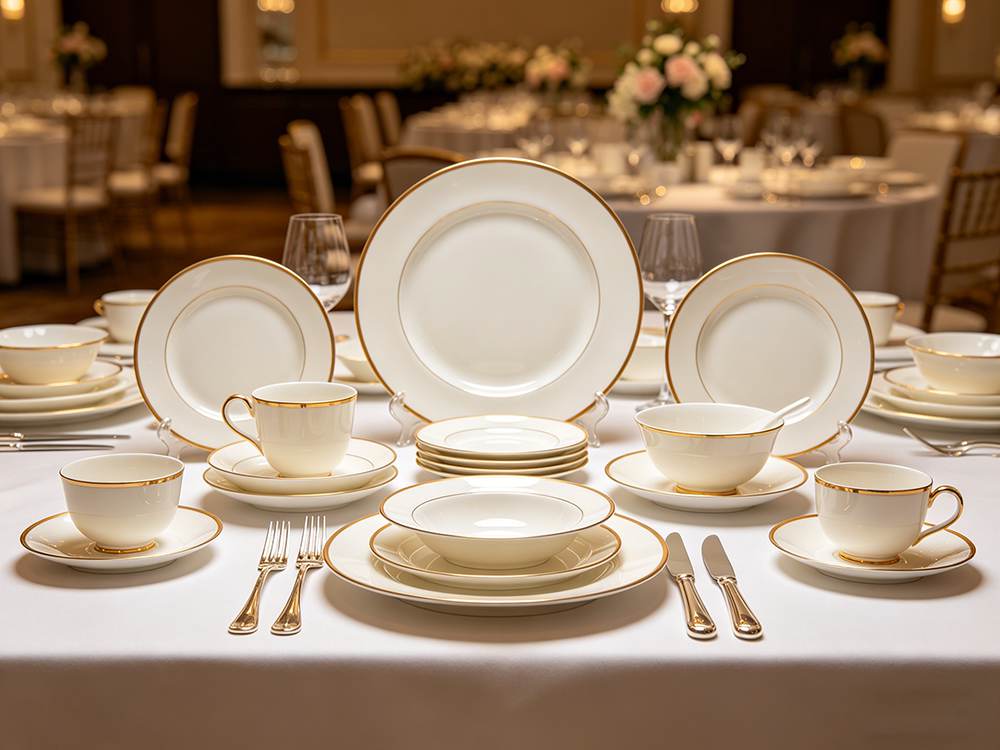
Complete Banquet Equipment Checklist
A great banquet execution starts long before service actually begins. To make the execution smooth, it is best to begin with a banquet equipment checklist.
Tabletop Per Guest
For formal plated service and buffet-assisted seating, you’ll need:
- A charger plate
- Dinner plates
- Salad or appetizer plates
- Bread plates
- Soup bowl
- Dessert plate
- Flatware: Dinner fork, salad fork, dinner knife, soup spoon, teaspoon, dessert fork and/or dessert spoon, and butter knife.
- Glassware: Water goblet, wine glasses, including red, white, or both based on menu, and champagne flute (if applicable)
- Cloth napkin: Formal fold or napkin ring
Buffet Station
Buffet setups require equipment that ensures flow, food safety, and compliance. Here’s what each buffet station must have:
- Heat and Holding Equipment: Full-size chafing dishes (8–9 qt), half-size chafing dishes (4–5 qt), fuel holders and canned heat, heat lamps
- Serving Tools and Accessories
- Serving platters for cold cuts, salads, and desserts
- Serving utensils: Tongs, ladles, slotted spoons, solid spoons, carving set
- Plate stacks for self-serve setups
- Beverage dispensers and coffee urns or tea brewers
- Ice beds and refrigerated trays
- Bread baskets or rolls trays
- Condiment holders
Table Infrastructure and Decor
The table infrastructure supports the event’s aesthetics and overall layout plan. It includes:
- Linens or tablecloths: 120” round for 60” round tables, 90” x 132” for 6’ banquet tables
- Table skirting: For head tables, buffet stations, and registration tables
- Visual or Navigational Aids such as place cards or name cards for assigned seating, table number stands, and centerpieces.
- Station Support Items
- Clipboards/checklists for setup crew
- Gaff tape/zip ties for fixing linens discreetly
- Spare linens and napkins
Read on more about dinnerware ordering: Bulk Dinnerware Ordering for Events: MOQ, Pricing, and Supplier Negotiation.
Banquet Dinnerware Setup Timeline: From Planning to Guest Arrival
A great banquet doesn’t happen by chance. It is driven by timed, coordinated preparation. Here’s a banquet event table setup timeline to ensure your guests leave delighted and are served with the utmost care.
- 72 Hours Before the Event:This is the ‘Foundation Phase’ where you confirm the final guest count, equipment inventory against your banquet dinnerware checklist, and banquet equipment list, including backups.
- Also, supplier deliveries like linens, chafing fuel, glassware, centerpieces, etc., are scheduled, and the staff is briefed on the event flow, menu, service style (plated vs buffet), and any other protocols.
- 24 Hours Before the Event: If you’re hosting a large event with over 200 guests, begin the room setup, arrange tables, chairs, and lay out the tablecloths. Also, stage the buffet equipment like chafing dishes and beverage stations.
- 4–6 Hours Before Guests Arrive:Set the chargers, dinnerware, flatware, and glassware as per the banquet service standards. Fold and place napkins on chargers or to the left of forks, position the centerpieces and table number stands.
- For buffets, assemble each station completely, place the serving utensils, and get the cold/hot food handling equipment ready.
- 2 Hours Before Guest Arrival: Conduct a full walkthrough. Make sure the chafing fuel holders are present, ice beds are chilled, and temperature gear is staged. Also, confirm the staff assignments for entry greeting, service flow, and specialty stations.
- 30 Minutes Before Guest Arrival: Light the chafing fuel at buffet stations, fill water glasses at head tables or starter tables, lint roll chairs and tablecloths, and lastly, open the doors and prepare for guest arrival.
Common Banquet Dinnerware Setup Mistakes to Avoid
Here are some common banquet setup mistakes to avoid:
- Only set the table with the utensils that will be used.
- Do not ignore the 2-foot spacing rule. Cramming place settings together will restrict the elbow room and slow down the service.
- Chargers are only temporary underplates. Remove them before serving the main course.
- Always buffer for inventory, especially forks, knives, spoons, and glassware.
- Always adhere to USDA’s safety standards and keep a check on the chafing fuel so it doesn’t run out mid-service.
- In a buffet line, always place utensils at the end of the line, so guests can select food with ease, with their hands free.
The Art of Banquet Dinnerware Setup
A flawless banquet dinnerware setup is more than a decorative flair. It is an operational discipline balancing guest experience, service flow, and safety. At Brett, banquet dinnerware is not about individual pieces. Rather, it’s about how they function together as a system.
The charger alignment, flatware flow, and glassware balance are all designed to work in sync long before service even begins. Brett makes the table look right and perform best, no matter the setting. Learn more in our guide about dinnerware sourcing: Catering Company Dinnerware Sourcing: Wholesale Purchasing and Durability Guide.
Frequently Asked Questions
1. How do you set a formal banquet table?
Begin with the charger plate in the center. Place the dinner plate above it, forks to the left (salad fork outside, dinner fork inside), and the knives and spoons to the right with the blades facing the plate.
The glassware sits above the knives and the bread plate, upper left. Dessert utensils must be placed horizontally above the plate.
2. How many place settings do I need for a 200-person banquet?
For a 200-person banquet plan for one per seat place setting with a buffer for breakage and last-minute guests. Around 240–250 pieces of each essential item, including dinner plates, salad plates, soup bowls, and dessert plates, work.
3. Should flatware go at the buffet or the table for a banquet?
For buffet service, keep flatware and napkins at the end of the buffet line to keep the guests’ hands free. For plated service, flatware is pre-set at each place setting, so each course has the right utensils available when served.
4. What temperature should chafing dishes maintain at a banquet buffet?
As per the USDA guidelines, hot food must be maintained at 140°F (60°C) or above and cold items at 40°F (4°C) or below. Perishable food left at room temperature over 2 hours or even 1 hour if above 90°F must be discarded.