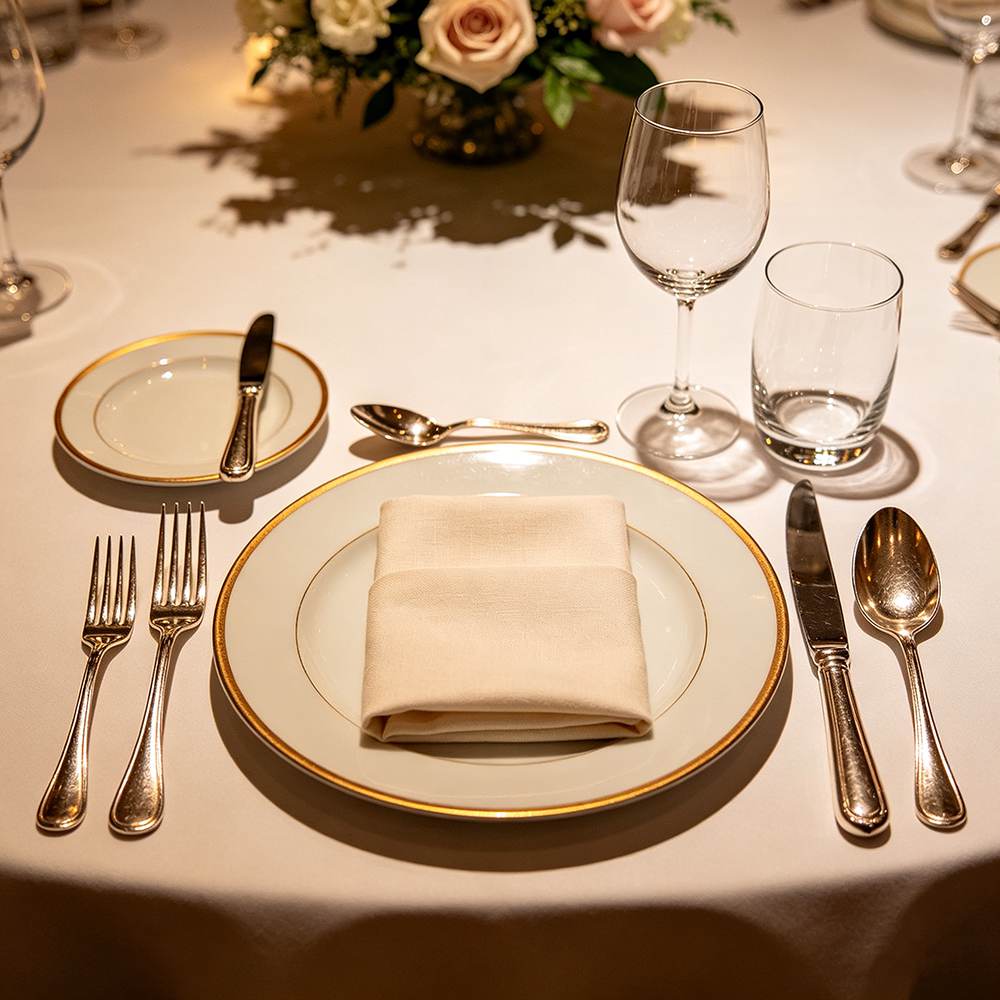
When we think of a banquet dinnerware setup, we usually picture floral arrangements, fancy dinnerware, and complementary silverware. However, setting a banquet table is as much about design and ambience as it is about operational functionality. Lizzie Post, the co-president of the Emily Post Institute, noted that table settings do much more than just look elegant. They actually send out the signal about the kind of food that’s about to be served. It sets the perception and expectations straight. For instance, if you see a soup bowl and spoon, soup is definitely on the menu! In this guide, let’s talk about formal and casual placements, plated versus buffet strategies, and essential equipment needed for the perfect banquet table setup. Formal Banquet Place Setting: The Emily Post Standard A formal banquet setup cannot be based on a basic checklist with just the essentials laid out on the table. It must be precisely and intentionally coordinated in a way that the plates, flatware, and glassware all come together. The Emily Post Institute sets the standard for formal banquet place setting. Following it can guarantee every component on the table has a purpose and a place. Charger Plate Right in the center of the formal banquet place setting, the charger or service plate is placed. What Is a Charger Plate? A charger (or service plate) is a large underplate used during pre-entrée courses. It should stay on the table through the first courses, like appetizers or soup, and is only removed when the entrée is served. At that point, it is swapped with the dinner plate. This is not your base decorative dinnerware, but just there to keep things functional. The idea is to ensure the guest always has a base plate in front of them during early courses. The charger is 12–14 inches in diameter, whereas the dinner plate is around an inch or so less, about 10–11 inches. Flatware: Outside-In Rule The cardinal rule, as per Emily Post, is that the utensils must be placed in the order of use. That is, they go from the outside to the inside. Forks must be placed on the left of the plate, knives and spoons on the right. Whereas the blades must always face the plate. There is an exception, though, the oyster fork must sit on the right as per convention. A maximum of three utensils must be placed on each side of the plate. For all additional courses, fresh flatware should be served with each dish. The dessert utensils rest horizontally above the plate, with the fork handle left and the spoon handle right. Explore more about flatware selection here: Commercial Flatware Selection Guide: Materials, Weights, and Durability for Restaurants. Glassware The glasses are positioned above and slightly to the right of the knives. Banquet settings usually include water and one or two wines. The water goblets sit first, with wine glasses arranged to their right in the order of service. Bread Plate, Napkin, and Finishing Touches The bread plates are placed on the upper left above the forks, the butter knife goes diagonal, with the handle on the right, and the blade down. Napkins are either on the charger or to the left. For banquets, a decorative fold on the charger is the standard. As per industry practice, utensil bottoms are aligned at 1 inch from the table edge, for professional precision. Table settings are expected to feature high-quality materials such as china, glassware, and stainless steel. Disposable plastic should be avoided in guest-facing service. Read more about dinnerware selection in our guide: Banquet Hall Dinnerware: Selecting Durable, Elegant Tableware for Events. Plated Service vs Buffet Service: How the Setup Differs In a commercial banquet, plated and buffet service are completely different. They change the dinnerware setup, staffing requirements, and also have unique equipment needs. Getting them right is what keeps the service flowing. Plated or Seated Banquet Setup For a plated service, we need a full formal place setting at each seat. That means there must be a charger, flatware, glassware, a bread plate, and a napkin. The courses are delivered in a sequence by the service staff. The flatware is either pre-set for each course or brought in as needed. This style eliminates the need for chafing dishes or buffet stations, but it requires a higher staffing of around one server per 15–20 guests. Because multiple courses are served at the table, each place setting requires more flatware per guest, which can make inventory management complex. The staff must coordinate the timing and placement of utensils and plates to maintain flow, so that each course arrives at the correct temperature and in the right order. Buffet Banquet Setup Buffet service simplifies the tabletop setup. The dinner plates may be stacked at the buffet station or placed at each seat. Whereas, flatware and napkins are positioned at the buffet end. This way, the guests can serve themselves without having to hold the utensils. The buffet station also includes specialized equipment, i.e., chafing dishes. These are full-size, 8–9 qt for entrées, then there are serving platters, serving utensils, plate stacks, and fuel or warming trays. Food safety, however, is critical here. As per the USDA FSIS guideline, hot foods should be maintained at 140°F (60°C) or above and cold foods at 40°F (4°C) or below. Staffing requirements are lower in a buffet setup than in plated service. Usually, one server per 25–30 guests is enough as the guests self-serve. Dinnerware Inventory Planning: How Much Do You Actually Need? A successful banquet service doesn’t begin when the first guest arrives. It starts in the storeroom. Banquet dinnerware checklist planning ensures there’s enough plates, flatware, and glassware for every course and every guest throughout the service. The Buffer Rule As per industry-wide practice, it is best to keep approximately a 20% buffer for extra dinner plates, soup bowls, dessert plates, glassware, and flatware beyond the guest count for essential items. This will cover accidental drops, losses, and last-minute attendees. Flatware Planning for Plated Service