There’s one term you’ll see in every hotel dinnerware tender: vitrified porcelain. If you’re new to the hospitality business, you may be wondering, “What is vitrified porcelain, and why does it separate commercial-grade dinnerware from everything else?”
To put it simply, vitrified porcelain is porcelain fired at temperatures hot enough to fuse clay particles into a dense, glass-like, non-porous body. This is usually around 1,200 to 1,400°C, giving vitrified porcelain a water absorption rate of 0.5% or lower.
If you want to know all about vitrified porcelain dinnerware and the process of vitrification, you’re at the right place. This is a complete material education guide for hospitality professionals, where you’ll learn about how vitrification affects commercial performance, ASTM testing standards, comparison to non-vitrified alternatives, and what to specify in procurement.
The Science of Vitrification: What Happens Inside the Kiln
Before we talk about industry standards, let’s answer this: What is vitrified porcelain?
First, you should know that porcelain has several mineral components like kaolin, feldspar, and quartz. During vitrification, the porcelain is heated to such a temperature that these components physically melt and fuse. This creates a continuous glass-like matrix, also known as vitrified porcelain. The name comes from the Latin word “vitrum,” meaning “glass.”
In unfired or low-fired porcelain, there are many microscopic gaps, which can be penetrated by water, odors, oil, bacteria, and food. During the vitrification process, these gaps close completely and result in a dense, non-porous material.
Porcelain doesn’t just need to be fired at any high temperature to be considered “vitrified.” It actually needs to reach a very specific range between 1,200 and 1,400°C. If you fire clay just a few hundred degrees lower at 900–1,100°C, the result would still be porous. Meanwhile, firing it at 1,100–1,300°C would result in partial vitrification.
The main way to measure the vitrification of any porcelain is its water absorption rate. According to ASTM’s C373 water absorption testing standards, “vitreous” refers to ≤0.5% water absorption. Fully vitrified porcelain typically achieves 0–0.5% water absorption. To put it into perspective, earthenware typically absorbs 8–12% water, while semi-vitrified stoneware absorbs 2–3%.
Some vitrified ceramic manufacturers also add alumina to the material to increase its strength and chip resistance. This creates “high-alumina vitrified porcelain,” which is used by brands like Churchill, Steelite, and Dudson for their commercial hospitality lines.
Why Vitrification Matters in Commercial Hospitality
Now that we know how vitrification works, let’s answer this: what does vitrification actually do for a hotel or restaurant on a daily basis? Here are a few of the many benefits of vitrified porcelain dinnerware.
Food Safety and Hygiene
Unvitrified clay harbors tons of bacteria in its microscopic pores. Then, there’s no way to completely sanitize the dinnerware even after dishwashing. Over time, this turns into a food safety hazard that’s completely invisible to the naked eye.
Vitrification creates non-porous porcelain, which means water, bacteria, food, oils, and odors can’t penetrate the dinnerware. Maintaining clean dinnerware is a crucial step in passing health inspections and being HACCP compliant.
Commercial Dishwasher Endurance
If you measure a non-vitrified plate after 200 dishwasher cycles, you’ll find that it’s much heavier than it was when new. Meanwhile, a vitrified plate will weigh the same, new and used. Why is that?
To put it simply, it’s because vitrified porcelain is able to withstand the thermal stress of commercial dishwashers. Not only do the water temperatures rise to 60–82°C, but these dishwashers also use aggressive alkaline detergents. This causes non-vitrified commercial porcelain dinnerware to warp, absorb water, and crack over time.
Stain and Odor Resistance
Because there are no microscopic gaps to penetrate, vitrified porcelain does not absorb food stains, curry discoloration, or coffee rings into the body. All these stains only sit on top of the glaze surface and wash off with a bit of soap. Meanwhile, porous dinnerware absorbs stains permanently.
Microwave Safety
Have you ever microwaved something, only for the food to be cold while the plate is scalding hot? Non-vitrified ceramics have tiny gaps that absorb moisture. When microwaved, the trapped water in these gaps heats the plate instead of the food on it.
According to ASTM, dinnerware should have a water absorption rate of no more than 2–3% for safe microwave use. Luckily, vitrified porcelain doesn’t absorb more than 0.5%, which makes it perfect for microwave reheating.
Longevity and Replacement Cost
Vitrief porcelain has a dense, fused structure that resists chipping at the edges much better than porous materials. Combine this with reinforced rims, and vitrified commercial dinnerware can outlast any type of non-vitrified alternative. That means you will save a ton on annual replacement spend. You can learn more about the durability of different dinnerware materials here.
Vitrified Porcelain vs. Other Dinnerware Materials
If you’re already in the hospitality business, you might be wondering, “Why should I switch from my current dinnerware material to vitrified porcelain?” Here’s a complete material comparison to help you decide which one is a better choice.
Vitrified Porcelain vs. Non-Vitrified Porcelain
Despite popular belief, not all hotel-grade porcelain is vitrified. Many hotel owners assume that they’ve ordered vitrified porcelain when it’s just standard porcelain.
In reality, this low-cost porcelain dinnerware is actually under-fired, which is why its water absorption rate is over 0.5%. If you want high-quality porcelain, make sure the manufacturer’s spec data says “vitrified” or request the water absorption data.
Vitrified Porcelain vs. Bone China
Bone china is actually also a vitrified ceramic, but it contains bone ash (a combination of calcium and phosphate) in the clay body. This creates a lighter and more translucent piece than the glass-like porcelain. Meanwhile, vitrified porcelain is denser and heavier.
If you need dinnerware for fine dining settings where elegance and weight are top priorities, bone china is the right choice. However, if it’s a high-volume operation where you need durable materials to withstand rapid handling, you’d be much safer with vitrified porcelain dinnerware.
Vitrified Porcelain vs. Stoneware
It’s possible to partially vitrify stoneware and achieve a 2–3% absorption rate, but it rarely reaches the full vitrification of porcelain with under 0.5% absorption. It looks different, too, as stoneware has more of a textured, artisanal aesthetic. If you pick stoneware or earthenware over vitrified porcelain, you can expect higher moisture absorption, heavier weight, and faster glaze degradation in commercial dishwashers.
Vitrified Porcelain vs. Melamine
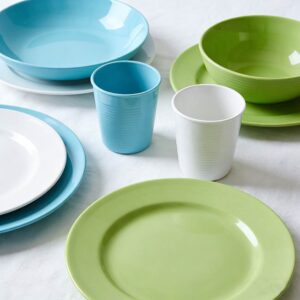
Since melamine is a plastic, not a ceramic, it’s considered much more “durable” in some ways. It may be shatter-resistant and cheaper to replace, but it cannot handle the heat of an oven, microwave, or even a plate warmer. Meanwhile, vitrified porcelain has a drastically higher heat capacity.
For outdoor, poolside, and high-loss settings, melamine wins on cost. For every other hospitality setting, vitrified porcelain is the professional standard.
What to Specify in Your Procurement — The Vitrification Checklist
If it’s your first time making a commercial porcelain dinnerware order for your hotel, it’s wise to start with some procurement guidance. Below is a complete checklist to include in your tender documents or supplier evaluations.
- Request water absorption data.These will be available in the form of ASTM C373 test results or equivalent. If the supplier isn’t able to provide this data, that’s a red flag to look out for. Brett provided all data related to water absorption, firing, and vitrification for their porcelain dinnerware.
- Ask about the firing data. Vitrified porcelain dinnerware doesn’t just need to be fired at any high temperature. It needs to be fired at a very specific range between 1,200 and 1,400°C. If the hotel-grade porcelain is underfired, it will still look identical to vitrified porcelain but will fail under commercial conditions.
- Check for high-alumina formulas. If chip resistance is your top priority, ask your provider for high-alumina vitrified porcelain. This material typically has 25–30% alumina content. If your hotel has high-volume buffet or banquet operations, this is a step you can’t miss. Brett is one of the few suppliers that offer high-alumina vitrified porcelain dinnerware in the industry.
- Ask for rolled-edge plates.The rim is actually the weakest part in any type of plate, especially porcelain. Rolled or reinforced edges can make the plate chip-resistant where it matters most.
- Request NSF/ANSI certification:This certification confirms that the vitrified porcelain dinnerware has been tested for food-contact safety and commercial kitchen conditions. This is an unmissable step in passing health inspections and being HACCP compliant.
- Test with a sample order:Commercial dinnerware is far from affordable. Before you commit to a bulk order, ask your supplier for a sample dozen of plates. Run this set through at least 50 to 100 dishwasher cycles to see how they perform. Check how much the weight has changed, as this will let you know about the water absorption (there should be virtually no weight change). Other than that, check for glade crazing and edge chipping, too. Brett has a sample program that allows you to confirm all these details before you make a bulk order.
Where Vitrified Porcelain Fits in a Hotel Dinnerware Program
Vitrified porcelain is the defined professional standard for hotel dinnerware. Here are a few settings where it performs best:
- Fine Dining:This is where vitrified porcelain dinnerware or bone china performs best. If durability is your priority, choose vitried porcelain. But if you want a more elegant aesthetic, bone china will get the job done.
- All-Day Dining/Buffet:In this case, vitrified hotel-grade porcelain is the clear winner. It’s able to handle aggressive dishwashing, high volume, and rapid handling. No other material performs as consistently in all regards.
- Room Service: Vitrified porcelain is also ideal for hotel room servicesince its heat retention capabilities keep the food hot for longer. Plus, it’s durable enough to be rolled around in a trolley risk-free.
- Banqueting: Vitrified porcelain works here as well, since you have a better chance of finding andmaintaining it in a large stock. Plus, it also typically had better long-term pattern continuity than other materials.
- Concept/Specialty Restaurants:If you have a concept or speciality restaurant, vitrified stoneware (if fully vitrified) will give you the ideal artisanal aesthetic. Plus, you can also keep standard vitrified porcelain as the backup.
- Poolside/Outdoor:In this setting, melamine tends to perform better than porcelain. There’s too much risk of breakage from hard surfaces, so there’s a need to deploy expensive vitrified porcelain.
The good news is that Brett manufactures vitrified porcelain across all these outlet types with OEM and ODM customization.
FAQs
What does “vitrified” mean in dinnerware?
Vitrified refers to dinnerware that has been fired at high enough temperatures, specifically between 1,200 and 1,400°C. This fuses the clay particles into a dense, glass-like body and makes the material non-porous. Vitrified porcelain has a water absorption of 0.5% or below 0.5%, which means it resists moisture, bacteria, stains, and thermal shock. That is why it’s the standard for commercial use.
Is vitrified porcelain the same as regular porcelain?
Not always. High-quality porcelain is vitrified by definition, but most lower-grade porcelain dinnerware is under-fired. That is why it retains water absorption above the 0.5% vitrification threshold. For commercial hospitality use, it’s wise to make sure that porcelain is fully vitrified by checking the manufacturer’s water absorption test data.
Is vitrified porcelain safe for microwaves and dishwashers?
Yes. Vitrified porcelain is safe for both commercial dishwashers and microwaves. Since it’s non-porous, with less than 0.5% water absorption, it does not absorb moisture that could cause uneven heating in microwaves or structural weakening from repeated dishwasher cycles. ASTM recommends absorption below 2–3% for microwave safety, and luckily, vitrified porcelain far exceeds this.
How can you tell if porcelain is vitrified?
The most reliable way to know if porcelain is vitrified is to check the manufacturer’s water absorption test data. If it’s vitrified, it would show less than 0.5% absorption. You’ll also notice that vitrified porcelain feels dense and heavy relative to its size. It produces a clear ring when tapped and does not gain weight after prolonged water immersion.
Why do hotels prefer vitrified porcelain dinnerware?
Hotels prefer vitrified porcelain because it withstands commercial dishwashers, resists chipping, and does not absorb food stains or bacteria. It also maintains its appearance through thousands of service cycles. The non-porous surface meets food safety standards, and the material’s durability reduces annual replacement costs compared to non-vitrified alternatives.