
The majority of hotels are utilizing melamine dishes in the incorrect applications.
Others never use it at all but nothing other than porcelain will be installed anywhere in the construction such as the pool deck or the rooftop bar. Every year they go about as though they have invested in a full set of new place settings, only to have them broken.They have been spending the equivalent of one full tableware replacement budget annually on broken plates that shouldn’t have been made of ceramic in the first place.
Others, on the other hand, apply melamine to their hotel’s dinner table, and, in doing so, violate the expected visual standard that the property is setting, and communicate to every guest that the brand is shoestringing the service for them.
Neither is correct. It’s not melamine or porcelain, it’s melamine and porcelain in the right places, at the right price, and for the right reasons. This guide shows you just where the line is!
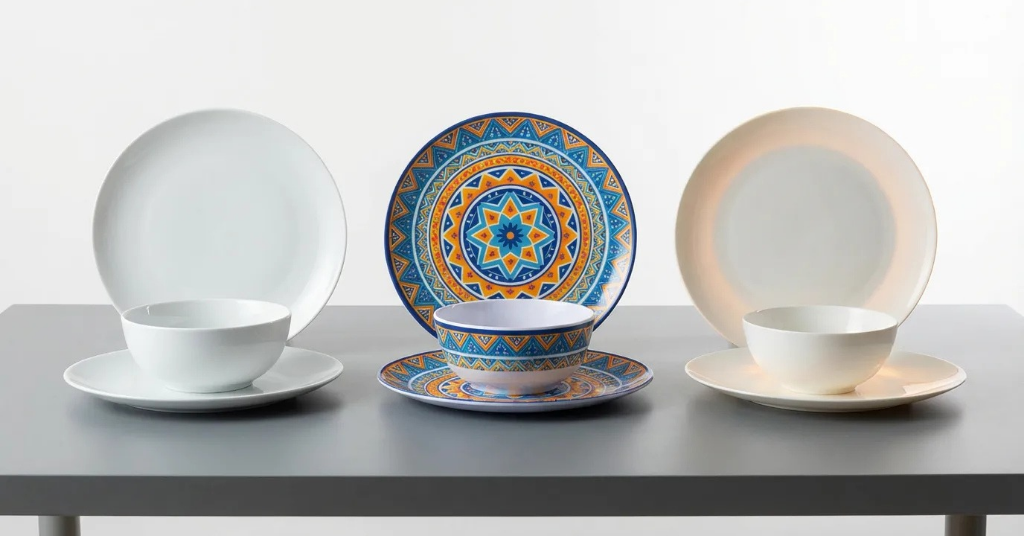
Table of Contents
What Is Hotel Melamine Dinnerware
Melamine dinnerware is actually created with a thermosetting plastic named melamine resin, which is created by joining melamine with formaldehyde after heating under pressure. The product has a high impact resistance, hardness, and density. Does not break when it comes in contact with hard surfaces outside. A melamine plate that falls on a pool deck bounces. When a porcelain plate hits the same surface it shatters.
Premium commercial grade melamine is made to look and feel like ceramic, it’s the surface texture, weight distribution and colour depth of high end melamine is close to porcelain most guests would not be able to tell from a casual look. That makes it possible for high-end hotel properties to utilize melamine dinnerware for outdoor or casual dining without the table appearing cheap.
There are performance limitations not dependent on quality tier. Melamine is not microwave safe because the material will break down with repeated microwave exposure, and can release trace chemicals into food at temperatures above 70°C (160°F) when continuously heated. It is not oven safe. I do not recommend serving very hot foods at high temperatures for a long time. These restrictions specify exactly what kind of hotel outlet you can use for melamine and which you cannot.
The Number That Makes the Decision Clear
A high volume hotel operation uses a 50-150 percent annual inventory replacement rate with standard porcelain. The replacement rate for commercial grade melamine is between 10% and 20% per year, based on G.E.T. Enterprises’ commercial dinnerware replacement rate data, under equivalent handling conditions.
With ceramic plates and a poolside bar at a 80 cover hotel on a busy weekend in the summer, you can expect anywhere between 15 and 25 plates to be broken. The same weekend with the same outlet, running commercial melamine dinners allows for almost no breakage. The plate bounces. It is picked up by the server. Service continues.
It would be incorrect to say that the financial case for a hotel’s dinnerware made with melamine in the right outlets is marginal. It is transformational. In the outdoor or high loss environment, the question is never if melamine will save money, it will. The question is, what is the correct deployment?
Hotel Outlet by Outlet: Where Melamine Belongs and Where It Does Not
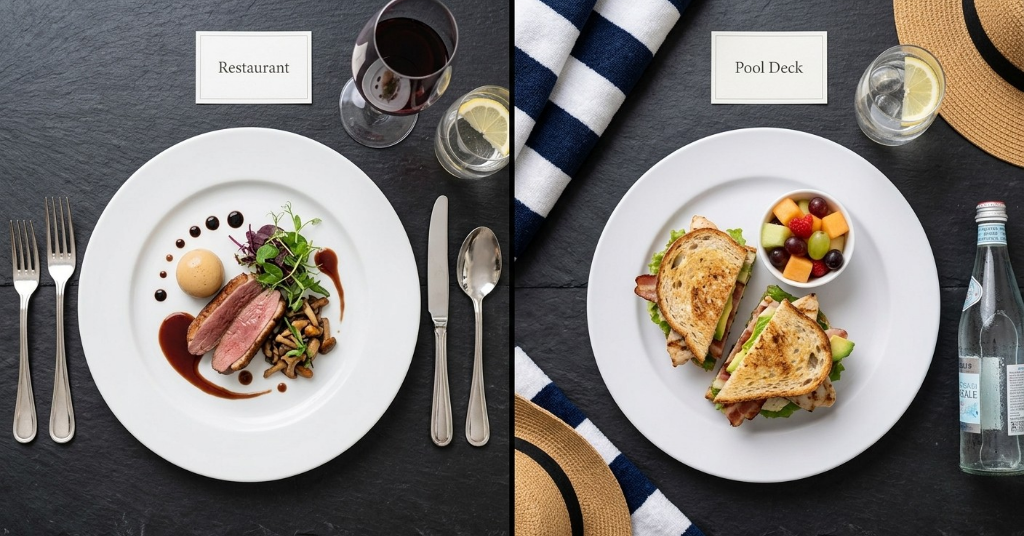
Not every hotel outlet has the same service conditions. The right material depends on the surface, the handling speed, the guest expectation, and whether hot food is involved. Here is exactly where melamine fits and where it does not.
Pool Deck and Outdoor Dining
This is the best application of hotel melamine dinnerware, and it’s what most properties get right. The pool deck is the most breakable area in any hotel property, whether it’s hard tile surfaces, bare feet, or distractions from walking with plates and drinks. It is not an economic material for porcelain. One restaurant can break more plates than one busy resort can break in a week, at the poolside!
Premium melamine dinnerware for hotel use is particularly designed for this type of setting. It is UV resistant (very important for the outdoors, where it will be used in direct sunlight), light enough for guests to comfortably carry and dishwasher safe on a standard commercial dishwasher, and is available in various designs that coordinate with the property’s brand palette. Casual service means commercial melamine dinnerware, and doesn’t break the bank.
Rooftop Bars and Outdoor Terraces
It’s the same for rooftop bars and outdoor terrace service. Breakage rates are so high in hard surfaces, ambient service areas and when guests stand and move with food that porcelain can truly become an unacceptable expense.
Designer melamine dinnerware is ideal for rooftop applications that wish to uphold a high-end look. Today’s high quality melamine is produced in styles that mimic the appearance of slate, ceramic or even marble, so that you can have a fine food presentation on your rooftop bar table without the fear of breakage. There are several G.E.T. Enterprises commercial lines that are tailored for this application.
High-Volume Banquet Service
Rapid-clearing breakage is created in banquet service, such as bus tubs, stacking collisions, and busy service by speed-driven staff. Commercial melamine dinnerware should be considered for the entry level banquet specification for banquet properties where they are running high volume events (500 covers and above).
The critical balance is between temperature. Porcelain’s heat retention properties are superior to melamine and are useful for banquet food served hot, such as main courses off the line, soup courses and hot desserts. Melamine is the solution for cold courses, desserts, salad service and fruit presentations at banquet applications. A lot of big banquet houses use a combination of specification – melamine for cold courses and dessert and porcelain for hot courses.
Staff Cafeteria and Back-of-House
Most hotels still have porcelain in the staff kitchen, not because it makes logical sense, but because they do it by tradition. Dining with the staff is a high volume of food, a high turnover, and a dining without supervision of handling care. Hotel melamine dinnerware is the economical choice for this setting. It minimises the risk of breakage to almost zero, makes ordering easy (no risk of cross contamination between guest and staff inventory), and eliminates the hidden expense of porcelain wastage in a low priority area.
All-Day Dining Restaurant
When properties are looking to save money, they often times misspecify melamine at the all day dining restaurant. This is not the time to do it.
The hotel’s table identity is clearly seen by guests all day at its dining room. The quality of the plate is most pronounced to guests at breakfast, lunch and dinner throughout the property’s most heavily used outlet. The restaurant table conveys cost-cutting when using melamine dinnerware. The right specification is Vitrified porcelain/Alumina-reinforced strengthened porcelain here.
Fine Dining and Signature Outlets
No exceptions. Fine dining customers are paying for a high-end experience and the tableware is an integral part of that. The fact is that, using melamine dinnerware in a fine dining environment is not a cost saving, but a brand damage. None of these is reproducible in melamine, including the weight and temperature change when hot food arrives, or the appearance of the food at close range over an extended meal. For fine dining, it must be bone china or top quality vitrified porcelain. At fine dining prices, there is minimal difference in expenses between covers.
Room Service
Room service plates go through a long recovery cycle, from the kitchen to a plate/trolley, through service corridors to a room where they sit in the hallway until housekeeping picks them up. The rough handling is not so bad that it compromises the visual integrity of melamine. The expectations of guests in a hotel room are the same as the restaurant. The best specification for room service is vitrified porcelain. Refer to our hotel table ware quantity planning guide to learn how to correctly calculate room service par stock.
Hotel Outlet Specification Guide: Melamine vs Porcelain
Hotel Outlet | Melamine | Porcelain | Reason |
Pool deck and outdoor dining | ✅ Yes | ❌ No | Hard surfaces, high breakage, casual service expectation |
Rooftop bar and outdoor terrace | ✅ Yes | ❌ No | Ambient handling, breakage risk, premium melamine available |
High-volume banquet (cold courses) | ✅ Consider | ✅ Consider | Mixed specification — melamine for cold, porcelain for hot mains |
Staff cafeteria | ✅ Yes | ❌ No | High-volume, unsupervised handling, no guest visibility |
All-day dining restaurant | ❌ No | ✅ Yes | Primary guest outlet — table quality registers directly in satisfaction |
Fine dining and signature outlets | ❌ Never | ✅ Yes | Premium experience — melamine undermines brand positioning |
Room service | ❌ No | ✅ Yes | Guest room setting — same standard expected as restaurant |
Breakfast buffet | ⚠️ Partial | ✅ Yes | Porcelain for hot items, melamine viable for cold and fruit stations |
What to Specify When Ordering Hotel Melamine Dinnerware
Commercial melamine dinnerware isn’t uniform. These are the standards you should ask when ordering for hotels:
NSF Certification
Ask for NSF certification, the national certification of commercial foodservice equipment and supplies by the National Sanitation Foundation. NSF Certified melamine is tested independently to ensure food safety and sanitation. It’s the minimum that all hotel dinnerware for us should meet. The melamine should be uncertified and should not be used in a hotel food service, irrespective of the price of a unit.
FDA Food Contact Compliance
FDA food contact compliance paperwork should be included on all commercial melamine dinnerware designed for use in hotels. The FDA’s safety assessment is for the use of melamine in food contact at normal temperatures, which is below 70°C sustained heat. Ask for written compliance documentation prior to placing an order. If you need EU Regulation 1935/2004 compliance for European properties, you must make a request for it.
BPA-Free Certification
Use BPA-free melamine for all hotel uses. Existing manufacturers produce modern commercial melamine with no BPA, but this may be a condition that should not be taken for granted, and should be checked in the product documentation. BPA free certification matters especially for properties that are required to report on their environment or have a sustainability commitment that is visible to guests.
UV Resistance for Outdoor Use
When choosing melamine for pool decks and outdoor terraces, look for UV-resistant melamine. Standard melamine will fade and discolour when exposed to direct sunlight for extended periods of time; colour-stabilised melamines are designed to stay true during an outdoor service life. If the application is outdoor use all year round, in a high sun environment, ask for UV resistance test data from the supplier.
Design and Custom Branding
Custom branding, logo printing, brand colour directions, signature surface finishes.Custom hotel Melamine dinnerware, hotel logo printing, hotel brand colour directions, signature surface finishes. Brett’s melamine dinnerware programme offers custom colour directions & logo applications from 50 pieces per item—allowing a pool deck or rooftop bar to operate branded melamine dinnerware, while remaining the same colour and print as the rest of the property’s dinnerware collection.
5-Year Cost Comparison: Melamine vs Porcelain for Pool Deck Service
This model features 80 covers on a hotel pool deck and 150 dinner plates on hand. The cost of standard porcelain is $3 per plate, while the commercial melamine dinnerware is $2 per plate.
Cost Component | Standard Porcelain | Commercial Melamine |
Opening order (150 plates) | $450 | $300 |
Annual replacement rate | 80-150% (outdoor breakage) | 10-20% |
Year 1 replacement cost | $540 to $675 | $30 to $60 |
Year 2 replacement cost | $540 to $675 | $30 to $60 |
Year 3 replacement cost | $540 to $675 | $30 to $60 |
5-year total cost | $3,150 to $3,825 | $450 to $600 |
5-year saving vs porcelain | Baseline | $2,700 to $3,375 saved |
This is a model that will only accept dinner plates. The saving of commercial melamine over porcelain in outdoor use, for a mid-size hotel pool operation, is typically $8,000 to $15,000 over a five-year period of time across a full pool deck inventory including side plates, bowls and serving pieces. Each year a proper specification is kept and the savings are made.
Brett's Hotel Melamine Dinnerware Programme
Brett has been supplying hotel-grade tableware to properties across more than 80 countries since 1998, 26 years from Chaozhou, China’s tableware manufacturing centre. We serve properties such as Four Seasons, Shangri-La, Fairmont, Raffles, Wynn, Sheraton, Hyatt, Marriott and Crowne Plaza properties as well as Michelin Guide and Black Pearl Restaurant Guide restaurants around the world.
Brett’s melamine dinnerware range is NSF certified, FDA food contact compliant, BPA free and can be specified to be UV resistant for outdoor use. From 50 pieces per item, custom colour directions and applications of logos are supported allowing pool deck and rooftop bar programmes to have a consistent look with the tableware’s visual identity by running branded dinnerware within the property.
Brett’s one source supply model covers all three, for hotels that are building a full multi-outlet tableware programme, melamine for outdoor and high loss areas, vitrined porcelain for the restaurants and room service, strengthened porcelain for the banqueting areas. For the complete spec framework, check our hotel tableware procurement checklist.
FAQ
Is melamine dinnerware safe for hotel use?
Yes – commercial grade melamine is FDA approved for food contact and it is a typical product used in hotels and restaurants. Avoid using in a microwave, oven or for foods over 70°C. It is 100% safe for cold and ambient service (most pool deck and outdoor dining). Check NSF and FDA compliance documentation prior to ordering.
Can guests tell the difference between premium melamine and porcelain?
Most guests at a casual poolside table cannot tell when the one at a more formal table is chilling alongside the other. The texture, weight and colour depth of premium melamine is now very close to ceramic. The difference comes into play under close scrutiny at fine dining, which is why melamine is not served in restaurants.
What is the minimum order quantity for Brett's hotel melamine dinnerware?
50 to 300 pieces per item, the same flexible MOQ as our ceramic range, designed for inconsistently fluctuating quantities needed by multi-outlet hotels, across pool, rooftop and banquet. For a quote please call 013535413512 or WhatsApp cbhoreca.
Can hotel melamine dinnerware be custom branded with our logo?
Yes. Custom Logo printing, Brand colours and signature textures from 50 pieces. Looking for identical pool deck melamine and restaurant porcelain? Brett’s OEM programme is extended into under one spec.
What is the difference between melamine and vitrified porcelain for hotel banquets?
Heat performance. Porcelain will retain heat and function in plate warmer, which is crucial for hot mains. Melamine cannot hold heat or withstand warm conditions, but it does serve its purpose on cold courses, desserts and when it comes to ambient presentation at a small fraction of replacement cost. Most high volume banquet operators combine both.
How does hotel melamine dinnerware compare to porcelain on total cost?
For 150 pool deck dinner plates, five-year savings run $2,700–$3,375, plates alone. A complete outdoor programme usually costs $8,000-$15,000 less. Full breakdown hotel dinnerware cost analysis.
Conclusion
Hotel melamine dinnerware is good or bad is not the question. It’s not when you use it, it’s where you use it.
The pool deck and rooftop bar, the outdoor terrace and the staff cafeteria – these are all good places to use commercial melamine dinnerware. This is not a small difference in the five year cost of the ceramic vs. the concrete. It means the difference between a money drain of the property and an efficient process that has virtually no breakage.
Porcelain is the only right answer in the restaurant, the fine dining outlet and the room service programme. The amount of melamine you have in these environments is not a cost saving. It’s a brand cost that is evident in guest satisfaction ratings and reviews before it’s present in a procurement budget.
Ensure that the specification is correct for the outlet. Where it saves money use melamine. Take the time to use porcelain when it’s appropriate. To find out more about the total tableware for the hotel, please refer to our hotel tableware quantity planning guide and our hotel tableware procurement checklist. Contact us today at cbhoreca to get customize your exclusive hotel tableware solutions with Bret, quotes, catalogs and samples available.