A broken plate is a minor issue on land. You contact the supplier. The replacement will be received in a couple of days. Service continues. An ocean at sea, it’s a different story.
If a cruise ship of 3,000 passengers makes a call to a supplier across the Atlantic, it can’t expect to arrive before dinner service. Any dinnerware piece that breaks, chips, or otherwise fails during a cruise season leaves a spot in the inventory that is not replaced until the next port of call to refit or the next sailing season. This is where it’s important to recognize that tableware purchase for cruise lines is a significantly different practice from purchasing tableware for hotels and restaurants. The margin for error is smaller. The risk of the wrong answer is more obvious. The type of dining experience on board for the entire season depends on the specification chosen, which is decided months before leaving harbour.
In this guide you’ll learn about the unique qualities of cruise ship dinnerware, what you can expect to specify for each dining area on a cruise ship, and what cruise lines, from the super-yacht collections to the large ocean liners, require from tableware suppliers.
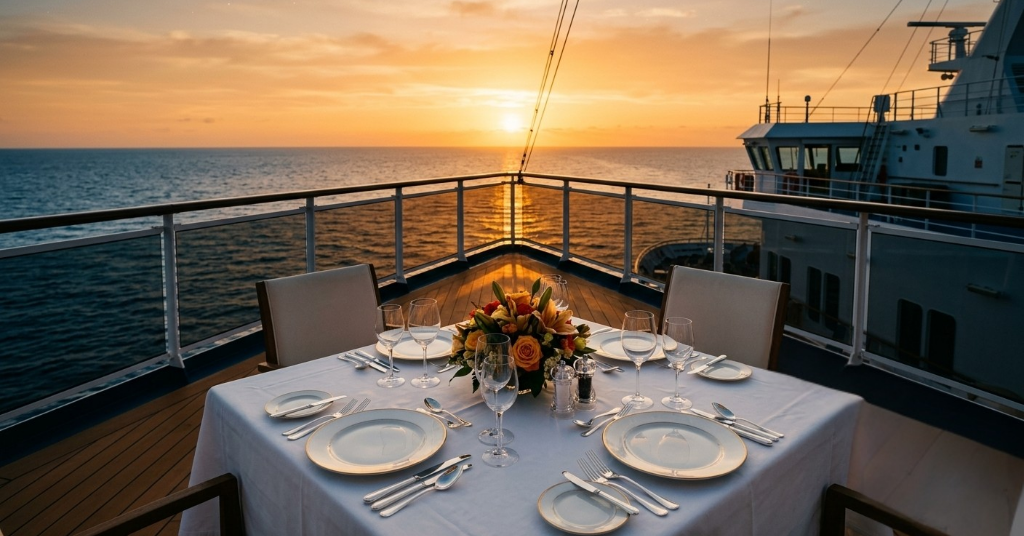
Table of Contents
Why Cruise Ship Tableware Procurement Is Different From Everything Else
All land-based challenges in tableware procurement apply to sea-based challenges and more! Before making any specification decisions, it’s important to recognize the unique nature of the cruise environment.
Constant Movement and Vibration
A cruise ship is always in motion. There’s the beating of the engines, swell, wind, and there’s always a bit of low-frequency movement even in calm waters. When the conditions are more onerous, the movement is noticeable. What may be on a land-based restaurant table will be able to move, tip, and fall off a moving ship. For cruise ship diners, the design of the cruise ship dinnerware should have a solid base and be well balanced to stand up to various sea conditions. This isn’t a task that can be handled by a typical restaurant plate. There are dedicated specifications of marine tableware for base stability, weights, and ratio of the rim-to-the-base with particular regard to shipboard applications.
SALT AIR & CORROSION
Marine corrosion happens at a more rapid rate than land-based corrosion. The chrome/silver plate on flatware inside the cruise ship cabin and the surfaces that are glazed, as well as the metallic finishes, are subject to an accelerated rate of Salt air attacks metallic finishes and glaze surfaces far faster than indoor restaurant environments ever would. For flatware, this makes the marine-grade stainless steel specification, NOT 18/10, the baseline of choice. The more highly fired ceramic dinnerware with non-porous surfaces withstand degradation from salt better than the lower-fired ceramic pieces with fine-grained porous glazes, which absorb moisture from salt degradation.
Scale of Service
Both Royal Caribbean and MSC Cruises cater to thousands of guests every day in various dining options. A huge cruise ship has a floating hotel complete with 5-12 restaurants, several bars, a 24/7 buffet, and room service in hundreds of cabins. To feed this size of operation, the total tableware inventory needs to be much greater than with most land-based properties of comparable guest numbers due to the longer and more complex recovery cycle between dishwashing and redistribution throughout multiple remote dining areas on several decks.
Supply Chain Isolation
This is the variable that makes all the procurement calculations different. A supplier can respond to an emergency reorder in days as long as it is on land. At sea, the next time you have the opportunity to get some supplies may be a few weeks out, the next port call, or the next contract. The need to provide a much larger opening inventory buffer, an accelerated replacement rate plan, and absolute confidence in the supplier’s pattern continuity plan over extended reorder cycles (which can be years on end) is the critical condition of cruise line tableware procurement. The problem with presentation inconsistency that arises with A cruise line that discovers mid-season its pattern has been discontinued faces a table inconsistency problem it cannot fix until the next refit.
Cruise Ship Dining Venues: The Right Material for Each
A large cruise ship has several dining areas, and the service, expectations, and tableware needs for each area differ. The most common and costly error when it comes to tableware for cruises is specifying one material for all venues. The following is the right specification by venue type.
Main Dining Room: Vitrified Porcelain
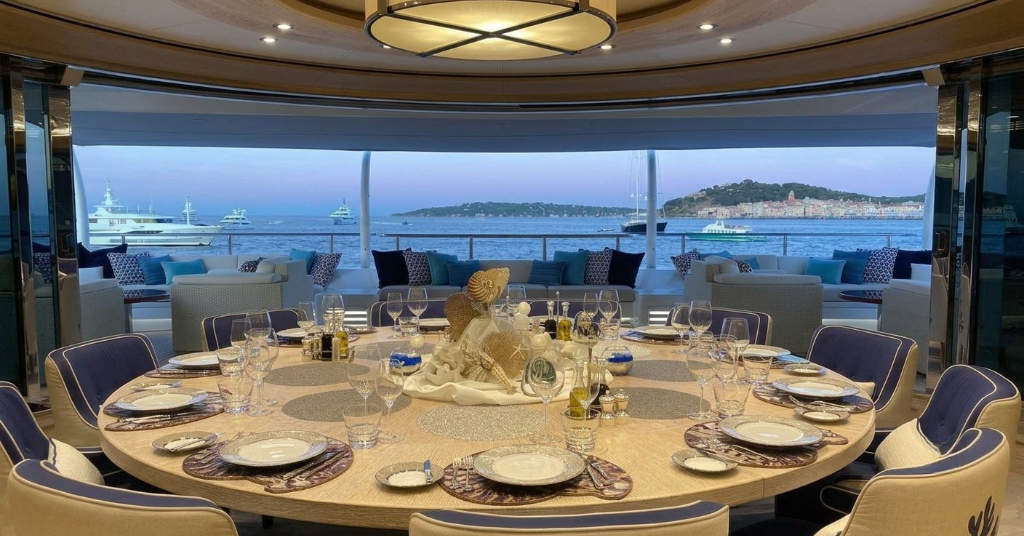
The cruise version of a hotel restaurant, the main dining room is high-volume, offers daily service, and has multiple sittings of commercial dishwasher cycles running. For the highest-volume operations, the correct specification is for the glass coating to be vitrified porcelain or alumina-reinforced porcelain. Vitrified porcelain, with a water absorption of less than 0.5%, is less vulnerable to glaze degradation and hygiene risks from continuous use in commercial dishwashers. A moving ship increases its speed with the stack and slide operation that causes the porcelain to break with ease, but this is not the case with strengthened porcelain, which has a higher edge impact resistance.
To specify for the main dining room, ask for ASTM C373 water absorption rate < 0.5%, edge impact resistance to DIN-EN-12980 from an accredited testing source, and dishwasher safety rating to 90°C. These are the same requirements as for Hotel Restaurant procurements – read our hotel tableware procurement checklist for the complete specification framework.
Specialty and Fine Dining Restaurants: Premium Porcelain or Glass
Specialty dining is available on luxury cruise lines, such as Ritz-Carlton Yacht Collection, Silversea, and Regent Seven Seas, which offer services on par with Michelin-starred onshore dining. If someone is paying for an ultra-luxury cruise experience, they expect to have a table that reflects that.
Glass dinner plates or bone china are the right specification for high-quality, specialty restaurants. Glass dinner plates offer colour depth and quality that porcelain can’t match, and are also more resistant to scratching by cutlery, as porcelain will develop a “grayness” to the metallic surface through repeated use with cutlery. Bone china’s degree of translucence and its relative lightness say luxury in a measured and controlled fine dining environment. Both work well in a specialty restaurant that serves anywhere from 60 to 80 covers at a time, but neither is suitable for a high-volume main dining service. For the full performance specification, have a look at our glass dinner plates guide.
Grey Cutlery Marks on Plates
This one sneaks in but is all-pervasive. Glazed porcelain gets marks on it from repeated contact with cutlery that cannot be removed by polishing; these are surface damage. A plate with any kind of cutlery on it appears dirty even after coming out of the dishwasher. Even if a plate is thoroughly clean, guests believe that it is a lack of cleanliness. The answer is glaze-hardened ceramics that do not exhibit this tendency for metal marking, or glass plates with a homogeneous surface that do not exhibit this tendency. To fix this problem altogether, refer to our glass dinner plates guide.
Buffet and Lido Deck: Strengthened Porcelain or Premium Melamine
The buffet is the highest-breakage environment on any cruise ship. The combination of self-service, constant handling by guests, hard floors, and the motion of the boat makes the standard porcelain specification truly cost-inefficient at scale.
Alumina-reinforced porcelain or commercial-grade melamine is the correct specification for buffet/lido deck service, depending on the location of the ship. In ultra-luxury lines, porcelain is even at the buffet (it’s the higher impact resistance of the porcelain that makes this possible). Commercial melamine is used in the buffet of mid-market and large-scale cruise companies; there is a significant reduction in breakage and the casual nature of the service call makes the visual trade-off acceptable.
When using melamine in a cruise buffet, the added requirement over land-based use is that the deck must be UV-resistant for lido deck service (when exposed directly to the sun) and that the buffet must be resistant to the sanitizing chemicals aboard ship.
Pool Deck and Outdoor Venues: Commercial Melamine
There is no ceramic specification that is economically suitable for a moving boat on an open-air pool deck. Hard outdoor surfaces, guest traffic, sea movement and exposure to salt air combine to cause breakage and degradation, which makes commercial melamine dinnerware the only viable specification for this environment.
Use commercial NSF-approved, BPA-free and UV-resistant melamine for outdoor cruise deck applications. The same specification requirements as for pool deck services in hotels also apply here, but with the added level of requirement for marine-grade material stability when exposed to salt air. For the complete specification framework, look at our guide to hotel melamine dinnerware, which is the same for use on a cruise deck.
In-Cabin Dining: Lightweight Vitrified Porcelain
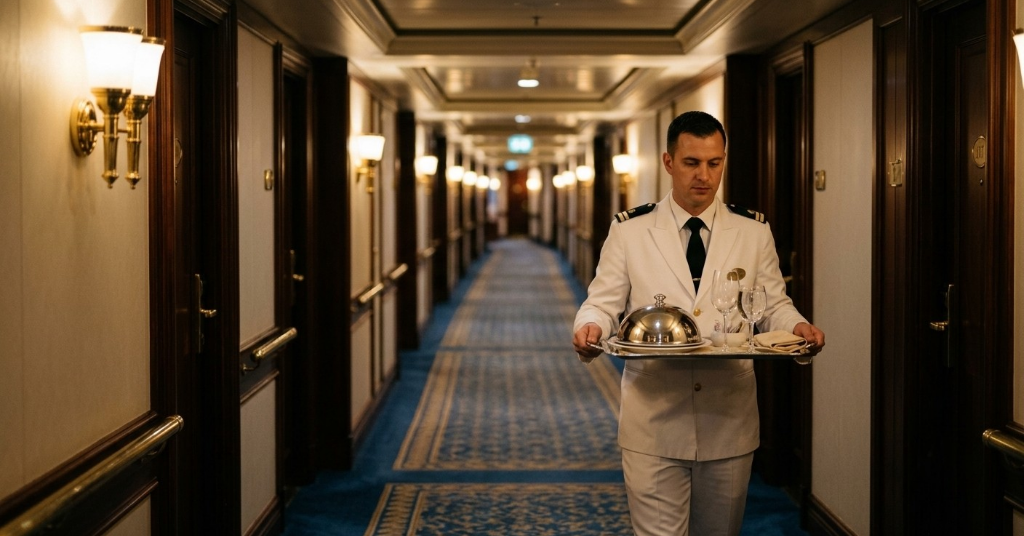
Cruise dining is similar to hotel room service in many ways: trays, covered plates, long corridor serving lines, and a slow turnaround. The main difference is that the corridors on a moving ship are not flat. While the base profiles of dinnerware for use inboard on a cruise ship need to be slightly more stable, it requires somewhat more rim weighting to provide for a reduced risk of tipping on a rolling dinner tray.
The correct specification is lightweight vitrified porcelain; it feels luxurious in a guest’s hands, but is not so heavy that it is impractical for trays in the cabin service room during movement. Here, standard hotel room service porcelain specifications are applicable and base stability is important in the selection of porcelain.
Planning Cruise Ship Tableware Inventory at Scale
Cruise ship dinnerware inventory calculation is similar to hotel tableware quantity calculation, except that the numbers are quite different and the supply chain isolation, which requires larger buffers than on land, does differ.
The 3:1 Rule Still Applies With a Larger Buffer
The standard 3:1 rule is used for the main dining room, with 3 plates per seat, one of which is actively in use, one is being washed and the third is in reserve. With no buffer, a main dining room that serves 800 people would need a minimum of 2,400 dinner plates.
The buffer percentage is the adjustment performed for the cruise. A buffer of 25-35% above the total is typical on land, to allow for annual breakage/replacement lead time. A ship at sea has a 40-50% opening buffer to consider – which means that the ship can provide full service throughout an entire sailing season without running out of stock before the next opening call.
Pattern Continuity Is Non-Negotiable
Pattern continuity is important for a hotel as it assures that the pieces of the pattern supplied are the same as the pieces issued at the beginning of the rotation. For a cruise ship, it’s a must.
If a cruise line finds mid-season that dinner plates that were sent out have been discontinued, or replacement plates are a slightly different white or a very slightly different rim profile, then the answer is to wait until the ship can return to home port to handle the situation. The lack of consistency is still on the table for the rest of this season’s sailing. It is for this reason that you should always ask a supplier for a written pattern continuity guarantee – they will ensure that the archive and production records are kept and that glaze formulas are not changed in any way, and that reordered pieces are the same as the originals.
Cruise Ship Dining Venue Specification Guide
Dining Venue | Recommended Material | Key Requirement | Buffer % |
Main dining room | Vitrified or strengthened porcelain | Water absorption below 0.5%, DIN-EN-12980 edge impact | 40-50% |
Specialty fine dining | Glass or bone china | Impact resistance ASTM C368, cutlery scratch resistance | 30-40% |
Buffet and lido deck | Strengthened porcelain or melamine | Impact resistance, UV stability for outdoor use | 40-50% |
Pool deck and outdoor | Commercial melamine only | NSF certified, BPA-free, UV resistant, marine-grade chemical resistance | 20-30% |
In-cabin dining | Lightweight vitrified porcelain | Stable base profile, tray-compatible weight | 35-45% |
How Brett Supports Cruise Line Tableware Procurement
Since 1998, Brett has been producing tableware for hotels in over 80 countries from our base in the tableware manufacturing hub of Chaozhou, China, in Dongguan, Guangdong Province we have our showroom and office. Our work spans Four Seasons, Shangri-La, Fairmont, Raffles, Wynn, Sheraton, Hyatt, Marriott, and Crowne Plaza properties, Michelin Guide and Black Pearl Restaurant Guide locations all throughout Europe, the USA and the Middle East — as well as cruise and yacht properties that demand the same high standards of specification.
Brett has the complete spectrum of materials needed by cruise line procurement teams for use throughout the ship’s dining facilities such as: vitrified and strengthened porcelain for use in the main dining rooms and cabins, glass dinner plates for premium specialty dining rooms, and commercial melamine for buffet and outdoor deck service. Pattern continuity is ensured across reorder cycles and all pieces are made to documented performance standards including FDA food contact, ISO 9001, ISO 22000, BSCI, and Sedex.
Brett’s OEM and ODM programme offers custom colour directions and logo placement, as well as signature edge profiles from 50 pieces per item, and allows cruise lines to create a unified, branded tableware identity from a single supplier in each dining venue. Brett’s dedicated account management helps to meet the procurement timeline for large opening inventory orders, across a wide array of material specifications for cruise operations.
FAQ
What makes cruise ship dinnerware different from hotel dinnerware?
Cruise ship dinnerware has to face problems that are not the same as those faced by hotels and restaurants. Stable, well-balanced designs are necessary for constant vessel movement, and salt air can wear out glazes and metal finishes. Deliverables of replacements are not available during a voyage and operators must also have higher stock buffers and have pattern continuity to ensure table settings are consistent throughout the sailing season.
What material is used for cruise ship dinnerware?
The material of the dinnerware is dependent on the place in which it will be used. Vitrified or alumina-strengthened porcelain is usually the option for main dining rooms, and bone china or glass is the choice for fine dining restaurants. Buffet areas are made from strengthened porcelain or commercial melamine, while pool decks are made from melamine for safety. For the room service, lightweight vitrified porcelain is typically used.
How much extra inventory should a cruise ship carry as a buffer?
Cruise ships need to have 40-50% more dinnerware than is needed. The larger buffer protects against losses, wear and tear during the voyage or sailing season when replacements may not be on hand.
Why is pattern continuity so critical for cruise ships?
Replacement pieces must be identical to the original dinnerware. Colour, shape, or finish variations can cause the dining appearance to be inconsistent for the remainder of the season, and it is important to have pattern availability for the long-term.
Can cruise ship tableware be customised with the cruise line's brand?
Yes. Tableware for a cruise ship can be designed, printed and customized with logos, colors and special designs in porcelain, glass and melamine. This ensures that all the dining establishments on board have a uniform look and feel.
What certifications should cruise ship dinnerware carry?
Tableware for use on cruise ships must comply with FDA and EU 1935/2004 food contact requirements. ISO 9001, 22000, 14001, BSCI, and Sedex are common supplier certifications, and commercial melamine products are recommended to be NSF certified.
What certifications should cruise ship dinnerware carry?
At a minimum: FDA food contact compliance and EU Regulation 1935/2004 for food safety. ISO 9001 and ISO 22000 for quality and food safety management. NSF certification for melamine applications. For cruise lines with environmental and social compliance reporting requirements, ISO 14001, BSCI and Sedex certification from the supplier is increasingly required. Request all documentation before production begins, not after delivery.
Conclusion
Cruise ship tableware is one of the most demanding tableware environments in the world. This motion, scale, salt air, and isolation of the supply chain make it difficult to implement land-based specification frameworks alone. Cruise ship dinnerware is a case in point: the perfect material for a 3,000-passenger vessel isn’t necessarily the same one for a luxury yacht, and likewise, the ideal specification of a luxury cruise collection isn’t the right one for a cruise ship. It necessitates the opening of inventory buffers, not just a normal annual turnover, but the total sailing season. It also calls for complete confidence in a supplier’s pattern continuity guarantee, since when you’re out to sea, you don’t call your supplier to have them fix it.
If you would like the full framework of the procurement specification, please view our hotel tableware procurement checklist, which contains all principles, and only the changes to these principles for the marine environment are discussed in this guide. Get your personalized cruise ship tableware quote, catalogs, and samples from Brett. For more details, please contact us today at cbhoreca.