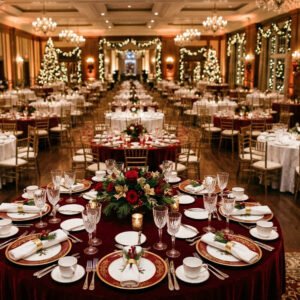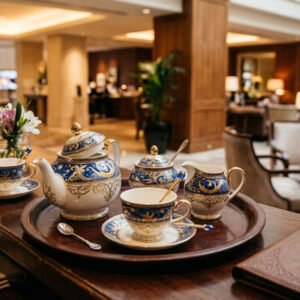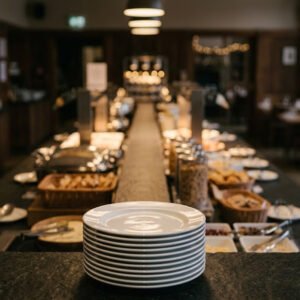
The quality of your hotel’s dining experience is decided at the time you select your tableware supplier — and that’s something most procurement managers find out too late.
The bulk of the world’s porcelain, bone china and stoneware is made in China. For decades, the manufacturing areas of Chaozhou and Jingdezhen have been providing international hotel markets, and it is no surprise. The scale, specialization and chain of supply simply don’t exist anywhere else at similar price points.
However, when you buy hotel tableware from China, without a systematic approach, you will have the same problems every time – samples look great, but then the bulk orders don’t; certifications don’t hold up to scrutiny; replacement goods don’t match the originals; and supplier relations go great until there is a single quality problem.
This guide covers how to get it right the first time.
Table of Contents
Why China Leads Global Hotel Tableware Production
China produces over 60 percent of the world’s hotel grade ceramics. That dominance isn’t marketing; it’s decades of investment in special manufacturing facilities, facilities that are not found elsewhere.
There are hundreds of manufacturers specializing in the manufacture of commercial-grade hotel tableware for export, all within the Chaozhou area in Guangdong Province. All the raw material suppliers, the technology providers for the kilns and the export logistics infrastructure are in one ecosystem. When you purchase hotel tableware from China, you are not only getting products, you are getting a supply chain that has been created specifically for the hotel tableware industry for over 30 years.
In 2026, the global kitchenware market was valued at over $79 billion, and is projected to expand at a rate of more than 4 percent per year. That demand comes from over 100 countries, and is met by Chinese manufacturers in more than half. For international hotel procurement teams, it was a no-brainer whether to source from China. How to do it well was always the question.
The Manufacturing Regions You Need to Know
Chaozhou — Where Most Hotel Tableware Comes From
If you are looking for commercial grade hotel porcelain or bone china, then the trail goes to Chaozhou. This province capital is often coined the Porcelain Capital of China and it is not wrongly named. Not only is it home to a high concentration of manufacturers, but it also has access to raw materials, as well as export infrastructure, making it the go-to sourcing location for serious hotel procurement buyers.
Chaozhou manufacturers come in all sizes and include both those with large production lines capable of millions of pieces a year and smaller specialists making premium custom programs. The first choice in any sourcing program is to determine which type will meet your hotel’s needs.
Jingdezhen — For Premium and Artisan Specifications
It has been more than 1,000 years since the ceramics industry has been established in Jingdezhen. Commercial volume is dominated by Chaozhou, but Jingdezhen is the source of choice for high-end hotel tableware specifications, especially kiln change ceramics and reactive glazes and those where the artisan aesthetic quality is the main requirement. When differentiation is more important than price, luxury boutique hotels and high-end resort dining programs often turn to Jingdezhen for their source.
Dehua — For Refined White and Bone China
Dehua, Fujian Province is the center of high-quality white porcelain and bone china of outstanding translucency. Dehua offers properties the luxury feel they are looking for in fine dining, but without the custom-made production.
Certifications — What to Verify and Why It Matters
A supplier claiming to hold certifications and a supplier who can produce current verified certificates from accredited bodies are not the same thing.
This is what you need to see, not in claims but in writing:
Certification | What It Actually Means | How to Check |
ISO 9001 | The manufacturer has a documented quality management system — production is consistent, not luck | Request the certificate document. Check the certification body name and expiry date |
FDA | Products meet US food contact safety standards — essential for US and many international markets | Ask for product-level test reports, not just facility registration |
BSCI / Sedex | Factory has been audited for worker welfare, labour standards and supply chain ethics | Request the most recent audit report — not the certificate alone |
ISO 14001 | Environmental management system — increasingly required for ESG-committed hotel groups | Verify certificate validity and the scope of certification |
ISO 22000 | Food safety management — important for any food contact product | Confirms food-safe production environment |
An important reminder: certificates should always be requested as documents, not photos. Verify the name of the certification body, the scope of certification and the expiration date. An expired certificate, even by a few months, is a red flag that the quality system has not been maintained and is an important factor in your procurement decision.
How to Evaluate a Supplier Before Committing
The manufacturer behind your hotel tableware matters as much as the tableware itself. Here is what separates reliable suppliers from those who perform well on samples but struggle with consistency.
Are They Actually a Manufacturer?
This sounds obvious. It is not. There are a lot of apparent manufacturers that are swapping companies that come from several unconfirmed factories. They can take you on a video call to a facility that they are not the owner or operator of. When you can’t go in person, ask for an independent audit and/or require factory verification to be a part of your purchasing process. A trading company is not able to assure that the validity of the certification will be maintained over a series of production runs and that there will be batch consistency and quality control.
How Long Have They Been Exporting Internationally?
A manufacturer who has served international hotel markets for 10 years or more has successfully dealt with the certification requirements, lead time expectations and quality demands of commercial hotel procurement — consistently. Their performance history is the best indicator of what they will do in the future. Request reference contacts from international hotel operators or distributors and follow up on these contacts.
Can They Handle Custom Specifications?
If a hotel is creating a signature table identity – a unique color of glaze, tableware with a brand name, unique shapes, etc. – then OEM and ODM are not just a service they can use, it’s a major component of what they’re doing. Request to view samples of custom programs for other clients. A manufacturer who has the capability to design and develop will demonstrate their process. One treating customization as an afterthought will show you a catalog.
How Fast Do They Respond?
Hotel sustainability commitments are increasingly extending to supply chain documentation. BSCI and Sedex certifications validate social compliance and ethical manufacturing processes along the supply chain, including the standards of labour and welfare of workers, and supply chain transparency that is now normal in hotel procurement.
The Sample Evaluation Process Most Buyers Rush
All serious manufacturers will send samples before bulk production. The mistake most hotel procurement teams make is evaluating those samples against aesthetics rather than performance. Expensive lessons are beautiful samples that can’t go through commercial hotel service.
So what to test, really:
- Treat all pieces like a server would. You can tell at a glance if the product is intended to be served or displayed by the weight distribution of dinner plates and the stability and balance of the flatware.
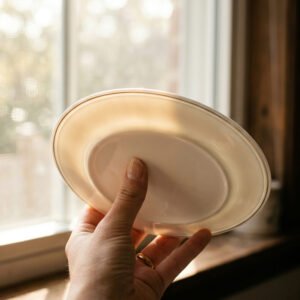
- Look at glazes with strong light at various angles. Check for pinholing, crawling, crazing or uneven coverage. These defects are much more noticeable after 20 commercial dishwasher cycles.
- Circulate finger around each edge. Roughness and sharp edges or profile inconsistencies are quality control indicators – and direct indicators of increased breakage in service.
- Test a few samples in at least 10 commercial dishwashers before choosing. Inspect the glaze surface, color stability and cracking. What survives 10 cycles will give you confidence about 1,000.
- Drop a plate from table height onto a hard floor. This is not an act of courage or drama — it’s a common commercial durability test. Retail grade ceramics fail it. Commercial grade ceramics pass it.
Batch Consistency — The Criterion That Saves Relationships
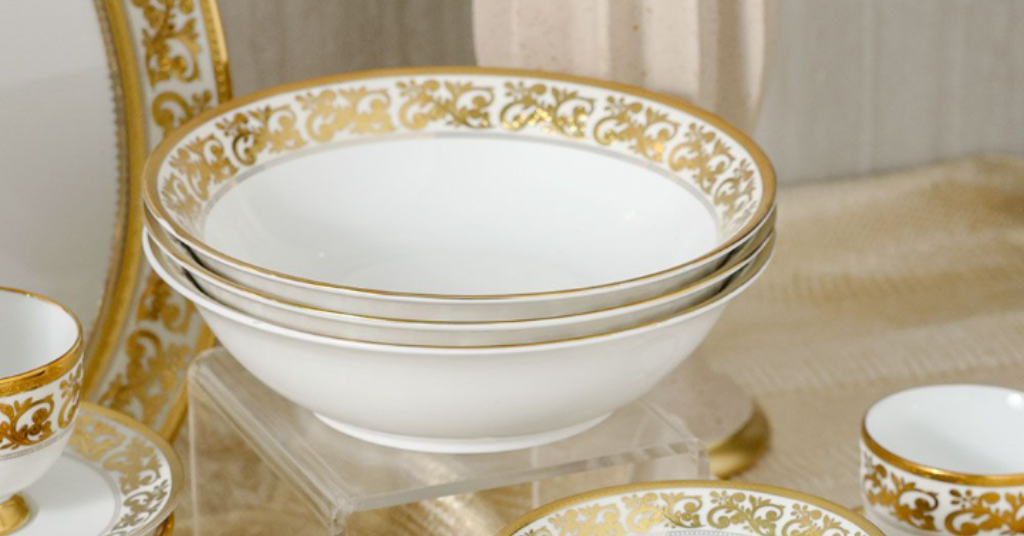
If you ask any F&B Director with experience what their biggest tableware frustration is, it will be in a matter of minutes that they will say batch consistency. It means whether replacement pieces (ordered a few months or years after originals) are close enough to match the opening inventory to be undetectable at the table.
This is possible with normal white porcelain. It’s really challenging in earth tone stoneware, or when the stoneware is naturally colored with variation, as is the case with reactive glazes and kiln change ceramics. If a manufacturer doesn’t have a system for batch records, they are sure to provide replacements that don’t match your original inventory. At any 30-cover boutique hotel table, a slightly different terracotta glaze is readily apparent to every guest.
Prior to ordering, ask the supplier: do you have batch records of active client specifications? Request to see a sample (if needed, anonymized). A credible manufacturer is accustomed to keeping these records and is not hesitant to share them. The person who can’t or won’t is telling you something important about how he or she will deal with your replacement orders in 3 years.
MOQ Planning Done Right
The amount of hotel tableware from China varies greatly depending on the minimum order quantity. This is important to get right before you start talking to suppliers to avoid negotiating with manufacturers that have different minimums than your program.
Standard Catalog Specifications
Most of the established manufacturers in Chaozhou have standard specifications and the MOQ is from 500 to 1,000 pieces per SKU. These minimums are suitable for hotel operators who are using pre-existing designs and glazes, and are applicable to hotel properties with 50 covers or more.
Custom OEM Programs
Custom specifications are those with unique colors, designs, proprietary shapes, etc. and require higher minimums to cover the cost of tooling and development. 1,000 to 3,000 pieces per SKU (depending on complexity of specification). When hotel groups are purchasing custom tableware for multiple properties, consolidating orders across properties will greatly ease the per-property load.
Five Mistakes That Cost Hotel Buyers the Most
1. Treating Sample Quality as a Bulk Production Guarantee
Sample production is carefully monitored and well controlled. The dynamics of bulk production are different. When considering full production never accept a design sample, always ask for a pre-production bulk sample. One step will resolve most of the quality drift problems before they become costly.
2. Skipping Supplier Verification
If you work with a trading company that buys from various factories that haven’t been verified, you won’t be able to connect with the people that actually make your tableware. Validity of certification, batch consistency and quality control cannot be guaranteed. Check that they are using the manufacturer or that a trading company has a proven and audited link with a specific certified factory.
3. Ignoring Lead Times Until It Is Too Late
In China, the normal period for standard tableware to be manufactured and delivered to port from the moment it is ordered is 45-90 days. If custom OEM specification is desired, it increases the time for tooling and development by 30 to 60 days. Hotels planning opening programs that treat lead times as negotiable variables pay for it in rush premiums and quality compromises.
4. Not Planning for Replacement Procurement
A tableware program that lacks a replacement procurement plan is only a crisis away from table inconsistencies showing. When placing your first order, create batch records, agreed re-order specifications and a designated replacement process — not when you need the first replacement pieces.
5. Optimizing for Unit Price Instead of Cost Per Use
Whole of chain appearance of retail grade tableware that retails at 40 percent less than the commercial grade seems like good procurement. It is not. Commercial grade alternatives offer replacement cycle of 3 to 4 times longer than retail grade alternatives in a commercial hotel service. Calculate cost per use across a three year procurement cycle and the commercial grade option wins decisively every time.
How Brett Supports International Hotel Procurement
For more than 20 years, we have been exporting tableware to the hospitality industry in hotels in more than 80 countries from our manufacturing base in Chaozhou. We have collaborated with boutique hotels launching their first dining program as well as with the hotel groups with tableware procurement in several hundred properties. The questions are always the same. The key elements to the answers are specification, verification and planning.
We deliver all the tools a serious hotel procurement needs:
- Hotel-grade porcelain dinnerwareand bone china dinnerware — ISO 9001 certified, FDA compliant, BSCI and Sedex audited, with documented commercial durability specifications
- Stoneware dinnerware— commercial-grade earth tone specifications including kiln change ceramics with batch consistency records maintained for all active specifications
- Custom ceramic dinnerware— full OEM and ODM capability for hotels developing exclusive table identities that cannot be replicated anywhere else
- 18/10 stainless steel flatware— commercial hotel grade, corrosion resistant, with full certification documentation
- Commercial glass drinkware— hotel service specifications including ribbed and textured options
All Brett products are certified to BSCI, Sedex, FDA, ISO 9001, ISO 22000, ISO 14001, Global Recycled Standard and Recycled 100 Claim Standard. Full documentation is available on request.
FAQ
Why do most hotels source tableware from China?
There is no other manufacturing area that’s as large, specialized, and cheap. China’s ceramics manufacturing areas, especially Chaozhou, have 30 years of investment in the hotel grade production infrastructure. For hotel operators procuring commercial grade porcelain at scale, sourcing from China is not a compromise. It is the obvious choice when approached correctly.
What certificates should be demanded by a Chinese hotel tableware supplier?
The minimum standards are: ISO 9001 (quality management) and FDA (food contact safety) compliance and BSCI/Sedex (social compliance). For properties where there are ESG requirements for procurement, ISO 14001 environmental management is also relevant. Always ask for the latest certificate as a document rather than a photo/website statement and check the certification body and expiry date separately.
What is the time frame for hotel table ware ordering from China?
In the usual course of business, the standard delivery terms and conditions to port are 45 to 90 days from order confirmation. There is an additional 30 – 60 days for custom OEM specifications for tooling and development. Integrate these timelines into a project plan from the beginning. Emergency production is possible but it comes with quality risks and premiums that are avoided when planning in advance with a well-experienced procurement team.
How many pieces of china tableware am I expecting to receive for my hotel order from China?
Regular specifications: 500 to 1000 pieces per SKU from trusted manufacturers. Custom OEM programs: 1,000-3,000 pieces per SKU depending on the specification complexity. For small properties and boutique hotels, a realistic solution is to collaborate with manufacturers that offer flexible MOQ programs for independent operators – not with manufacturers that have minimum order quantities set for chain scale procurement programs.
How to make replacement orders consistent?
Set the batch consistency requirement when you place the first order. Request your supplier to keep production batch records of your specification (glaze colour parameters, firing specifications and raw material lot numbers). Maintain a collection of approved opening samples (as physical reference standards). As a result, a manufacturer that cannot guarantee this process is not a good fit for any hotel tableware program where there is a need for uniformity in the dining room.
Conclusion
One of the most sure-fire purchases a hotel operator can make is to source their table ware from China. When done wrong, it can become one of the most frustrating, and, over time, quality inconsistencies and gaps in certification along with the matching of batches.
The two different results are a matter of choices that are made prior to placing the initial order. Verify your supplier. Test samples correctly. Start batch records from the outset. Be prepared for replacements in advance. Compute the cost per use, not cost per piece.
Hotels that do this establish their tables well on opening day — and three years later look exactly the same.
Get exclusive hotel tableware quotes, catalogs and samples from Brett. Please reach out to us if you have any questions or concerns, Contact us today at chinabrett.