If you’ve ever tried sourcing custom ceramic dinnerware, you’ve probably had this moment where you ask for 200 plates, and the supplier comes back with an offer of a minimum of 2,000.
Although it feels like the number has come out of the blue, it really hasn’t.
Dinnerware minimum order quantity is a complicated concept. However, while we see the numbers, the logic is well hidden beneath the surface. Unfortunately, most suppliers and the internet don’t talk about it much.
Even if you look up MOQs, you find endless product grids and listings, but no explanation about why these MOQs exist and how to work around them. That’s just what we will cover in this article.
MOQs are all about physics and production economics.
What Does MOQ Actually Mean in Ceramic Manufacturing?
To understand what MOQs mean, we need to understand the production process.
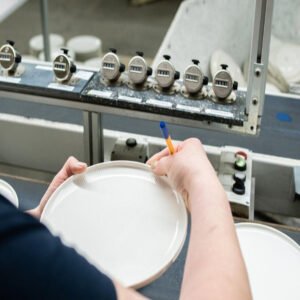
In a ceramic producing factory, kilns fire plates, glaze lines switch colors, and molds? These are spread across the total output.
None of these processes can be viably done for a single individual plate. All of these have upfront costs that need to be spread across volume.
As per the industry discussions published in the Journal of the European Ceramic Society and industry trade insights, ceramic manufacturing is organized around batch processing. The materials are prepared, formed, and fired in controlled production runs rather than individual units.
But before you write off the 2,000-piece MOQ, considering it unreasonable, we’ll help you understand what the numbers actually mean. On paper, MOQ (minimum order quantity) is simply the smallest number of units a manufacturer produces in one run. Whereas, in reality, it is layered, conditional, and rarely ever a single number.
What Does MOQ Actually Mean in Ceramic Manufacturing?
In custom dinnerware production, the MOQ exists in three distinct forms. So if a supplier tells you their MOQ is 1,000 pieces, your question should be, “1,000 of what?”
MOQ Per SKU
Most buyers think they are negotiating on the MOQ per SKU. However, an SKU-level MOQ represents a specific product configuration. Like, say a 12-inch dinner plate or matte ivory glaze. Each variation means a new SKU with mold preparation/adjustment, glaze calibration, and production line setup, aka new costs for the manufacturer.
MOQ Per Color / Decal / Finish
If you’re placing the order for, say, 1,000 plates, but in four glaze variations and with two different logo placements, the math will change. In real terms, you are ordering 6 micro batches instead. Each one has to meet their own minimum threshold.
This is because the glaze lines may have to be cleaned between the colors, it may require separate screens or transfers, and consistent firing for every finish.
So more variations automatically means higher MOQs.
MOQ Per Total Order
Since the clients are mostly concerned about the MOQs per SKU, the suppliers are concerned with the MOQ per total order. Factories need this total order MOQ to justify their raw material batching, kiln loading efficiency, and labor allocation across the production.
Although most suppliers will allow you to mix items, they will require a minimum order quantity or certain units.
MOQ Ranges by Product Type (And Why They Vary So Much)
Once you understand how MOQ behaves across different levels of customization, you will stop asking why it is so high. Instead, you will begin to ask the right questions, such as: What exactly am I asking the factory to do?
MOQ Benchmarks for Ceramic Dinnerware
Product Type | MOQ Range | Key Reasons |
Stock or Blank Ceramic (existing molds and standard glaze) | 50–500 pieces | No tooling required. It has a minimal setup and is often pulled from existing production lines. |
Custom Logos (decal or pad print) | 500–2,000 pieces per design | Separate printing screens are needed. Also requires firing consistency and batch decal application |
Custom Shape (new mold or OEM) | 3,000–10,000+ pieces | Requires mold creation, prototyping, and production calibration. |
Custom Glaze Color or Reactive Finish | 1,000–5,000 pieces per color | Needs glaze mixing, line cleaning, and firing consistency. |
Bone China Custom Dinnerware | Higher than standard ceramics | Custom bone china has a complex composition. It requires stricter firing control and has a higher rejection risk. |
Stock / Blank Ceramic
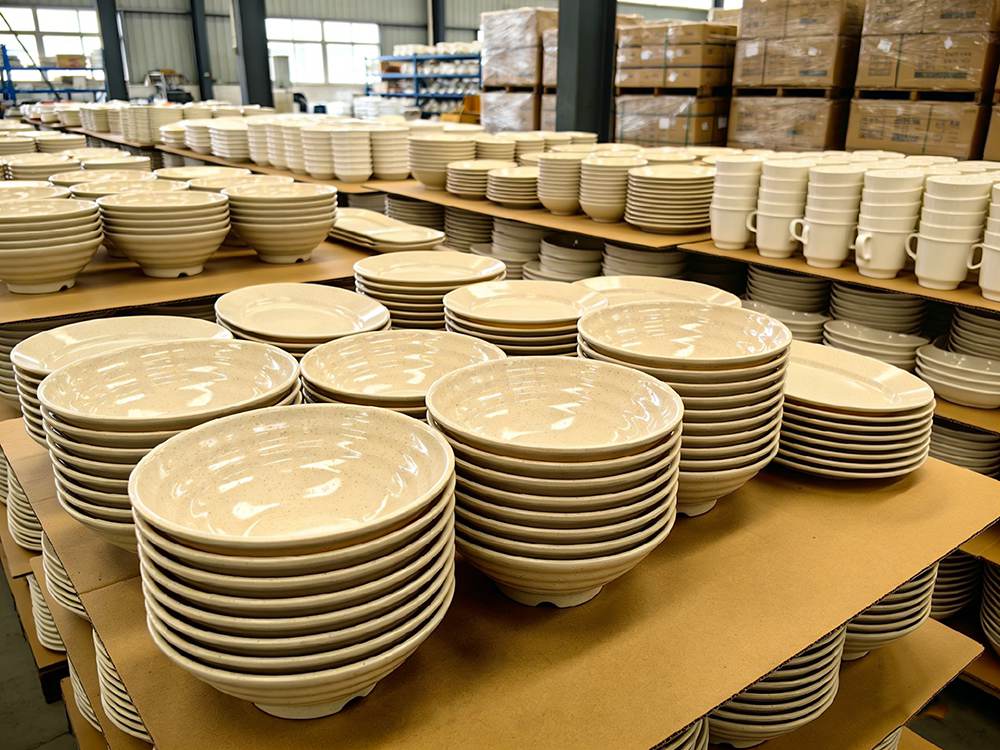
This is the only scenario where the 50-500 MOQ is reasonable. This is because the factory already has existing molds. The glazes, too, are standardized and are being used in ongoing production runs.
It is almost as if you are ‘piggybacking’ on an existing system. This is why many suppliers offer flexibility and allow mixing SKUs to achieve the total order threshold.
Custom Logo
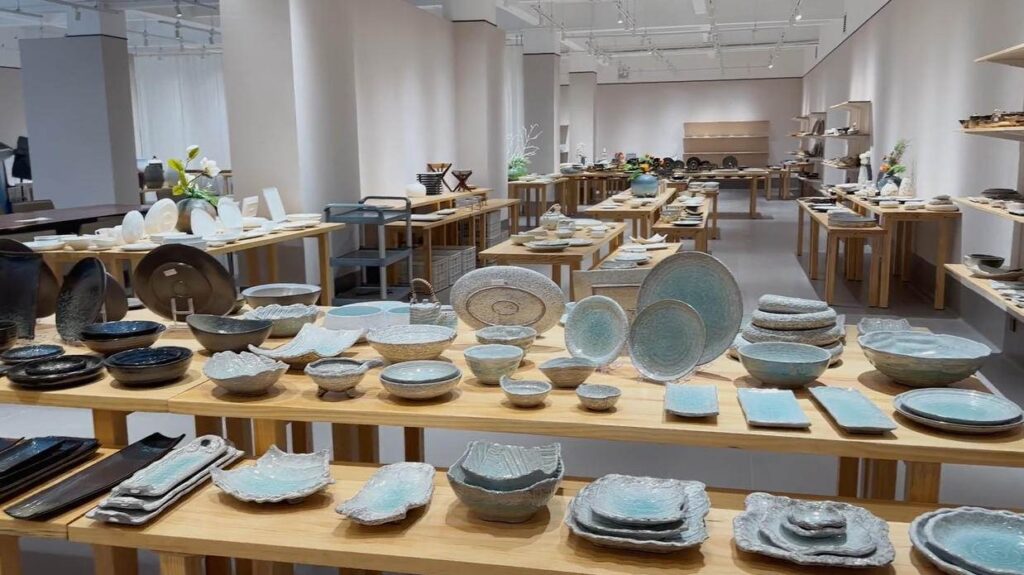
For customized orders, most suppliers allow MOQs of around 500-2000 pieces. This is because adding logos is not as simple. Logo placement requires decal production or pad printing setup with alignment precision across batches.
At times, additional firing cycles are required to fix the design into the glaze. Consistency is the key here. Even a slight shift in the placement across batches leads to rejected batches, so suppliers like Brett enforce strict application templates and quality checks during production.
Custom Shape
Creating a new shape in ceramics may get you an MOQ between 3,000 and 10,000 pieces. This is because it requires a new mold design and fabrication that can cost hundreds to thousands of dollars.
There are iterations to the prototype and structural testing as well that add to the costs.
So the OEM production comes at a much higher cost, and the order has to absorb all these fixed costs to be accepted.
Custom Glaze Color
Most people do not expect much change in the MOQ when they ask for different colors. But from the manufacturer’s perspective, it means new glazes that have to be mixed in batches, differences in kiln firing, and also the production lines’ cleaning between colors.
Learn more about the process in our guide: Why Does Glaze Change Color in the Kiln?
So we are looking at MOQs around 1,000 to 5,000 pieces.
Bone China
Bone China is all about beauty. It is lightweight and durable as well, the two qualities that make it slightly terrifying from the production point of view.
As compared to standard stoneware and porcelain, bone china requires tighter firing tolerances. Read more about the differences between porcelain and bone china here: Bone China vs Porcelain Dinnerware.
So suppliers enforce higher MOQs for bone china, especially for custom designs.
Compliance Matters
The ceramic industry isn’t just about aesthetics. It is highly regulated. There are strict standards from the U.S. Food and Drug Administration, falling under food-contact materials guidance and EU frameworks such as EU Regulation 1935/2004, that require lead and cadmium migration testing, consistent glaze formulation, and batch traceability.
Large and controlled production batches ensure consistency that passes the compliance tests. So that’s another subtle reason why factories push for high MOQs for custom work.
Why MOQs Exist: The Real Cost Drivers
The truth about dinnerware minimum order quantity is that it is how the factory protects itself from inefficiencies at every stage of production.
In ceramic manufacturing, unlike apparel or simple assembly, the stages are tightly linked. The kiln firing stage, for one, is one of the most important stages in the manufacturing process. The kiln has to run no matter whether it is full or half-empty.
It will still consume the same energy levels whether it’s firing 500 plates or 1,000. So manufacturers are just doubling the cost per unit when they’re running on low capacity. That’s why they often align their MOQ with the kiln load.
Asking for an entirely new custom-designed plate, bowl, or cup will require mold fabrication and prototype testing. The cost again exists whether the order is for 300 units or 30,000 units. The manufacturers amortize this cost over the volume.
Then, different decoration methods such as decal transfer, pad printing, or hand-applied design require separate setup processes, alignment calibration, and firing cycles. For each variation, there’s a separate production run. That calls for a higher MOQ per design.
So, MOQs exist because every step in ceramic manufacturing has a minimum efficient scale. When you understand the cost drivers, you shape your order around them, which can give you more favorable MOQs.
How to Negotiate Lower MOQs
MOQs cannot be negotiated in the true sense. It is engineered around the production system. Most factories or manufacturers actually manage to lower their MOQs when you help reduce friction in their production system, rather than by asking them nicely.
So, the best strategy is to restructure your order so the factory doesn’t have to take on extra cost or complexity. Here’s how procurement teams negotiate lower MOQs.
Combine SKUs Into One Production Run
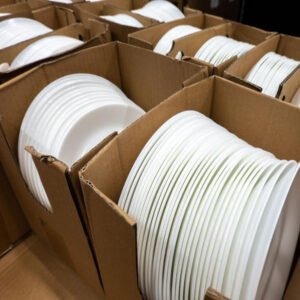
Instead of asking for 6 SKUs with 500 units each, call for 1 production run for 3,000 units. Then, after production, split the quantity into variations.
This will allow the kilns to run at full capacity, where labor will be scheduled only once, not six times. Most manufacturers strongly prefer this method as it aligns with their existing production structure.
Use Stock Shapes and Custom Decals
If you want a lower MOQ, do not reinvent the plate. Use existing molds and apply custom branding via decals or pad printing onto them. This will help avoid tooling costs, delays of mold setup, and the supplier will also be willing to drop MOQs because the product already exists. They will just charge you for the surface-level decor.
In fact, many suppliers serving hospitality lines routinely push clients towards semi-custom ranges, as that’s a win-win for both.
Trade Lead Time for Lower MOQ
Factories are operating on production scheduling windows, labor planning, and kiln cycles. If you tell them you have the time and can wait for the stock, you offer them production flexibility. This lowers the scheduling pressure on them.
This way, they often willingly accept lower MOQs or offer favorable pricing tiers.
Sample Orders That Become Pilot Runs
Another thing you can try is instead of going for one large-scale production order, ask for a 100-300 unit pilot batch. Test the quality, finish, and durability of the set. Run them through your daily cycles and then scale to repeat production.
Most suppliers are more flexible when the risk is low. With sample orders, the QC uncertainty is reduced, and rejection risk runs low. They also establish trust in your brand.
MOQ Considerations for Different Buyer Types
The thing about MOQs is that there isn’t a universal number that can be assigned to every buyer. A boutique hotel ordering signature tableware has different requirements than a multinational hospitality group.
Every concept has unique capacities and requirements.
- Boutique Hotels and Concept Properties: The boutique hotels look for aesthetics and unique elements in their dinnerware that tell their brand story. Most of these are running on limited storage and also have a smaller dining volume. So they usually go with stock shapes with custom decals or mixed-SKU consolidated runs.
- Restaurant Chains: Restaurant environments require durable dinnerware. The focus is on a simplified design that performs efficiently and reduces the replacement cycles. Since demand is repeated and predictable, fewer SKUs with high volume per SKU and consolidated ordering cycles work for them.
- Catering Companies: In the catering business, we are looking at durable and portable dinnerware. The best fit strategy is to order standardized base sets, with minimal customization. The core inventory should be simple enough to replicate easily in the future.
- Large Hospitality Groups/Multi-Property Chains: Since large hospitality groups deal with multiple properties where procurement is centralized, brand consistency matters. SKUs must be consolidated across properties, and procurement cycles synced.
Dinnerware MOQ Is Built Into the Kiln
MOQ is how ceramic production actually works. Kilns don’t fire on demand, molds don’t amortize themselves, and glaze chemistry doesn’t scale per order. Dinnerware minimum order quantity isn’t a barrier, but a manufacturing fingerprint.
As a buyer, it is best not to fight the MOQ. Instead, design your procurement strategy around it. Brett can help you structure your orders with real factory workflows.
FAQ
1. Can I order custom ceramic plates in small quantities?
Yes, ordering custom ceramic plates in small quantities is possible when manufacturers use existing molds with no structural changes in the order. Fully custom shapes or new glaze systems, however, require higher MOQs due to production setup costs and batch firing.
2. Why do ceramic manufacturers require high minimums?
Ceramic production is batch-based. Kilns consume about the same energy whether full or partially loaded, molds require amortization across volume, and glaze and firing processes depend on controlled batch consistency.
Larger production runs make it easier to maintain consistency and to pass compliance testing.
3. How much does a custom dinnerware mold cost?
Custom ceramic molds can cost you from a few hundred to several thousand USD, depending on the complexity, size, and material.
The cost is spread across the production volume, which is why low-quantity orders can increase per-unit pricing in OEM ceramic manufacturing.
4. Is MOQ negotiable with overseas suppliers?
Yes. But most suppliers would not lower the MOQ right away. But they may offer flexibility for first-time buyers, long-term partnerships, or mixed-product orders.
You can also negotiate through options like accepting existing molds instead of custom ones, choosing standard glazes, or agreeing to slightly higher unit pricing for lower quantities.