A guest just ordered your most expensive Burgundy.
Your servers move in, just as they’ve been trained to, and present the bottle, label forward. On approval, the tumblers arrive polished, but thick-rimmed and heavier than usual. The wine is poured in, and the guest lifts the glass. Just one sip and they notice the thick rim, the tight bowl, and the aroma of the layered notes of Burgundy that never comes. And that just kills the whole experience.
Here, every part of the service was elegant and carried to perfection, except the part that mattered most: the glassware.
Unfortunately, this is where most restaurants and fine dining concepts fall short. Wine glasses for restaurants aren’t just a tabletop accessory; they can alter the whole experience from the way the wine tastes, feels, or even smells.
The bowl width controls the oxygen exposure or aroma, the rim changes the entire way the wine feels on the palate, and so even the rarest Burgundy can fall flat when served in the wrong glass. In this guide, we will talk about what actually matters in glassware, including the material, shape, and type, along with how to control breakage and the number of glasses you need for your concept.
Wine Glass Types for Restaurant Programs
Glass Type | Best For | Operational Strength | Maintenance | Breakage | Procurement Notes |
Universal (Crystalline) | Full-service restaurants | Suits most of the wine-by-the-glass programs | Dishwasher-safe | Manageable with proper racks | Ideal core inventory for bulk wine glasses for restaurants |
Red Bordeaux/ Burgundy style | Wine-forward concepts | Larger bowl supports aeration | Dishwasher-safe | High risk due to size | Buy only if the wine list depth justifies expansion |
White Wine Glass | Seafood-heavy or white-dominant menus | Small bowl preserves temperature and aroma | Dishwasher-safe | Moderate risk | Core inventory if using a well-designed universal stem |
Champagne Flute | Restaurants serving sparkling wine | Preserves carbonation and uplifts presentation | Dishwasher-safe | The tall profile increases handling risk | Specialty glass most programs need |
Stemless Wine Glass | Casual, fine-casual concepts | Stackable, low breakage | Dishwasher-safe | no stem, low risk | best for a relaxed service style |
Crystal (Leaded) | Fine dining with trained staff | Ultra-thin rim | Requires controlled washing | Highly fragile | Best for low-volume, high-touch programs |
Crystalline (Lead-Free Crystal) | Modern restaurants | Clear with thin rims | Commercial dishwasher compatible | Low risk of breakage | Ideal for hospitality stemware |
Tempered Glass | High-volume and institutional use | Impact- resistant | Dishwasher-safe | Shatters under stress | Useful in banquet-heavy environments
|
Glass vs Crystal vs Crystalline: Which Material Grade Belongs in Your Restaurant?
When you’re looking for commercial wine glasses, the choice of material isn’t a style decision only. These glasses won’t be up for display, but will carry the serving itself. So the choice of material, type, and size all matter.
Standard Glass
Also known as the Soda-Lime Glass, this is the workhorse of the industry. The standard glass is non-porous, completely dishwasher-safe, and hence the most widely used glassware in high-volume venues. Another advantage is that it comes with an affordable price tag.
It’s a high-quality commercial glass and can withstand up to 1,000 dishwasher cycles under proper handling conditions.
However, there are trade-offs with this style, such as thicker rims, added weight, and low brilliance. Think of it more like a convenient but less glamorous option in your serveware.
Learn more in our guide: Commercial Glassware Selection.
Crystal
Traditional crystal material contains lead oxide. The lead composition changes the glass structure and makes it thinner, but gives it a high refractive index or ‘sparkle’. These glasses look extremely elegant and are usually more suited for fine dining concepts and tasting menus.
However, since they are thin, they are more prone to breakage. The same quality also makes them more eligible for gentle hand washing.
Since the material is delicate and porous, it’s also not the best for high-volume concepts, unless the staff is well-trained and the handling procedures are more controlled. Brett’s Custom Luxury Crystal Wine Glass Set and Luxury Gold-Rimmed Crystal Glass Set are some options worth exploring in this category.
Crystalline
The crystalline category is the literal sweet spot for modern dining concepts. The material is lead-free, in fact, replacing the oxide with alternative minerals like zinc and magnesium oxides. This is the very property that gives it the almost crystal clarity and refined look.
It’s also dishwasher safe, which is another reason why it’s becoming one of the fastest-growing segments in professional stemware. Many concepts, in fact, consider it to be amongst the best wine glasses for restaurants.
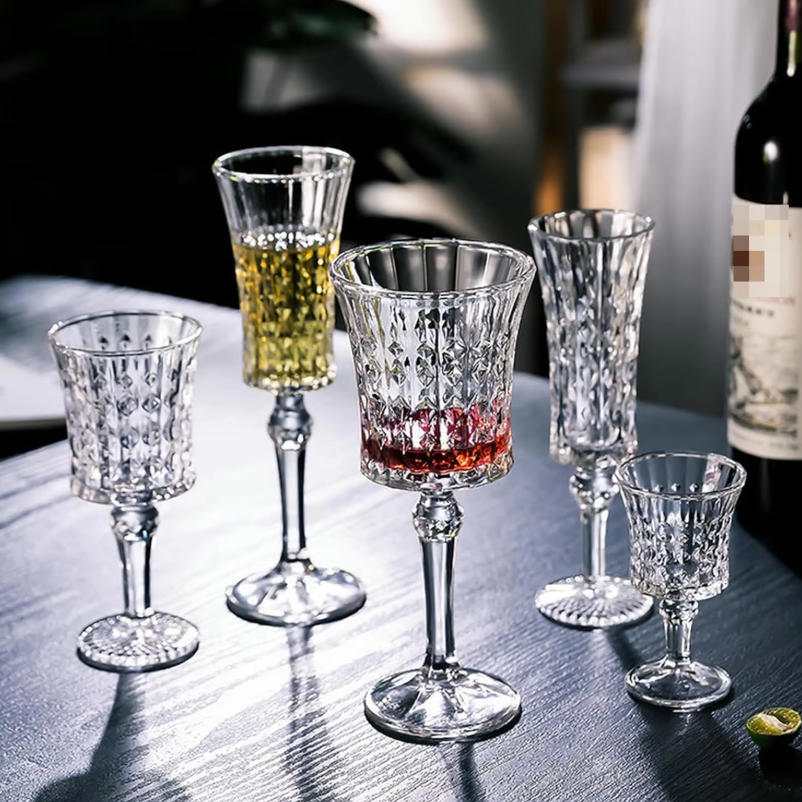
Explore Brett’s Minimalist Spherical Crystal Wine Glass and Vintage Diamond-Shaped Embossed Crystal Glass Set here.
Tempered Glass
Tempered glass material is heat-treated, which gives it high impact resistance and the ability to resist temperature changes. The material is commonly used in high-volume environments such as banquet halls, catering businesses, and institutes.
However, it can still shatter under stress. Learn more in our guide: Tempered vs Annealed Glassware: Safety, Durability, and ROI Analysis for Commercial Kitchens.
The Rim Quality
When it comes to delivering a great guest experience, the rim quality matters just as much as the glass material. There are three types of rim qualities:
- Rolled Rims: These are thick and so less refined, but also economical and best for budget SKUs.
- Cut and Polished Rims: These are thinner and smoother compared to rolled types. Since they give a better drinking experience, they are found in most casual and fine dining concepts.
- Laser-Cut Rims: The laser-cut rims have smooth edges but are extremely thin. These are mostly found in premium and specialty dining concepts.
Wine Glass Shapes: What Your Restaurant Actually Needs (and What It Doesn’t)
Most restaurant owners make the mistake of overbuying glassware. Some do it to buffer for breakage, others for aesthetics, and still others just for a varietal lineup. But if the glassware doesn’t move, it’s just dead inventory.
So what type of wine glasses does your concept really need?
Remember, a standard wine pour is 5 oz. That yields about 5 servings per 750 mL bottle. Some venues even pour up to 6 oz, depending on their pricing strategy. So a standard glass for wine must be sized to accommodate a 5-oz pour.
For an optimal setup of wine glasses for restaurants, you’ll need a high-quality set of universal wine glasses, a champagne flute, and specialty stems.
The Universal Wine Glass
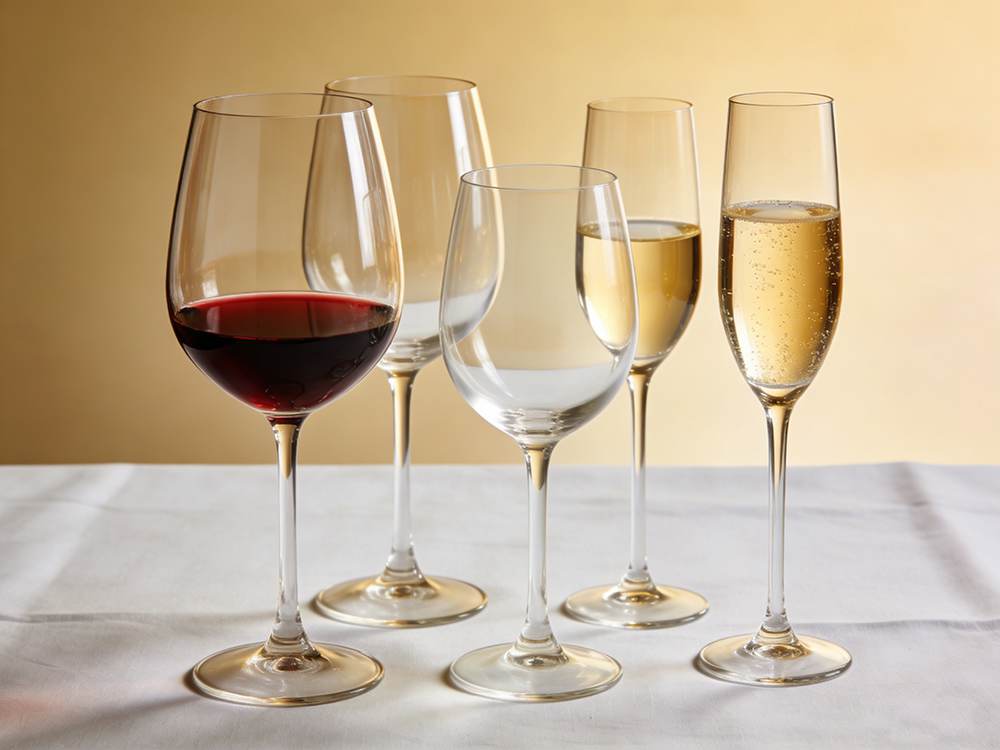
This is part of your core inventory or foundation of the restaurant stemware program. A typical universal wine glass has a moderately sized bowl, a narrow rim, and should be able to hold 12-16 oz.
The standard size gives it enough space for aeration and controls the aroma concentration. It can be used to serve both red and white wines in casual dining concepts, modern bistros, and high-volume dining. Learn more in our guide: Wine Glasses vs Water Glasses vs Specialty Glassware: A Restaurant Buyer’s Guide to Selection by Concept.
Red Wine Glasses
Red wine glasses or Bordeaux and Burgundy Styles have large bowls and a taller profile. This gives them a greater area for aeration. The shape enhances the structured reds and high-tannin wines.
These are best suited for fine dining, wine bars, or sommelier-driven programs.
White Wine Glasses
These are the traditional glasses with small bowls; the white wine glasses preserve cool temperatures better. The shape also slows down the oxidation and keeps the delicate aromas concentrated.
The glassware works best in seafood-style restaurants and concepts that serve structured wine.
Champagne Flutes
Flutes are distinguishable by their narrow bowl. For most restaurants, these are a core SKU. The narrow bowl preserves carbonation, maintains the bubble structure, and also adds to the visual appeal of the glassware.
Restaurants usually use these to serve sparkling wine, prosecco, and sparkling water.
Explore Custom Vertical Stripe Wine Champagne Glasses by Brett.
Stemless Wine Glasses
The stemless restaurant wine glasses have recently captured a growing market and are the adopted style in casual and fine-casual concepts. These are stackable, hence easy to store, and offer more of a relaxed aesthetic compared to the stemmed versions.
Also, there’s less chance of breakage as they are stemless. The only downside, however, is the presentation, which looks less formal, which makes them not suitable for formal or fine dining.
Dessert Glasses
These generally have a small capacity, say about 3–4 oz. In most concepts, these do not fit the menu and often just sit on the shelves. Procure these only if you serve dessert wines or have a structured after-dinner beverage program.
How Many Wine Glasses Does Your Restaurant Need?
Just as for procuring dinnerware, it is important to calculate the number of wine glasses you need for your restaurant. (We don’t want to overbuy or run out mid-service!)
The quantity must be calculated based on the seat count, type of concept, and, of course, the breakage buffer.
2-3x Rule
Remember the dinnerware procurement rule? The same applies to wine glasses. Restaurants must stock glassware 2–3 times their seating capacity. Say, you have 80 seats, your target range is 160-240 glasses (2*80 or 3*80).
This way, you balance service rotation, dishwasher cycle, and also keep a breakage replacement ready at hand.
No matter how many variants you need for your menu, just multiply the seating by 2-3x.
Breakage Buffer
In the tabletop category, if anything breaks, it’s usually stemware.
So the most practical approach is to add a 20–25% buffer for the inventory in the first year. Later, you may track the actual losses and work with the real breakage data to estimate the inventory requirements.
Breakage and Cost Control: Protect Your Wine Glass Investment
Glassware breakage in restaurants and dining concepts falls into three categories:
- Impact: Just one drop and the stemware can shatter. Common during service, dish handling, and tray loading, wine glasses break the most from impact.
- Mechanical Shock: When glasses touch during stacking or a server overloads a tray, the clanking results in mechanical shocks, which can crack or break the glass. Glass-on-glass contact can also occur in a dishwasher where they are loaded without separators.
- Thermal Shock: Pouring cold wine or sparkling beverages into glasses that haven’t cooled down coming out of the dishwasher, too, can cause stress fractures on the glassware. The temperature change weakens the structure and can cause cracks.
Conclusion
The guest’s experience with wine doesn’t start with the bottle, its brand or age, it all happens in the glass. The right material, rim, shape, and pour size can change the way your diner perceives the wine and your entire service at the table.
Brett’s Glassware is built to match the pace of real service. Explore the range of exquisite wholesale wine glasses for restaurants and turn every pour into value.
FAQ
1. What type of wine glass is best for restaurants?
For most restaurants, a set of universal wine glasses made from crystalline (lead-free crystal) works best. They are durable, offer clarity and dishwasher compatibility, and work best with both red and white wines, thus reducing inventory complexity.
2. How many wine glasses should a restaurant have?
The standard industry guideline is to stock 2-3 wine glasses per seat. This way, you can manage service rotation and dishwasher cycles. Also, since glassware is highly prone to breakage, it is best to keep a 20-25% buffer for breakage.
3. Should restaurants use stemmed or stemless wine glasses?
Using stemmed vs stemless wine glasses depends on the concept. Stemmed glasses are an expected standard in fine dining. Operationally, too, the stem prevents hand warmth from reaching the wine temperature and maintains a formal presentation.
Whereas stemless glasses are more popular in casual and fine-casual restaurants.
4. How do you reduce wine glass breakage in a restaurant?
Many restaurants believe they need to buy better quality glass to control breakage. However, it’s more important to work on the operational systems, not the glass material. For instance, use dedicated glass racks in commercial dishwashers, train the staff how to handle and stack the glassware, the carrying limits and tray loading, and also track breakage weekly to identify patterns.
This way, you can reduce losses and extend the stemware’s lifespan.
5. What is the best material for commercial wine glasses?
For high-volume environments, crystalline wine glasses are the best choice. These are durable, offer more clarity, and are also dishwasher safe. While standard glass can work in casual operations, crystal looks and serves best in fine dining restaurants.
6. What is the difference between crystal, crystalline, and standard glass?
Crystal contains lead oxide, which gives it the high brilliance and a thinner, more delicate structure. The qualities make the material best for use in fine dining. Crystalline is lead-free but often appears as clear and refined as a crystal. But, comparatively, it’s more durable and dishwasher compatible.
On the other hand, standard glass (soda-lime) is a longer-lasting and cost-effective option for high-volume service.
7. Why is universal wine glassware better for restaurants?
Universal wine glassware can work well across multiple wine types and venues. Whether you are serving reds or whites, the glassware supports consistent pour sizes, improves operations, and minimizes breakage. Storage, too, is easier, and that makes it the most practical choice for restaurant dining and concepts.