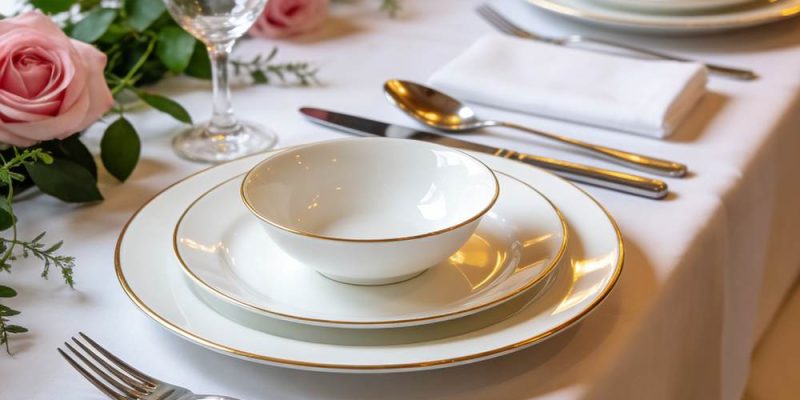
A wedding is an event built on details.
From the florals and lighting to the playlist, every element is carefully thought through. Candles flicker along a linen-draped aisle, and glassware catches the light, completing the polished presentation. But when the dinnerware arrives chipped, mismatched, or fragile, it undermines the entire setup.
For rental operators, this isn’t a minor hiccup. Rather, it’s a direct hit to your reputation and profitability. Hence, wedding dinnerware isn’t about aesthetics; it’s about durability and consistent performance under high-turnover conditions.
In this guide, we’ll focus on the most visible yet most vulnerable component of your fleet: wedding dinnerware rental. We will talk about how to choose the right materials and build an inventory that can withstand repeated use while maintaining the elegance your clients expect.
What Wedding Clients Expect from Rental Dinnerware
Before deciding the kind of dinnerware to import or retire, consider the perspective of the venue coordinator or bride. They are the ones who will be making the key decisions about the decor, cake, venue, and everything else, down to the wedding plate rental package.
A bride or wedding planner doesn’t look at the dinnerware simply as plate rentals for weddings. She’s actually paying for a coordinated tabletop presentation. The dinnerware, flatware, stemware, and charger blades all have to be visually aligned with the overall decor.
Most dinnerware suppliers showcase coordinated wedding dinnerware packages that make the whole set look like a unified offering. So the planners rent plates for the wedding as a whole set, which minimizes the mental load and gives a consistent look to the whole table.
Wedding dinnerware comes in different styles and designs, mostly segmented as follows due to the categorical demand.
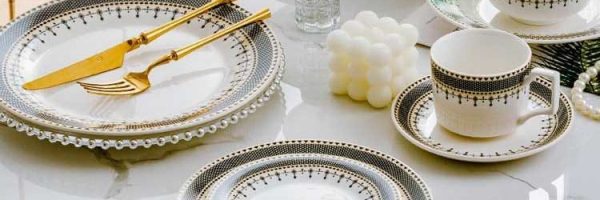
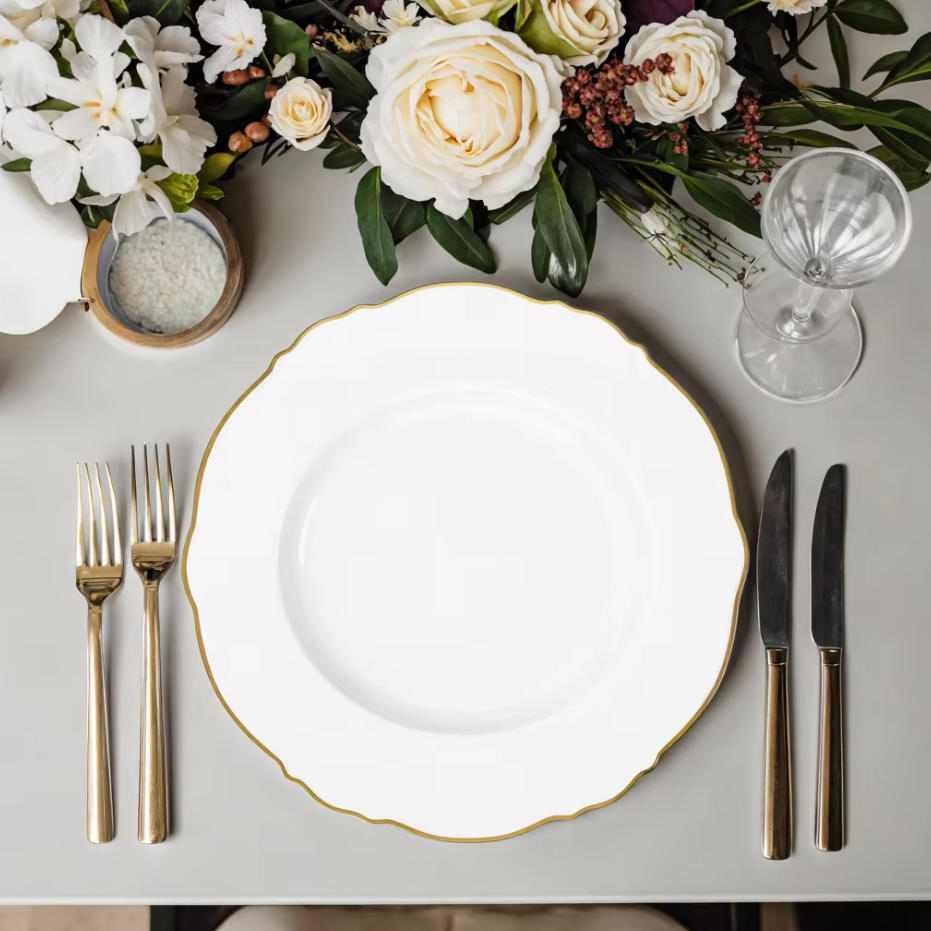
- Gold-Rimmed Porcelain: Best for formal ballroom and hotel weddings
- White Bone China: Classic and timeless, it’s a versatile fleet workhorse
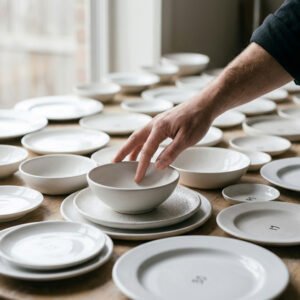
- Stoneware: Modern and ideal for industrial aesthetics
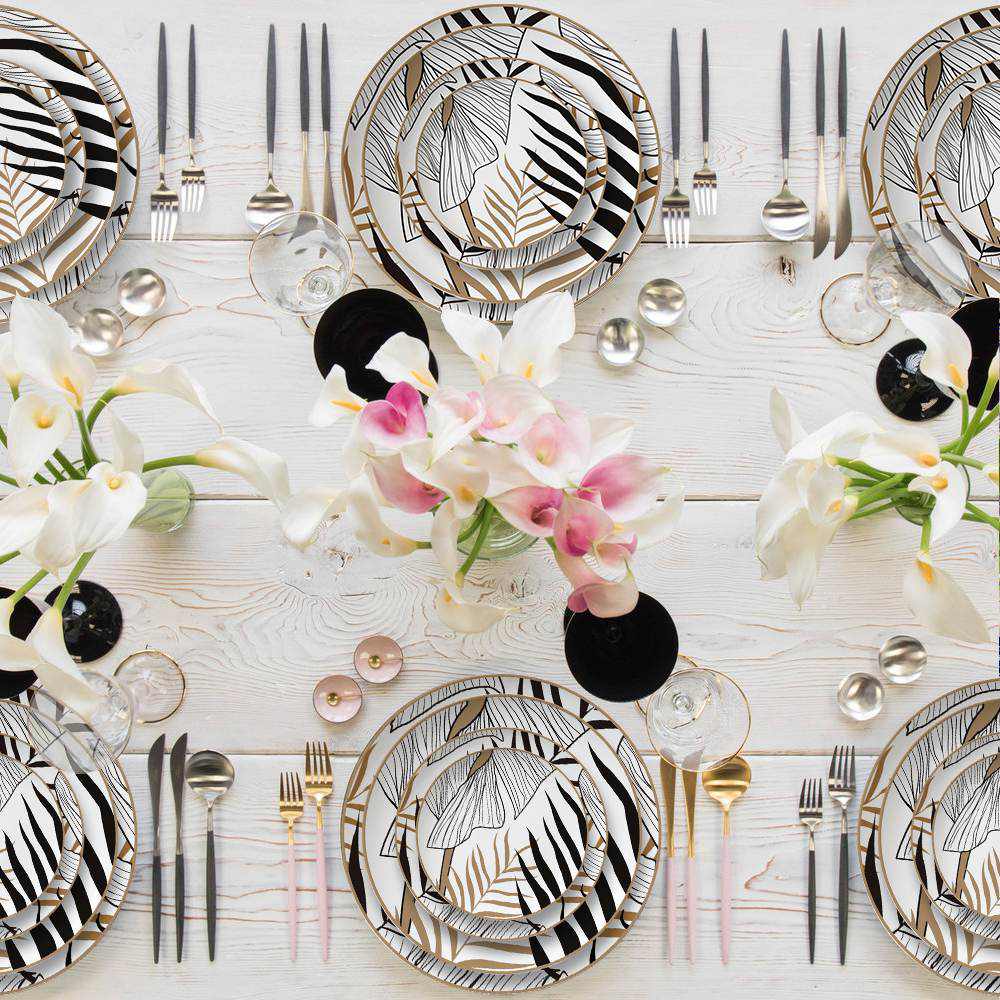
- Specialty Finishes and Patterns: Perfect for adding character to themes such as rustic and bohemian weddings

Planning the Wedding Dinnerware Inventory
The US wedding industry is currently valued at USD 65 billion. With over 2 million weddings held annually, that’s a recurring, predictable volume. Each event represents a predictable demand for wedding china rental.
For an average 150-guest wedding, it’s plausible to think we need 150 dinner plates. But you need to keep a safe buffer for breakage, last-minute guest additions, and other contingencies. That accounts for around 10–15% extra dinner plates.
Add in the salad plates, dessert plates, bowls, and cups, and for a single event, you will need up to 600–800 individual pieces. Once you procure the fleet, it’s not going to rest stacked up in the inventory.
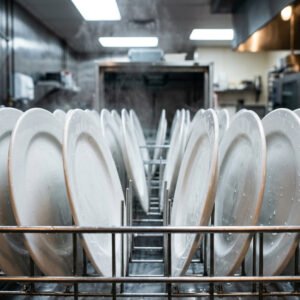
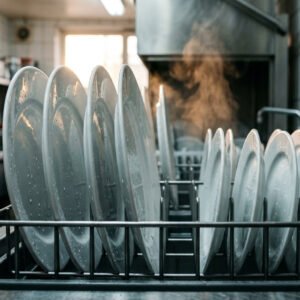
It has to move from the warehouse to the truck, up the venue, and back again, often going through the high-temperature commercial dishwashers multiple times a week.
Unfortunately, many wedding rental businesses miscalculate the required quantity by keeping the focus solely on aesthetics. Where, in reality, durability, stack strength, glaze hardness, and chip resistance all affect how long the procured dinnerware will last and how well it will perform across events.
Take a look at the Best Wedding Dinnerware: Top 10 Picks of Brett here.
The Right Dinnerware Material for Your Rental Inventory
The choice of the dinnerware material determines the number of events each piece can handle before it chips, cracks, or needs a replacement. The stronger and more durable it is, the fewer headaches and costs down the line.
In commercial wedding rentals, the three materials that consistently deliver performance and style are porcelain, bone china, and stoneware.
Material | Durability in Rental Rotation | Stackability | Wholesale Cost Range | Best For |
Porcelain | Highest wash-cycle resistance | High | Low to moderate | Core fleet inventory or high-volume weddings |
Bone China | High in controlled handling | Moderate | Moderate to high | Luxury weddings and hotel banquets |
Stoneware | Moderate durability due to weight | Low | Moderate | Rustic, styled, or trend-driven events |
Porcelain
The crown jewel of commercial wedding dinnerware is porcelain. Since it is fired to scorching temperatures (1,200°C to 1,400°C), it forms a dense, glassy surface that makes it strong and resistant to chips and stains, and increases its life.
Its non-porous nature also prevents odors and preserves glaze integrity through frequent commercial dishwasher cycles.
From a procurement viewpoint, porcelain is cost-efficient as well. The wholesale price per unit is usually lower than that of bone china, making it ideal as a reliable core inventory.
Whether it’s the classic white collections or gold-rimmed banquet sets, porcelain provides durability, versatility, and sourcing stability, all the key considerations when planning for fleet expansion.
Bone China
The premium tier of wedding event rental is bone china. Manufactured under the ISO6486 standards, bone china is a high-fired ceramic that includes 30% tricalcium phosphate or bone ash. The composition gives it a unique combination of strength, light weight, and refined feel.
Compared to other ceramics, the material has high chip resistance, and so, it’s more suited for rental inventories where appearance and quality both matter.
When used by trained staff under controlled handling, i.e., with proper storage and stacking practices, bone china has a long life that justifies the premium pricing. Being known as elegant and durable, it is hence most suited for ballroom venues, high end hotel contracts, and luxury wedding events.
However, there is an operational tradeoff to using bone china for wedding dinnerware rental. Many designs come with metallic trims made of gold or platinum. These can degrade over time, especially due to repeated exposure to high temperature commercial dishwashing.
For a detailed comparison between bone china and other dinnerware materials used in commercial settings, read: Bone China vs Porcelain Dinnerware: Which Should Hotels Choose?
Stoneware
From reactive glazes and matte finishes to speckled textures, stoneware gives a rustic aesthetic that works for farm-to-table and modern/industrial kinds of wedding themes.
Slightly heavier than porcelain and fired at low temperatures, it emphasizes visual character over fleet durability. The weight, however, does come with operational considerations.
There are higher transportation and handling costs, and a greater variability in color and texture between production runs. These factors make reordering less predictable.
Stoneware, hence, is a good specialty collection but not ideal as a fleet foundation. You can place it along a stable porcelain core inventory, but not as the primary dinnerware.
How to Source Wholesale Wedding Dinnerware?
As much as material selection is important, the sourcing strategy is also very important to ensure you achieve your bottom line. Whether to buy from domestic distributors or to go directly to the manufacturer is a key decision procurement teams have to make.
Domestic distributors offer convenience and have lower Minimum Order Quantities (MOQ). Their logistics are simplified, and they quickly replenish smaller quantities.
However, the convenience comes at a cost, and the pricing includes a 20 to 40% markup over the factory-direct rates. If you are a rental company looking to build a 5,000 to 10,000-piece fleet, this markup quickly adds up as additional cost.
Sourcing instead, directly from the manufacturer or OEM/ODM partners, gives you a lower cost per unit, and you can place consistent re-orders through the production runs.
If you want customized sets, you can specify the rim colour, embossing, and shapes. Direct ordering also gives you long-term SKU continuity.
How to Select the Right Manufacturer?
Different manufacturing facilities offer dinnerware of various qualities, price ranges, and materials. Not all suppliers are the same, which is why we need a careful evaluation of factors other than the per-unit cost.
Production Capacity
The chosen supplier must be able to handle container-level orders. Ask for their portfolio or the clients they serve, which will give you an idea about their supply chains.
Consider things like whether they supply dinnerware to hospitality chains and cruise lines or individual hotels. This way, you will get a complete picture of their production capacity and whether they can meet your volume requirements reliably and on schedule.
Certifications and Compliance
All dinnerware material must comply with the FDA food contact regulation. Request SGS third-party testing reports and verify compliance with EU Regulation EC 1935/2004 for food safety.
If your inventory passes through commercial kitchens, adherence to these certifications and guidelines isn’t optional, rather mandatory.
Customization Capabilities
Most leading manufacturers offer custom shapes and logo embossing and back stamps, along with rim colors in gold, platinum, and matte finishes.
Investing in Custom-Designed Collections gives you a competitive edge as your inventory becomes unique and hard to replicate. It’s a strategic advantage, especially when the dinnerware rental for a wedding is photographed and shared on social media; they act as silent brand ambassadors, promoting your business without additional marketing spend.”
Lead Times
Standard design dinnerware typically takes 30 to 45 days to produce. For custom orders, add another 10 to 15 days depending on the finishing required and the mold development.
However, for peak season, plan to order at least 90 days in advance, which includes the freight time as well.
MOQs
Check the supplier’s MOQ carefully. Standard SKUs usually start at 50–300 pieces, and semi-custom modifications require 300–800 pieces. Whereas, completely custom collections often require 1,000+ pieces.
Always confirm the MOQ with the supplier before placing your order, and remember that 300 pieces may only cover two event rotations.
Calculate your fleet requirements accurately before committing to ensure you meet demand without gaps.
One-Stop Sourcing
Ideally, choose a manufacturer that offers dinnerware, flatware, and glassware in a single, coordinated package. A unified tabletop set not only books faster but also improves your cost per guest.
Ordering from multiple vendors instead increases the freight costs and risk of mismatched finishes. A one-stop manufacturer like Brett ensures visual consistency and quality control across your fleet.
Replaceability
One of the biggest challenges in sourcing dinnerware is timing. Patterns get discontinued, and manufacturers often retool their lines. Once that happens, even if you’ve placed an order, long-term consistency in pattern and glaze cannot be guaranteed.
Your carefully built collection can lose its value overnight when a mismatched set renders the entire fleet unsuitable for a premium event. Confirm with the supplier if they can provide long-term SKU continuity.
Ask about repeat production runs, archived molds, and guaranteed glaze consistency. This way, your core and specialty collections can be replenished or expanded, keeping your brand reputation intact.
Build a Profitable Wedding Dinnerware Rental Collection
Once you have made the material selection and finalized the vendor or sourcing partner, the real strategy begins.
Think of your wedding plate rental inventory not just as a catalog of plates, but as a capital asset. Just like an investment portfolio, each piece serves a purpose, that is, generating revenue across multiple events while minimizing replacement costs.
The strategic allocation of core and specialty collections ensures a consistent service quality and stronger returns for your rental business.
The Core Fleet
White porcelain, given its high compatibility with a broad range of venues, makes up the core inventory. Your core fleet must have 300-500 pieces of white porcelain dinnerware.
The specialty collection or the margin boosters, such as gold rimmed bone china, can be served at ballroom wedding setups. Keep an inventory stocked of around 150-300 pieces of bone china, which brings the flair clients are often willing to pay extra for.
Also, stock a similar quantity of reactive stoneware or matte black to serve modern or rustic aesthetic-themed weddings.
As a revenue model, the core fleet drives the volume, keeping your operations smooth, while specialty pieces boost the per-guest revenue.
Starter Inventory
To efficiently serve weddings of varying styles and themes, here’s a practical guideline for stocking your rental inventory.
You will need:
- 400 pieces of white porcelain dinnerware
- 150 pieces gold rimmed bone china
- 400 set coordinated flatware
- 400 stems of matching glassware
By pairing a durable core fleet with the specialty pieces, rental operators can serve multiple events a week without running out of key items. You can also fulfill diverse aesthetics, ranging from modern industrial to rustic and bohemian themes, while keeping breakage and replacement manageable.
Conclusion
Remember, a wedding table is under as much scrutiny as the cake itself.
Chipped plates, faded finishes, or mismatched sets won’t just eat into your inventory, but will put your reputation on the line.
Sourcing the right dinnerware isn’t about filling shelves; it’s about selecting materials and suppliers who deliver consistent quality that can withstand repeated use.
When your supply chain is reliable, your collections are uniform, and reorders are predictable. That makes you the go-to partner for venues and planners alike.
Explore Brett’s Wedding Dinnerware Collection and build a fleet that performs just as beautifully as it looks.
FAQs
What type of dinnerware is best for a wedding rental business?
The most popular and cost-effective dinnerware for a wedding rental business is white porcelain. It matches most of the themes and has a re-order consistency. Many planners also keep bone china and stoneware in inventory for luxury bookings and style events.
How many plates should a rental company stock for weddings?
Ideally, maintain 10 to 15% above your maximum event capacity. Say you are serving 200 guests at a wedding, stock at least 220 to 230 dinner plates in your core fleet. Also, keep proportional quantities of salad and dessert plates.
Can rental companies get custom-branded wedding dinnerware?
Yes, in fact, most OEM/ODM manufacturers offer custom designs for dinnerware. You can order customized shapes, rim finishes, and glaze color with brand or logo embossing.
However, MOQ for customized dinnerware begins around mid-100 pieces, and production lead times after sample approval are often around 30–45 days.