You thought placing a bulk order for dinnerware would be easy. You approve the pattern, samples, agree on the price and lead times with the supplier, and the shipment arrives. But just six months in with the new dinnerware and you’re stuck with chipped plates or mismatched replacements.
The situation has you questioning: Where did you go wrong in the process?
For restaurant owners, head chefs, F&B managers, and hotel procurement teams in the UK, this scenario is a bit too familiar. You spend hours searching for restaurant dinnerware suppliers UK, commercial crockery suppliers UK, or wholesale dinnerware UK, yet most online catalogues only show designs and prices.
Unfortunately, there isn’t much on how to evaluate suppliers before you commit. In this guide, we will bridge this gap. Here are practical, market-specific tips to choose dinnerware suppliers based on consistent quality and long-term reliability.
Sourcing Channels: Where UK Restaurants Find Dinnerware
Before you start your search for restaurant dinnerware suppliers in the UK, you need to think about where you are actually sourcing the dinnerware from. In the UK, a supplier can mean three very different things.
UK-Based Distributors and Wholesalers
Most procurement teams first come across distributors and UK tableware wholesalers when looking for dinnerware suppliers. There are companies such as Nisbets, Goodfellows, Ascot Wholesale, and Jacksons Catering Equipment that act as multi-brand distributors.
These commercial crockery suppliers UK stock collections from established manufacturers and offer fast delivery all over the UK (often within 24 hours) with low or no minimum order quantities.
However, there are pros and cons to buying from these sellers.
On the one hand, you get easy access to samples, customer service, and do not have to deal with any import logistics or customs-related matters. On the other hand, you get limited stock to choose from. There’s very little customisation and less reliability in terms of long-term pattern continuity. The pricing, too, is higher as it includes the distributor margins.
The framework works best for independent restaurants that are testing new concepts or expanding their operations. It’s also efficient if you’re looking for quick replenishment or emergency restocking.
UK-Heritage Manufacturers
UK manufacturers are all about quality, long-term commitment, and heritage. The ceramics industry in Stoke-on-Trent, also called “The Potteries”, has been the centre of restaurant tableware in the UK not for years, but for years.
This region produces high-quality vitrified porcelain and commercial crockery designed for busy hospitality environments. These UK-based manufacturers provide British-made dinnerware in high-quality, built to last in high-volume hotels.
If you want a reliable supplier, they have supply chains within the UK, which makes them a convenient choice. Moreover, you get customisation options for branding and a premium credibility in your dinnerware as well. When you procure from them, your dinnerware is termed “Made in Britain.”
These suppliers work best for boutique hotels and design-led restaurants where table presentation and aesthetics take the lead. However, the disadvantages of this channel are that you get a slightly less variety to choose from and the per-piece cost is higher than imported alternatives.
Direct-from-Manufacturer
In this model, you work directly with the suppliers. You can choose manufacturers from around the world, like China, Portugal, or Turkey, which gives you access to exclusive designs, shapes, customizable features, and lower prices than local manufacturers.
However, the production lead times are higher, usually around 30-60 days. Shipping takes an additional 20-30 days, and the MOQ is also much higher.
Often referred to as the OEM or Original Equipment Manufacturing, and ODM (Original Design Manufacturing), experienced procurement partners such as Brett provide expertise in international production.
With us, you can access unique designs, like the Dark Brown Swirl Colour-Block Glaze Ceramic Dinnerware Set, negotiate MOQs, and let us manage the shipping and logistics.
Most dinnerware procurement teams in the UK usually follow a hybrid model to balance speed and cost of dinnerware.
The 8-Point Supplier Evaluation Checklist
Choosing the right restaurant dinnerware suppliers in the UK isn’t just an exercise that ticks boxes. It’s a key investment decision that can save you thousands of quid a year.
Let’s take a look at the 8-point supplier evaluation checklist.
Material Quality and Vitrification
Whenever you order commercial-grade porcelain or stoneware, make sure what you’re buying is fully vitrified. Water absorption must be ≤0.5%. Ask your supplier for ASTM C373 or other such testing results.
This way, you will be able to distinguish the best quality from the poorly vitrified ceramics. As a result, your dinnerware will not absorb moisture, crack, or stain under pressure and so, last longer.
Chip Resistance and Edge Construction
Most dinnerware designs fail at the rims. Look for rolled or reinforced edges and ask the seller about any chip warranties.
Another important aspect to look for before finalising the order is to avoid buying thin-edged or extra lightweight plates. Even though they look elegant, they fail commercial dishwashers and heavy service.
Commercial Dishwasher Compatibility
Most kitchens in the UK run dishwashers at 55-65°C and use strong alkaline detergents. Always ask the supplier if the glaze has been tested for 200–300 cycles. If the material gets dull or flakes after these cycles, it means it’s not commercial-grade.
Food-Contact Compliance
The UK dinnerware must comply with the retained EU Regulation 1935/2004 and the Materials and Articles in Contact with Food (England) Regulations 2012.
Suppliers must provide a Declaration of Compliance (DoC) that confirms that the lead and cadmium migration limits are met (tested to BS 6748).
Minimum Order Quantities and Sample Access
Most often, the distributors in the UK have no MOQ or dozen-level MOQs. Whereas international OEMs usually require an MOQ of 50–500+ pieces per design. Always check the supplier’s MOQ and request sample pieces and test them by running a full service.
Also, observe how the weight and balance work during serving, plate stackability, and its dishwasher compatibility.
Lead Times and Delivery Reliability
Look into suppliers’ delivery accuracy by checking their last accounts. Ask them how they handle delays when they occur and stock buffer options.
Many of the multi-site operators often go with distributors for urgent top-ups and OEMs for planned bulk orders.
Pattern Continuity and Reorder Availability
One of the top cost killers for dinnerware performance is discontinued patterns. Before finalising your order, always discuss with the suppliers how long a line will remain in production. Also, ask whether open-stock ordering is an option.
Total Cost of Ownership
Remember, the cheapest plate today might cost you more tomorrow. Always complete your homework before buying the dinnerware.
Your total cost is the unit price multiplied by the annual replacement rate and years of use. Also consider the delivery timelines and breakage buffer before finalising your deal.
Material Matters: Choosing the Right Dinnerware for UK Restaurants
Apart from the supplier selection, one of the most important decisions to make in dinnerware procurement is the material. Your choice will affect life, thermal performance, the guest’s perception about your brand, breakage rates, and ultimately the total cost of ownership.
Let’s take a look at the top material choices most restaurant dinnerware suppliers in the UK offer.
Porcelain
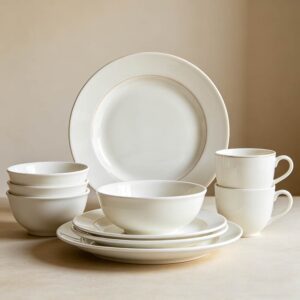
Porcelain is a high-fired ceramic made from kaolin clay, feldspar, and silica. Porcelain Dinnerware is dense and has a non-porous structure, giving it strength and longevity compared to most other materials.
The ability to withstand the tests of time and extensive dishwashing cycles makes it a top choice for high-volume restaurants, hotels, and operations where durability and ease of cleaning are the top priorities. Explore Brett’s Pure White Embossed Vertical Stripe Porcelain Tableware Set here.
Bone China
Lightweight and refined but still tough, Bone China Dinnerware is made from bone ash that gives it translucence and high durability. However, despite its delicate look, bone china is very durable.
Hence, it is often the best choice for fine dining restaurants, Michelin track and luxury restaurants, boutique hotels, and concepts where presentation is part of the brand. However, it’s costlier than porcelain and requires care in handling and stacking.
Check out Brett’s Brown Artistic Hand-Painted Floral Bone China Plate Set.
Stoneware
If you’re looking to bring some character to the table, Stoneware Dinnerware looks fine, classy, and has a distinctive aesthetic. The material is finer than other earthenware but thicker and heavier than porcelain.
It’s best for casual dining, cafés, and concepts with a rustic vibe. Brett’s Japanese Hand-Thrown Ribbed Stoneware Dinnerware Set is an option worth exploring in this category.
Melamine
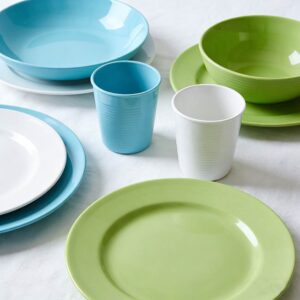
Melamine is a plastic resin dinnerware with a glossy finish and a lightweight feel. Melamine Dinnerware is not ceramic, but has a near indestructible nature, making it an ideal choice for busy, high turn environments.
It is best for outdoor dining areas, children’s menus, or patios, but not high heat kitchens. Browse Brett’s Minimalist Dark Brown and Off-White Melamine Dinnerware Set here.
Also, learn more about dinnerware materials and selection in our guide: Best Restaurant Dinnerware: Material Selection & Buying Guide.
UK-Specific Procurement Considerations
Buying dinnerware in the UK isn’t just about style or price. There are actually post-Brexit regulations you need to be mindful of.
The UK has retained the EU Regulation 1935/2004 as assimilated law. What that means for ceramic dinnerware is that it must still meet strict lead and cadmium migration limits for food-contact safety. The regulation applies to both suppliers in the UK and internationally.
Every commercial dinnerware order should include a Declaration of Compliance (DoC), confirming that the product meets these requirements (Food Standards Agency).
Also, from January 2021, UKCA marking replaced the CE mark for products placed on the UK market. However, as of August 2023, the UK government confirmed that CE marking will also continue to be recognised for most products.
Practically, that means businesses can use either UKCA or CE marking for most goods in Great Britain, including types of hospitality equipment.
Import Logistics
Sourcing directly from the manufacturer, especially from Asia or Europe, can be complex. Imports must clear customs, with correct HS codes, duties, and VAT applied. In the UK, Felixstowe and Southampton remain the primary container ports for large-volume dinnerware shipments.
When comparing suppliers, apart from the cost of the dinnerware, also consider the total landed cost, which is: production + ocean freight + UK customs duty + VAT + last-mile delivery.
Matching Supplier Type to Restaurant Type
All suppliers cannot and do not fit all kinds of restaurant operations. Here’s how to select suppliers that match the type of concept you own:
- Fine Dining / Michelin-Track Restaurants: For fine dining or Michelin-track restaurants, the UK-heritage manufacturers are the best fit. Most concepts, in fact, follow direct-from-manufacturer custom programmes.
- Casual Dining Chains: Direct-from-manufacturer OEM is ideal for core programmes. However, opt for UK distributors for speciality or replacement items, as consistency is crucial.
- Independent Restaurants and Cafés: UK distributors and wholesalers offer dinnerware with low minimum orders, fast delivery, and easy browse-and-buy. Opt for direct sourcing if you need special designs or high-volume sets.
- Pubs and Gastro Pubs: For pubs, porcelain and stoneware from UK distributors works best.
- Hotels and Banqueting: You need high-volume branded pieces, so the direct-from-manufacturer model works. However, specialist pieces and urgent restocking requirements may be fulfilled by UK distributors.
- Catering and Events: UK distributors and catering crockery suppliers offer high-volume, stackable, and durable finishes available for immediate use.
Learn more in our guide: Sourcing Dinnerware From Custom Manufacturers vs Stock Suppliers: Complete Buyer’s Guide.
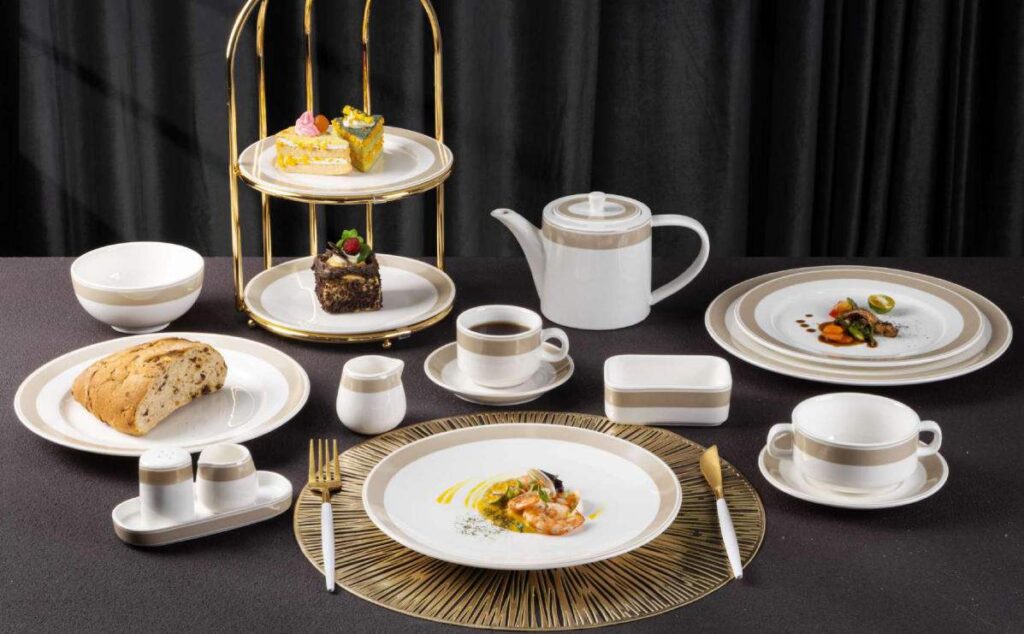
Restaurant Dinnerware Suppliers UK that Support Your Busy Kitchen
The 8 pm crowd, clatter from the pass, the quiet panic when something runs out mid-service, nothing goes unnoticed in the world of dining. Even a small chip around the rim can break the flow and become chaos for your concept.
The best operators understand that hotel dinnerware UK isn’t just a cost but a part of the whole dining system, and having the right ones can keep the flow smooth.
That is why a supplier like Brett can be your reliable behind-the-scenes partner, ensuring your dinnerware doesn’t disappoint. With Brett, you can rest assured that all your plates will arrive on time, match, and pass all compliance checks.
Talk to Brett today and turn your dinnerware from a daily risk into one less thing you have to worry about.
FAQs
1. Who are the main restaurant dinnerware suppliers in the UK?
Most UK restaurant dinnerware is sourced from three primary channels: UK-based distributors, wholesale, heritage manufacturers, and international OEM/ODM producers. Most restaurant groups use a combination of these channels based on their required volume, timeline, and customisation requirements.
2. Should UK restaurants buy from their local suppliers or import directly?
It all depends on your priorities and concept. UK distributors offer fast delivery, with low MOQs, and zero import logistics.
Whereas, direct-from-manufacturer sourcing can get you custom branding, lower unit cost, and exclusive designs. But there are customs duties and long lead times. In many cases, it is best to use a hybrid approach as it gives you flexibility to procure the best material, quantities, and designs.
3. What should I look for when choosing a dinnerware supplier?
When looking for a dinnerware supplier, focus on performance. You need durable, vitrified materials (like porcelain or reinforced stoneware) that can survive thermal shocks and heavy dishwasher cycles.
You need porcelain suppliers UK who guarantee consistency so you can reorder the exact same design months or years later without colour or size variations, and also verified compliance with UK food safety standards (e.g., lead/cadmium release testing).
Also, look into the lead times, MOQs to match your scale, and customisation options. Consider the cost over time, including breakage rates, replacements, and delays, and not just the unit price.