Most hotel F&B managers know the flatware grade numbers. What fewer understand is that within the same grade there is an enormous range of quality determined by two factors most procurement briefs never specify: weight and finish. When you need something that’s durable enough to stand the test of time, but still looks good, then 18/10 heavy weight, satin finish, hits the sweet spot at a more affordable price. The heavy weight is the common specification for banquet service — it is sturdy enough to withstand high volume, and cheap enough to replace at banquet service frequency. Grade alone doesn’t make the difference. What the guest actually receives depends on weight, finish, and these are more important than the grade number on the supplier’s invoice.
The importance of weight and finish, beyond score.
Table of Contents
Why Weight and Finish Matter More Than Grade Alone
The majority of hotel F&B managers are familiar with the difference between 18/10 and 18/0 stainless steel flatware. But most people don’t realize that, even within the same grade, even within the same 18/10 specification, there is a massive difference in quality, feel and performance depending on two criteria that are seldom included in any procurement brief: weight and finish.
The most telling piece of flatware is its weight. It is not done with one’s mind, but is felt by the hand when the fork is raised. A study conducted at The Sheraton Grand Edinburgh showed that guests who used heavier ware rated the same food as more enjoyable, and were 15 percent more willing to pay for it than those who used lighter ware. The food was the same. The kitchen was the same, too. The fork in the hand transformed the experience.
Finish is the aesthetic and tactile appeal of the hotel flatware that is responsible for its appearance on the table and its look in photographs, its durability in commercial dishwasher cycles, and its need for maintenance to keep it looking presentable throughout an entire service season. If the finish is incorrect, e.g., mirror polish in a high-volume banquet setting, then the flatware is a liability that builds up every week until it needs to be replaced.
The procurement decision that is key to determining whether a hotel flatware programme works or costs money each month is getting both the specification and the weight and finish right, matching to the actual service conditions of the individual outlets.
The Weight Specification That Changes Guest Perception
In commercial hospitality, weight, which is a measurement of flatware, falls into 4 standard levels: grams per piece
The average weight of Medium weight dinner forks run 28 to 35 grams. Standard weight runs 35 to 45 grams. Heavy weight runs 45 to 60 grams. Extra heavy — the five-star specification — runs 60 grams and above. The top of the range are the extra heavy, which is used by five-star hotels and Michelin-starred restaurants, and which are at or above 60 grams for dinner forks, and 85 to 95 grams for dinner knives.
Flatware weight runs across four tiers. Medium weight dinner forks run 28 to 35 grams. Standard weight runs 35 to 45 grams. Heavy weight runs 45 to 60 grams. Extra heavy — the five-star hotel specification — runs 60 grams and above for a dinner fork, with dinner knives typically reaching 85 to 95 grams.
A standard teaspoon in the Garbo Flatware commercial production is 115mm long and 17 grams (medium weight). A premium hotel extra-heavy teaspoon is the same length as a standard 28 to 32 gram teaspoon. The same piece, double weight, but different with the guest.
Hotel Flatware Weight by Outlet: The Correct Specification for Each
The weight specification is not uniform throughout a Hotel Property. The right weight for a fine dining signature restaurant isn’t the same weight for banquet service. This is the correct specification for each outlet.
Fine Dining and Signature Restaurants
It’s here that the extra-heavy weight hotel flatware gets its premium. At fine dining restaurants where patrons sit for 90 minutes or more, the weight of the fork is a factor from the first course to the final. There is a message of quality before the meal through extra-heavy weight. It seems well thought out, thoughtful, solid. When matched with 18/10 stainless steel and a mirror polish or brushed satin finish, extra-heavy flatware is the table “star” that makes everything the kitchen is doing come together.
Specify: 18/10 stainless steel, extra-heavy weight (60g+ dinner fork, 85g+ dinner knife), mirror polish or satin finish.
All-Day Dining Restaurants
The hotel’s biggest restroom is the all-day dining room, with breakfast, lunch, and dinner service, several styles of service, and frequent dishwashing. In this instance, heavyweight 18/10 flatware is the best choice – it should feel luxurious to use, withstand the high volume of use, and be cost-effective with the replacement frequency that all-day service entails.
Finish for all-day use should be satin and not mirror polish. The minute scratches, fingerprints, and watermarks stand out much more on mirror polish than on the satin finish — and in a high-volume environment with constant traffic, keeping this mirror polish to a presentable finish is too time-consuming for most hotel F&B operations to keep up with.
Specifications: 18/10 stainless steel heavyweight (45-60g dinner fork) satin finish.
Banquet and Events Service
The most intense flatware handling operation in any hotel is banquets. Extra-heavy specification is unnecessary and cost-ineffective when large teams are clearing at speed; when bus tubs are used; when transport is carried out in trolleys between kitchen and function room; and when the dishwasher cycles are run continuously during event setup and teardown.
The proper specification for banquet service is 18/8 or 18/10 heavy-weight satin (or tumble-polished) finish. A tumble polish, which is a mechanical process that uses rotating drums to polish the pieces, is the most practical choice for a high volume of pieces that would not be feasible to be individually polished before serving a banquet.
A satin or tumble-polished banquet flatware set hides handling marks between polishing cycles.
Specify heavyweight (45-55g dinner fork), satin or tumble-polished finish.
Room Service
The room service is a special specification challenge. The flatware must be high quality enough for a guest staying in a hotel room, which is not a staff cafeteria, but is used in a service elevator, recovered on trays in corridors and has a much longer round trip than restaurant flatware.
Satin finish, heavyweight 18/10 flatware is the optimal size for room service. It provides the high-quality experience that the guest is looking for, the durability that the handling cycle requires, and the low-maintenance experience that lasts through the corridor without having to be polished before collecting.
If you are looking for a hotel that provides the same satin pattern for both your restaurant and your room service, you will have one fewer item to order and will have a consistent look throughout the hotel.
Specify: 18/10 heavyweight (45-60g dinner fork) satin finish
Staff Cafeteria and Back of House
Staff dining is to be done with standard weight 18/0 stainless steel flatware. The more cost-effective nickel-free design, the medium to standard weight for use in a non-guest-facing environment and the lower cost and greater economic feasibility to replace during staff food loss rates. Never serve 18/10 heavy flatware in a staff food service area. The specification is not suitable for the environment and the expenses are disproportionate.
Specify: 18/0 standard weight (35-45g dinner fork), satin or economy finish.
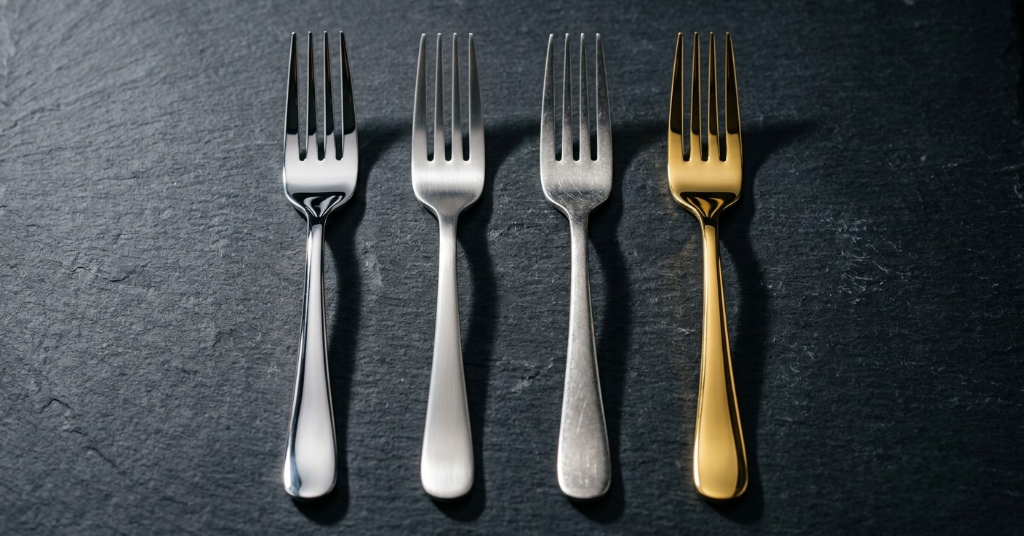
Hotel Flatware Finish Types: What Each Delivers and Where Each Works
Finish is the surface finish on stainless steel flatware for hotels that is applied after the forming and polishing steps. It affects its look, cleaning needs and how it will hold up in restaurant dishwashers. Each type of finish provides benefits and is suitable for certain situations.
Mirror Polish
Mirror polish is a very shiny stainless steel flatware finish available. The surface reflects the light well; the piece appears to be polished silver. It is the end that is typically linked to those fine dining and signature restaurant outlets, plus the luxury hotels with fine dining tables – hence the good choice for fine dining and signature restaurant outlets where table presentation is paramount.
The cost of the trade-off is upkeep. Mirror-polished flatware reveals the watermarks, fingerprints and minor scratches much better than any other finish. This is OK in a fine dining restaurant where pieces are hand polished before every meal. Mirror polishing is a daily task in a high volume/high traffic all day dining/banquet setting, which most hotel operations would not be able to do at a uniform level.
Satin Finish
Satin finish, or brushed/matt finish, is done by brushing or rubbing the flatware surface against a special abrasive belt, which leaves a fine-grained, directional pattern. The outcome is a warm, sophisticated appearance with fewer watermarks, fingerprints, and wear than mirror polish.
The most all-purpose flatware finish in the hotel industry is satin. It is used in fine dining (where it conveys a degree of luxury rather than formality), all-day dining, room service and banquet dining. It needs very little maintenance compared to mirror polish, and wears much more discreetly — it’s the sensible option for any outlet that cannot ensure their clients have had their hands polished before any service.
Tumble Polish
Tumble polish is a mechanical technique in which flatware pieces are placed in rotating drums containing abrasive materials, and then polished together as a group. This will produce a surface that is smooth but not directional, clean and professional, but not as formal as satin or mirror surfaces.
Polish is the appropriate finish for large quantities of flatware used for banquets and events. Can be used repeatedly between polishing cycles, is very wear-resistant to dishwasher and handling during banquet service, and is virtually maintenance-free. Among the finishes for banquet flatware, the most cost-effective is tumble polish over the five-year life of the tableware.
Gold and PVD Finish
There are two styles of hotel flatware finished in gold: water gold (real gold is electrochemically deposited over a nickel pre-plate) and PVD (Physical Vapor Deposition — a vacuum process that deposits a hard metallic layer which can be gold or even other colours). Both are suitable for upscale hotel environments where the design of the table requires a lovely, unique look over the silver-toned stainless.
Water gold plating is a more intense and shinier gold color than PVD — closer to the look of real gold. PVD is much harder than water gold and therefore can be used for more washes. When considering gold flatware for hotel use, with a dishwasher cycle that is repeated daily, PVD specification is more suitable for the extended length of a season. Water gold is more visually appealing than cycle-resistant gold for luxury fine dining, but not as cycle-resistant.
Gold-finished flatware is particularly popular in Middle Eastern hotel markets where warm metallic finishes are culturally preferred. Brett’s custom flatware programme offers water gold and PVD options for all weights.
Hotel Flatware Specification Reference Table
Outlet | Grade | Weight | Finish | Fork Weight |
Fine dining | 18/10 | Extra heavy | Mirror or satin | 60g+ |
All-day dining | 18/10 | Heavy | Satin | 45-60g |
Banquet and events | 18/8 | Heavy | Satin or tumble | 45-55g |
Room service | 18/10 | Heavy | Satin | 45-60g |
Bar and lounge | 18/10 | Standard to heavy | Satin or PVD | 35-50g |
Staff cafeteria | 18/0 | Standard | Economy satin | 35-45g |
Outdoor and pool deck | 18/8 or 18/0 | Standard | Satin | 35-45g |
What to Specify When Ordering Hotel Flatware From China
When purchasing hotel flatware from a Chinese manufacturer, much more than a grade number is required. The following are the documentation needs that can make the difference between a good commercial order and a procurement error.
Steel Composition Documentation
Ask for a mill certificate (the steel maker’s document stating the actual composition of the steel being made). This verifies chromium and nickel percentages as opposed to what is listed on the supplier’s label. The best way to make sure that a 10% nickel and not a lower nickel grade being passed off as 10/10 is to get a mill certificate from a reputable steel mill.
Weight Per Piece Specification
Don’t take weight categories; give the weight per piece for each item in the set. Each item of dining utensils (fork, knife, spoon, spoon, fork) should be listed in the purchase order with a gram weight. This is the only way to guarantee that you get the weight specification that you want. If piece weights are not available, then the supplier is not supplying hotel flatware.
Finish Quality Standards
Ask for documentation for finish quality, including a description of the polishing process, a surface roughness standard (Ra of micrometres for precision specifications) and dishwasher cycle resistance rating. In the case of gold-finished flatware, indicate water gold or PVD, thickness of gold finish (micron) – standard for water gold is nickel pre-plate; cycle resistance – commercial dishwasher washers at 65°C.
Defect Rate and QC Documentation
Ask the supplier to provide a written record of the percentage of defect rate — the number of pieces that don’t pass (before they depart the factory). Typical commercial hotel flatware in use today is less than 3 per thousand. Ask for a detailed description of the inspection method and the criteria that will be used to determine whether the surface defects, dimensional tolerances and surface finish are satisfied.
Brett's Custom Hotel Flatware Programme
Hotel-grade tableware is one of the services that Brett has provided since 1998, in over 80 countries, based in Chaozhou and Dongguan, China. Our clients range from Four Seasons, Shangri-La, Fairmont and Raffles, Wynn, Sheraton, Hyatt, Marriott and Crowne Plaza hotels, through to Michelin Guide and Black Pearl Restaurant Guide restaurants in Europe, USA and the Middle East.
Brett’s custom flatware programme offers stainless in 18/10 and 18/8, all weights, with mirror polish, satin, tumble polish and water gold finishes as well as PVD finishes. All orders for flatware come with a mill certificate, piece-by-piece weight specification and finish quality documentation. MOQ is available in quantities between 50 and 300 pieces per item, which caters for the various asymmetric needs of a multi-outlet hotel property in a complete flatware programme.
If hotels are marking up their ceramic dinnerware programme, Brett’s single-source supply includes both standard of quality, pattern continuity guarantee and delivery time. To view the full procurement specification framework, please check out our hotel tableware procurement checklist or our 5-year cost analysis for the full financial case for premium specification.
FAQ
What is the best grade of stainless steel for hotel flatware?
18/10 is the proper specification for fine dining, all day dining and room service: 18% chromium and 10% nickel for maximum corrosion resistance, shine retention, and commercial dishwasher life. 18/8 will be a viable option for banquet service where cost and replacement rates are important, as it will offer almost identical performance at a lower unit cost. Only use 18/0 (no nickel) for staff cafeteria and back of house applications where guest perception is not relevant.
What is the recommended weight of flatware used in hotels?
This is subject to the outlet. For fine dining, you will need a dinner fork that is heavier than usual, 60g or higher. Heavy weight (45-60g) is suitable for all-day dining and room service. The correct specification for Banquet service is heavy weight 45-55g. Sheraton Grand Edinburgh research, though, found that heavier cutleries lead to higher food quality perceptions and higher prices, and that it’s not only about the longevity — it’s about the guest satisfaction score as well.
What's the difference between mirror polish and satin finish on hotel flatware?
Mirror polish forms a high-gloss reflective surface, which is the closest to being silver. Communicates luxury but needs to be hand polished regularly – watermarks, fingerprint marks and minor scratches are very noticeable. Satin finish hides watermarks and minor wear much better than other finishes and still looks like a high-quality finish, all while requiring less maintenance. Satin finish is more practical for high-volume hotel outlets where it is not realistic to dictate hand polishing before service. Mirror polish is suitable if you can be sure that you will be able to keep it polished — say for fine dining and where the cover count is lower.
What's the difference between water gold and PVD gold flatware?
The water gold plating is an electroplated process that uses real gold instead of nickel. It provides a more saturated gold look, which may not be as durable to commercial dishwasher chemicals over time. PVD (Physical Vapor Deposition) gold is a hard metallic deposit that is formed in a vacuum process, which is a more durable option than water gold and is more resistant to water chemicals and dishwasher, but it has a slightly cosier appearance. If the flatware in a hotel is used for everyday commercial dishwasher cycles, the more durable of the two is PVD. Water gold will have the best look in luxury fine dining where the presentation of the gold is paramount.
Which documents need to be requested when ordering hotel flatware from China?
Ask for mill certificate documentation to prove actual steel composition, piece-by-piece gram weight specification for each item in a set, finish quality documentation (polishing process and dishwasher cycle resistance), and confirmation of the QC defect rate (industry standard is below 3 per thousand pieces). If gold is to be used on flatware, also ask for the thickness of the gold layer in microns and the pre-plate specification. If a supplier can not provide these documents, he or she is not supplying commercial hotel flatware.
Is it possible to have a hotel logo or design on the flatware?
Yes. The OEM programme at Brett’s custom flatware makes it possible to engrave a logo, create custom handle designs, add PVD colour finishes (gold, rose gold, black), and even define custom weight distributions. From 50 pieces per item, custom flatware is available to meet the needs of boutique hotels and individual restaurant programmes as well as large hotel groups. Please consult with Brett for a custom flatware specification at cbhoreca today.
Conclusion
A fine dining guest is holding a dinner fork that has the mirror polish finish, a signal before they even get their first bite of food about the quality of the meal they will have. A banquet patron handling a 35-gram, medium weight, economy finish fork – no matter what the number on the supplier’s invoice reads – is getting a different message.
Use the correct grade. Then, set the weight properly. Then get the finish right — to the right outlet, the right service conditions and the right guest experience the property is looking to provide. It’s that full specification that makes the difference between a hotel flatware programme that works and one that changes out annually.
For the full specification framework, see our hotel tableware procurement checklist. For the flatware grade guide, see our 18/10 stainless steel flatware guide and our stainless steel flatware grades comparison. Quotes, catalogs, and samples for customizing your exclusive hotel flatware solutions are available. Please feel free to get in touch cbhoreca with us now.