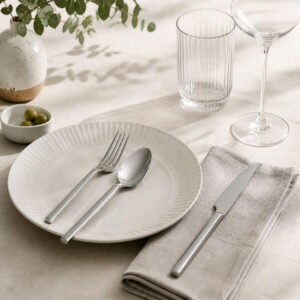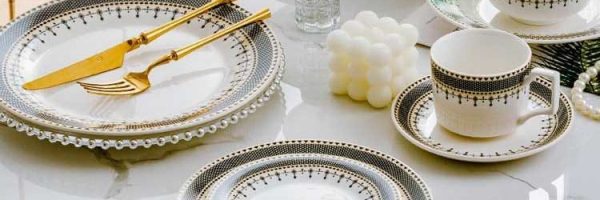
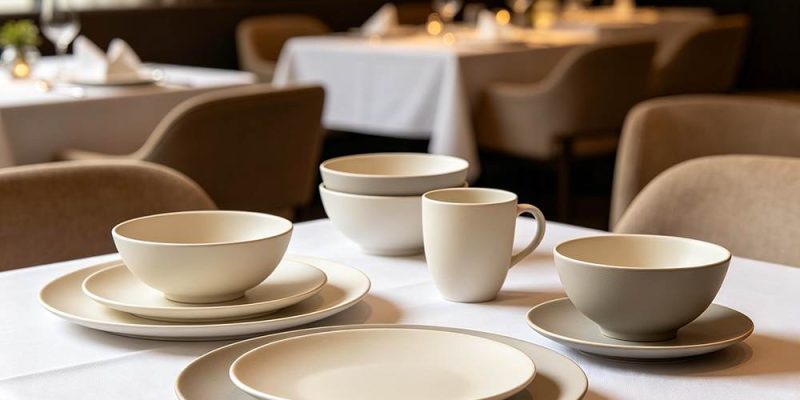
Every time a guest lifts their cup of tea or cuts into a perfectly seared and plated steak, they interact with your brand identity. Custom dinnerware for hotels today is one of the most important yet overlooked branding tools.
In fact, according to research by Medallia, around 61% of consumers would spend on more personalized experiences, especially in hospitality. Backing this up, McKinsey and Company reports that 71% consumers in fact now expect personalization from brands, and that too as a baseline, not a bonus.
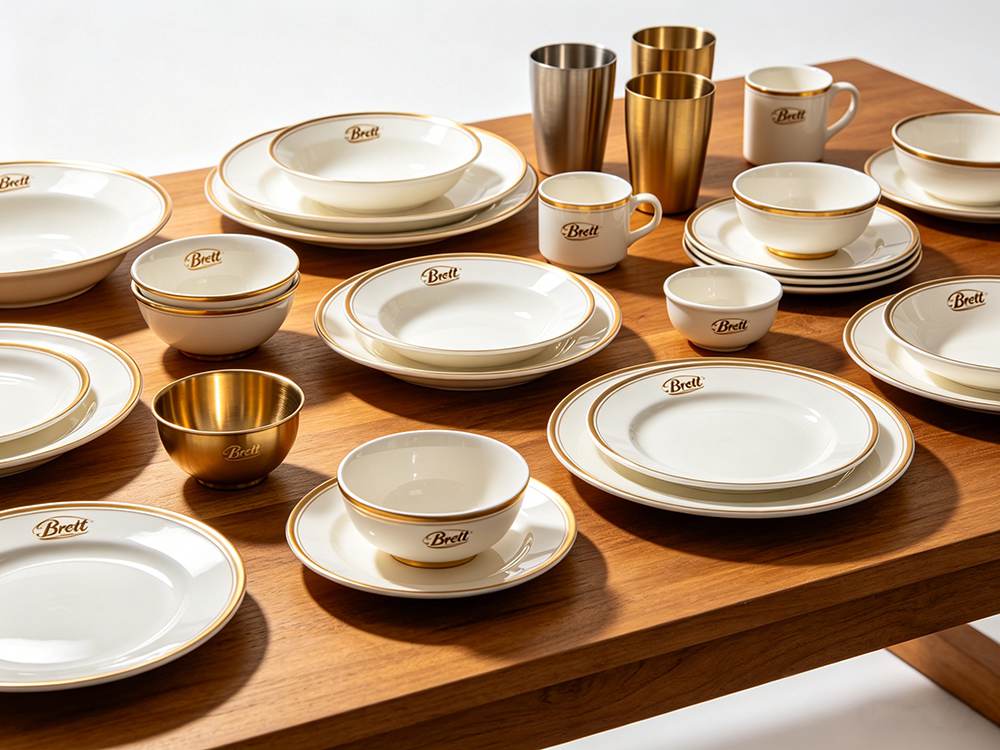
In a hotel or dining concept, the expectation shows up on the table. It means thoughtfully sculpted custom restaurant plates, custom glazes, signature color pallets, and back stamps that reinforce brand identity.
Which brings us to the more important question: how do you actually bring that vision to life? Through OEM or ODM?
What Is OEM (Original Equipment Manufacturing) Dinnerware?
OEM dinnerware is a hotel dinnerware procurement process where the dinnerware is built from scratch. You do not just choose a set from a catalogue, but are free to select the shape and dimensions of the plates, the material, the glaze chemistry, and the finish.
You can customize the plate color, rim design, and thickness. It gives you the liberty of going for full branding, where you decide the logo placement and all other branding details.
OEM is about full control, i.e., you own the intellectual property for the design, but that also comes at a high upfront cost. Also, the lead times for the manufacturing process are longer, around 60-120 days.
In the end, you get a plate that is your brand and your distinct visual identity. This is especially valuable when you are managing multiple properties. It ensures every guest experiences the same level of detail and brand recognition at every outlet.
The OEM Process
The OEM process is the complete production journey. Here’s how it works.
- Concept:The process begins with a vision that is connected to the brand identity or presentation. The plating requirements are defined as per the dining concept, menu setting, and service style. Like in fine dining, you’ll need asymmetrical plates and specific rim depths.
- Technical Specifications: Next, the concept is translated into accurate production drawings. The measurements, glaze formulation, and firing requirements are considered, and the final blueprint is created.
- Mold Creation: At this stage, the actual production begins. TheCustom molds are built according to the shape, dimensions, and structural details in your specifications. Because molds define the geometry, this step is one of the biggest upfront investments in OEM and also the foundation for long-term consistency.
- Prototype / Sample Development: The manufacturer provides initial samples for testing. These samples are checked in-house for glaze consistency, color, and structure, and then shared with the client to see how they perform in service.
- Glaze and Material Testing: If the design needs any tweaks or adjustments, the iterations take place in this stage. At times, glazes and colors shift during firing iterations, and so the formulation needs to be fine-tuned for consistency.
- Approval: Once the client approves the design, they sign off on the final sample. That takes us to the final stage: bulk production.
- Bulk Production: Scaled manufacturing begins with strict batch controls for consistency. QC inspects the production for warping, defects, and design accuracy. Once the batch passes these checks, it is signed off as ready for packaging and shipment.
- Shipping and Delivery:Lastly, the finished products are packed and shipped to the client.
What Is ODM (Original Design Manufacturing) Dinnerware?
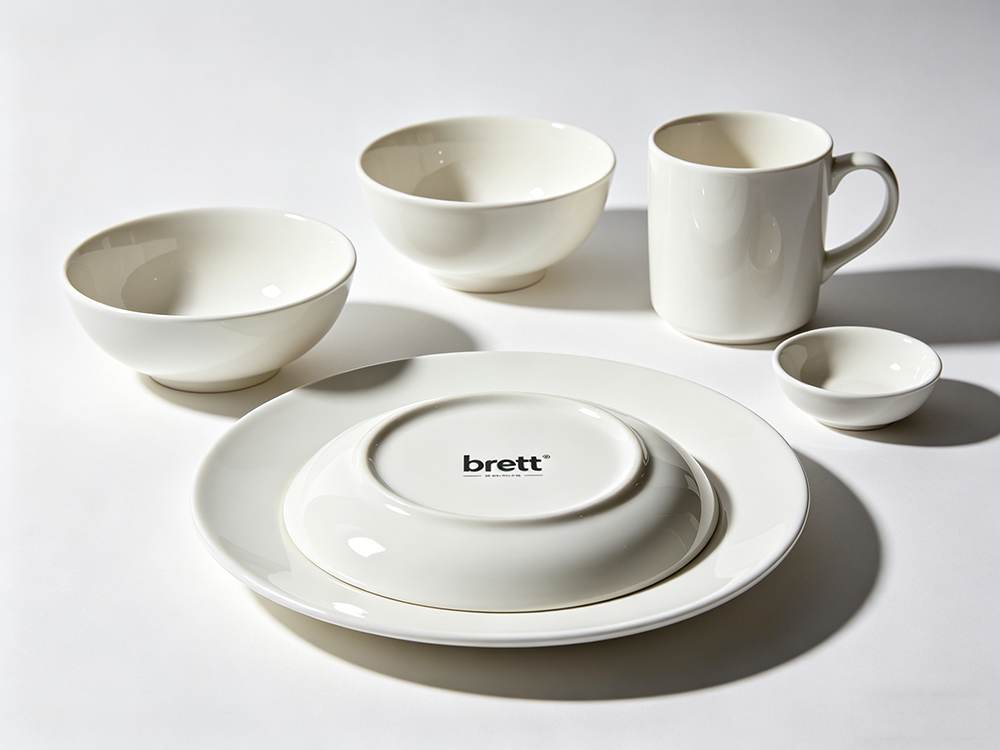
Unlike OEM, in ODM, or Private Label Dinnerware, the process is shorter. In ODM, you choose a design from an existing catalog. The manufacturer has already worked out and tested the shapes, sizes, and profiles for you to pick from. You just layer your brand on top of that.
That means you select the plates, bowls, and cups from the manufacturer’s range and then customize the surface elements. You can choose the glaze color, finish, rim, logo placement, and other detailing.
But there are no custom molds. No specific dimensions or other details that are specific to your concept only. That also means other hotels could technically choose the same base as you. But honestly, with the glaze, branding, and color palette, the dinnerware rarely ever looks the same elsewhere.
ODM works perfectly if you are running a boutique hotel, are a single-property operator, or are testing a new menu. It’s also ideal if you are looking for cost efficiency and speed. In fact, most hospitality brands start from ODM and later transition to OEM as they scale.
OEM vs ODM Tableware: A Side-by-Side Comparison
The OEM vs ODM decision is an operational choice. It affects the timelines, budgets, brand control, and how painful or smooth your future reorders will be.
However, no design is a winner. Both concepts give you equally strong dinnerware in terms of quality and design.
Factor | OEM | ODM |
Design Ownership | You own the complete design, including the shape, mold, and branding specs | The manufacturer owns the core design, while you own the branding elements |
Customization Depth | Total control of the shape, size, material, glaze, and structure | Surface-level control and choice of color, logo, finish, and detailing |
Upfront Cost | Higher due to mold tooling and prototyping | Lower, as no mold creation is required |
Lead Time | 60–120 days (depending on design complexity) | 30–60 days (existing molds speed up production) |
MOQ (Minimum Order Quantity) | Higher – Around 1,000–5,000+ pieces | Lower – Around 300–1,000 pieces |
Design Exclusivity | Completely exclusive to your brand | Shared base designs |
Best For | Hotel groups and luxury brands | Boutique hotels, startups, and fast launches |
Reorder Consistency | Strong. The specific mold and specs are fixed | Variable, depends on the manufacturer |
What Can You Actually Customize? A Hospitality Buyer’s Checklist
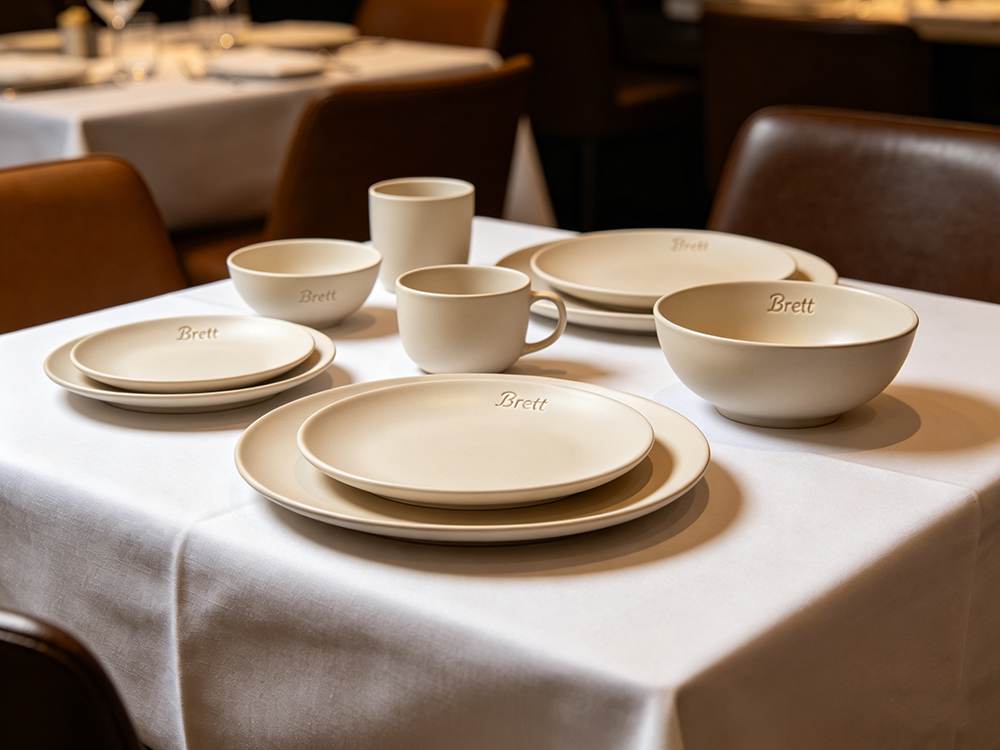
The logo placement is the bare minimum when it comes to customizing dinnerware. It’s not the end but only the beginning of dinnerware customization.
Here’s what you can actually customize and make your dinnerware stand out as unique and specific to your brand and concept.
Shape and Profile
The first visual difference in the dinnerware is the shape and profile. You choose from coupe vs. wide rim, the depth and curvature of the dishes, the rim width and height, and the overall silhouette of the plate.
OEM gives you complete freedom to choose these distinguishing features that will later become part of your brand persona. When people repeatedly get served in the same dish at every outlet you own, they begin to recognize it as your signature style.
Material
The material isn’t an aesthetic choice. It affects the plate weight, its service performance, and durability. There are four basic choices for dinnerware material:
- Porcelain:Porcelain Dinnerware is the King of dinnerware that’s durable, versatile, and hence widely used in hotels. However, the material is prone to chipping and is also heavy in weight, which can lead to server fatigue.
- Bone China:Bone China Dinnerware, in comparison, is lighter and slightly more refined than porcelain. It comes at a high cost and is prone to cracks over time, so the category is more specific to premium dining concepts. Read more about the difference between the two materials in our guide: Bone China vs Porcelain Dinnerware.
- Stoneware:The material is heavy and has a rustic feel about it, making it ideal for casual and concept dining. However, Stoneware Dinnerware can develop stains over time and is also hard to stack given its weight.
- Melamine: Being lightweight and shatterproof, Melamine Dinnerware is perfect for outdoor and high-turnover settings. It’s dishwasher-safe but not for use in the microwave. It also lacks the premium feel of ceramic or bone china. Learn more about the material in our guide: Melamine vs Ceramic Dinnerware: Which is Better.
Glaze and Finish
The glaze and finish make things interesting in dinnerware design.
Instead of going for the regular white or off-white, your dinnerware can exude a visual language. It can be glossy, clean, or matte. You can choose between reactive glaze and satin finish. Every choice you make can bring character, aesthetic, and branding elements to the table.
Logo Application Methods
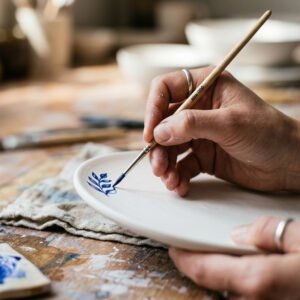
There are different logo placement methods that produce very different results. Most manufacturers use decal transfer and pad printing. Both methods are precise and clean and give consistent results.
Premium designs can have hand printing, embossing, and laser engraving. These leave a very high-end feel on the dinnerware. Explore more about logo applications by Brett in our guide: Custom Dinnerware: Ways to Print Your Logo on Plates.
Backstamps
The real branding space is along the underside of the plate, and that shows up much more often than you think. During service resets, dishwashing, and all behind-the-scenes operations, people will see the backstamp.
It’s not something the customers will see much of, but the people associated with your brand will notice how dedicated you are to reinforcing your brand identity. The same also helps in inventory tracking and adds a subtle premium touch to your dinnerware.
Sizing and Proportions
When the procurement and kitchen teams work together, they tailor the dinnerware diameter, depth, and weight according to the actual service requirements. This impacts the plating style and table setting.
Balanced dinnerware reduces fatigue for servers and ensures consistent presentation.
Food Safety & Compliance: Certifications Your Custom Dinnerware for Hotels Must Meet
A plate may look beautiful and could be just perfect for your concept, but what if it fails compliance? For custom dinnerware for hotels, safety isn’t optional. Everything must be regulated and tested.
Make sure your supplier clearly complies with the FDA 21 CFR for food contact. This ensures the dinnerware materials do not transfer harmful substances into food during dishwashing and serving.
If you are operating in Europe, the dinnerware must comply with EC Regulation 1935/2004. That means the materials must not transfer substances into food that can endanger human health or change the composition of the food.
Most reputable dinnerware manufacturers also provide certifications from independent labs like SGS, TÜV Rheinland, and Bureau Veritas for migration testing and material analysis. Learn more about Commercial Dinnerware Durability: Testing Standards & Performance Data here.
What You Should Ask Your Manufacturer
Before you approve any order from a hotel dinnerware manufacturer, request that they provide:
- A Declaration of Compliance (DoC): It is a formal statement that states the products meet relevant regulations.
- Migration Test Reports: These are the lab results showing lead/cadmium levels under test conditions.
- Batch-level Traceability: Ask if they have the ability to trace production runs in case of issues.
- Certification from Recognized Labs: Ask for authentic labs and certifications from SGS, TÜV, Bureau Veritas, or equivalent.

How to Choose Between OEM and ODM: A Decision Framework for Hotels
Choosing between OEM and ODM dinnerware is a mini strategic assessment. You need to see which production pathway best fits your property, brand, and budget.
Here are five questions that can make your decision on custom dinnerware for hotels easier.
1. Do You Need a Unique Shape or Profile?
Answer: Yes. Go with OEM. This will give you a design that’s unique to your hotel or restaurant. You get signature plate shapes and rim profiles.
If your answer is no, ODM works well. You choose from the supplier’s existing catalog designs, but can still customize logos and colors at a much lower cost.
2️. Is Design IP Ownership Critical for Your Brand?
Answer: Yes. Again, the OEM will give you the intellectual property design, which no other hotel can use. The specific shape, glaze, and design become your signature dishes.
If the design IP doesn’t matter, ODM is fine. The manufacturer can retain the mold, but the branding will remain yours.
3️. Are You Ordering for One Property or Multiple Properties?
Answer: For multiple properties, OEM ensures consistency. You get the specific sizes and designs of plates, cups, and bowls. For single property or concept testing, ODM is low risk and a quick and cost-effective way to trial branded dinnerware.
4️. What’s Your Timeline?
Answer: If you want dinnerware within 60 days, ODM is faster. If you are flexible, OEM will take longer as the mold has to be developed, and the lead times are longer.
5. What’s Your Budget Reality?
Answer: Tight initial budget. Go with ODM. It’s more accessible with lower MOQs and zero custom mold fee.
If you are willing to invest more, OEM is worth it.
Custom Dinnerware for Hotels: Your Brand, Served on Every Plate
When it comes to custom dinnerware for hotels, remember that every dinner plate, cup, and bowl is a silent ambassador of your brand. OEM vs ODM isn’t just a procurement choice, but a decision that influences the guest’s perception and your long-term operations and costs.
Where OEM gives you complete control and long-term consistency, ODM delivers speed at lower costs. Reach out to Brett today, and we will help you choose the right path for your concept.
FAQs
1. What is the minimum order quantity for custom hotel tableware?
The MOQ depends on the model and manufacturer. OEM orders usually start around 1,000–5,000+ pieces due to custom mold costs. ODM orders can start as low as 300–1,000 pieces.
2. How long does it take to produce custom dinnerware?
An OEM project takes 60–120 days from design approval to delivery, depending on complexity. ODM projects are faster; they usually take 30–60 days.
3. Can I put my hotel logo on dinnerware?
Yes! You can choose between different options such as decal transfer, pad printing, embossing/debossing, or laser engraving. Each process varies in cost and finish. However, for commercial dishwashing, underglaze or high-temperature decal methods work best and have the longest-lasting results.