Catering companies have tight margins. One great weekend might look profitable on paper, but then a stack of chipped plates or emergency replacements end up keeping your profits low.
Dinnerware is one of those costs that people don’t think about until it starts causing problems. When you choose the right pieces from the start, you spend less over time, keep your presentation consistent, and avoid scrambling for replacements before a big event.
That’s why wholesale dinnerware sourcing matters. Instead of cutting corners here, you need to choose dinnerware that works event after event, without dragging down your reputation or your profit margins. Let’s explore what works for catering companies and how to choose dinnerware that supports everyday business operations.
Why Catering Companies Choose Wholesale Dinnerware
When you run a catering business, you’re handling things much differently than a restaurant. You’re not plating the same meals in the same room every night. One weekend might be a 300-guest wedding, the next a corporate lunch, then a backyard celebration.
Your dinnerware gets stacked multiple times and gets washed on repeat, only to go through this process again shortly. That is where wholesale purchasing changes everything.
When buying dinnerware in volume, you’re not paying retail pricing for something you’ll use hundreds of times. You’re building a working inventory that supports your operations instead of draining it.
For example, when you buy 1500 to 3000 place settings at once, you’re not just stocking your shelves. You’re locking in consistent color, shape, and quality across every event. This means you won’t have mismatched plates halfway through a season and no panic orders the week before a big booking.
Wholesale dinnerware sourcing also gives you room to plan. You can account for breakage, build a replacement buffer, and know exactly what your cost per event looks like. That kind of predictability matters when your margins are tight and schedules are packed.
Most importantly, wholesale sourcing gives catering companies control over pricing, availability, and their brand identity.
But how does this play out?
When your dinnerware is sourced this way, you no longer react to shortages or last-minute fixes. You know what you have, and you know what you can replace, and you know it will look the same every time it hits a table. This predictability keeps service running smoothly even on the busiest days.
Catering Dinnerware Requirements vs Restaurants
Catering and restaurant operations look similar from the outside, but the way dinnerware gets used is completely different.
If you’ve ever packed up 400 plates at midnight after a wedding, you already know this. The demands are not just about how a plate looks on the table but how it survives the full cycle of transport, service, cleaning, and storage.
Event-Based Use vs Daily Restaurant Service
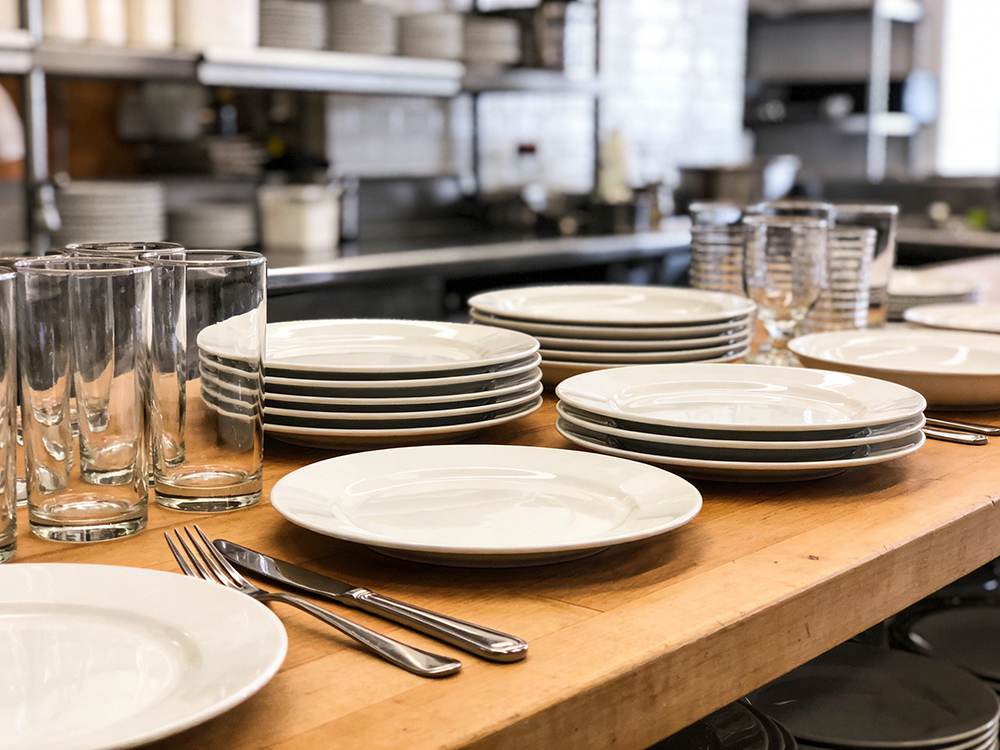
In a restaurant, plates come out for lunch and dinner, get washed, and return to the same shelves. Over time, the investment balances out because each plate gets steady, repeated use.
Catering works differently.
A plate might only touch the table once per event, but it gets handled a lot more. Think loading trucks, stacking racks, quick resets, and long wash cycles. For instance, a plate used at a 300-guest wedding might only see food once that night, but it’s handled by five people before and after service.
So what does this mean for durability?
You don’t need ultra-delicate china built for fine dining rituals. What you need is commercial-grade porcelain that can take repetition without getting stress cracks.
For example, many caterers choose pieces rated for 1500 to 2000 wash cycles because that gives reliable performance across busy seasons. Because catering relies on volume, you can lean into smart compromises.
A slightly heavier porcelain works well. White or cream tones stay flexible across themes. Branding matters less than consistency for catering companies. Guests remember clean presentation, not the logo under the plate.
Specs That Actually Matter
For a bulk dinnerware purchase, look for pieces designed for service. Here’s what to look for.
- Commercial porcelain rather than bone china
- Sizes around 10.5” for mains, 8 to 9” for salads, 6 to 7” for bread
- Tested durability with 1500+ wash cycles
- Food safety certification and commercial standards
- Low defect rates, so replacements don’t become a hassle
This wholesale purchasing approach works because you build a system that holds up through 200 to 300 events a year.
Volume Purchasing Strategy and Pricing
If you run catering at any scale, volume is your biggest advantage. You just have to use it correctly.
Buying dinnerware for one event at a time usually feels safe, but it costs more over the year. Wholesale purchasing flips that dynamic.
Instead of reacting to breakage or shortages, you plan ahead and let volume work in your favor.
How Wholesale Pricing Works
Most suppliers price dinnerware in tiers. The more you commit upfront, the better the unit cost becomes. For example, once you cross the 1000 to 2000 piece range, pricing usually drops by 15 to 20%.
Push past 3000 pieces, and those savings grow even more. At that level, suppliers start seeing you as a long-term buyer. This is where catering companies benefit from wholesale dinnerware sourcing. You already know that you’ll use the inventory. The volume isn’t a risk.
Planning for Replacements
Most catering teams start with 1500 to 2000 settings, then replace a few hundred pieces annually as wear happens.
Smart operators negotiate replacement pricing upfront, usually in the $5 to $15 range per piece. That way, breakage never becomes a budget price.
How to Negotiate
Volume is your leverage. You need to ask for tiered pricing, extended payment terms, and locked-in pricing for future reorders.
Suppliers expect these conversations.
When you treat purchasing as a long-term relationship rather than a one-time buy, the numbers start working for you, and your margins breathe a little easier.
Durability and Quality Testing Standards
When you’re running catering at scale, you stop thinking about plates as “products” and start treating them as everyday tools. Some days, these plates barely get a break. That’s why durability in catering services is important.
What Daily Use Looks Like
In a busy catering setup, plates get washed, stacked, loaded, unloaded, and sent right back out again. Now multiply that by hundreds of events a year, and you start to see why durability matters more than design details.
A plate that looks great on day one but can’t hold up to repetition becomes a liability. A good benchmark to keep in mind: if a plate can’t handle around 2000 wash cycles, it’s probably not built for catering volume.
Many caterers expect visible wear within a year, and that’s acceptable. What isn’t acceptable is cracking, warping, or constant replacements, draining time and money.
Heat as a Stress Test
Think about what plates go through during service. Hot entrees, heat lamps, warming cabinets, then straight into industrial dishwashers.
This temperature swing is where weaker pieces give up.
Dinnerware that can handle temperatures between 140°F and 160°F tends to perform reliably without developing stress lines or surface damage.
Edge Strength and Chipping
Most breakage doesn’t happen in the middle of a plate. It happens on the rim, during stacking, clearing, or transport. That’s why edge strength matters more than how thick the centre feels.
A chip rate under 5% is a healthy target. Anything higher starts showing up in photos, guest tables, and staff frustration.
Grip
Linens, overlays, and banquet cloths are part of the setup. Plates without a stable base slide more than people expect, especially when servers are moving quickly.
A subtle nonslip foot keeps things to study and avoids those awkward near-misses during service.
What to Check Before You Buy
Before committing, you need to run tests. Ask for samples. Run them through your dishwasher. Stack them as your team would. See how they feel after a week of use.
Good suppliers expect this. The right dinnerware proves itself before it ever reaches your guest table.
Before committing, ask suppliers for:
- NSF/ANSI 2 certification
- FDA compliance documentation
- Defect rate data
- References from other catering companies
- Replacement availability for emergencies
- Sample pieces to test in your own kitchen
Supplier Selection and Wholesale Sourcing
Selecting a wholesale dinnerware supplier is about finding a partner who understands how catering works. Your supply partner should be familiar with the volume, timing, replacements, and pressure.
Where Catering Companies Usually Source Dinnerware
Most caterers end up choosing between two main routes.
Direct manufacturers are common when volume is high and budgets are tight. Many porcelain manufacturers offer strong pricing and large production capacity, which works well if you’re ordering 1000 to 5000 settings at a time and can plan 8 to 12 weeks ahead. The tradeoff is longer lead times and less flexibility if something breaks or plans change.
Hospitality wholesalers, on the other hand, sit closer to your day-to-day reality. They stock products, understand catering timelines, and can react faster.
Regional distributors and restaurant suppliers also fit here, though pricing can be higher for smaller quantities. Many caterers end up using a hybrid approach: core inventory sourced through a wholesaler who works directly with manufacturers, giving you both scale and responsiveness.
What Actually Matters When Choosing a Supplier
When you’re comparing options, a few questions tend to reveal whether a supplier fits your operation:
- What kind of volume discounts are available once you cross 1,000 or 2,000 settings?
- Can you reorder individual pieces without starting from scratch?
- What happens when you need replacements quickly before a large event?
- Do they offer payment terms that support cash flow, like 30 or 60 days?
- Can they share real catering clients who rely on them long-term?
These answers matter more than catalogs or sample photos.
Why Many Caterers Work With Wholesale Partners
Wholesale partners simplify the entire flow. They help you plan inventory, lock in pricing, and keep replacements consistent over time. That stability matters when you’re running multiple events each week and can’t afford surprises.
Partners like Brett focus on supporting catering businesses at scale, offering wholesale pricing, dependable stock, and long-term supply planning that grows with your operation rather than slowing it down.
ROI and Implementation Strategy
When you look at bulk dinnerware for catering companies, the goal isn’t finding the cheapest plate; it’s creating a system that stays predictable as your business grows.
Most catering teams think in terms of events, not individual items, so the smarter metric is cost over time, not cost per piece.
With wholesale tableware, pricing usually falls into tiers.
Smaller orders have a higher price point, while larger volumes have better rates. That’s where working with a commercial dinnerware supplier starts to pay off. The more consistent your purchasing, the more pricing leverage you have to negotiate stable pricing, better terms, and priority restocking.
Instead of reacting to breakage, experienced caterers plan ahead. They map out expected annual usage, build in a replacement buffer, and treat dinnerware as a long-term asset. This is especially true when sourcing catering plates wholesale, where continuity matters just as much as cost.
How Catering Teams Typically Approach This
Planning phase: You review how many settings you use per event, how often events run, and how frequently replacements are needed. This step defines whether you need a high, mid, or lower price tier.
Sourcing phase: You compare 3 to 5 suppliers, request samples, and evaluate quality, lead times, and reorder reliability. This is where choosing the best wholesale dinnerware supplier matters more than chasing the lowest quote.
Implementation phase: You place an initial bulk order, set up a replacement schedule, and lock in pricing terms so costs stay predictable throughout the year.
Example Cost Framework
Take a quick look at the average cost framework for sourcing dinnerware.
Order Size | Pricing Tier | Best For | Cost Behavior |
500-800 | Higher range | Small or seasonal caterers | Frequent reorders |
1000-2000 | Mid-range | Growing operations | Balanced cost control |
3000-5000 | Lower range | High-volume caterers | Strong long-term savings |
Wrap Up
If your catering business is growing and dinnerware keeps becoming a problem, it might be time for a better setup. Brett works with catering teams to simplify sourcing, stabilize costs, and keep supply consistent as volume grows. Reach out to Brett to build a smarter, more dependable dinnerware plan.