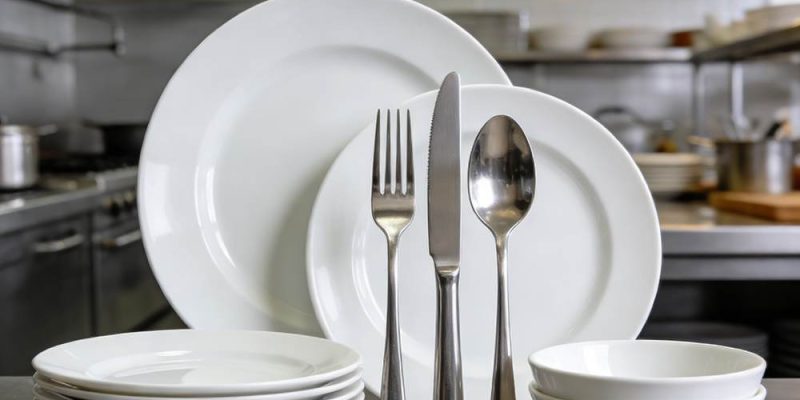
Opening a new dining place or refreshing your tableware usually feels like a simple decision. The plates look right, the price fits the budget, and the supplier promises they’re built for commercial use.
Then the service starts.
Dishwashers run nonstop. Stacks move faster. Staff handle plates under pressure. Within a few months, replacements creep into the order lists, and costs rise.
Most operators don’t expect dinnerware to fail this way. The problem is that durability isn’t a label. It’s the result of materials, testing standards, and kitchen conditions.
This guide explains how commercial dinnerware is tested, where it breaks, and how durability decisions affect long-term costs.
What Is Durability in Commercial Dinnerware?
When suppliers talk about durable dinnerware, it’s easy to picture a plate surviving a drop. That’s part of it, but it’s not the full story.
Two plates look identical on the shelf and still behave very differently once service gets busy. One keeps its edges clean and surface smooth, while the other starts showing wear within weeks.
In commercial kitchens, plates rarely fail because of one dramatic moment. They wear down day after day. The plates get stacked tightly in racks. They slide against other plates during clearing. And they also move from heat lamps to prep tables.
Commercial dishwashers that run hot all day long with aggressive detergents also wear down the plates over time.
None of this looks extreme on its own, but together every factor adds up.
That’s why durability isn’t about whether a plate breaks once. It’s about how the plate handles repeated strain without changing shape, losing its finish, or chipping at the rim.
Durability is about how the plate behaves on its 500th wash, not its first service. For restaurant and hotel operators, the difference determines replacement rates, consistency on the table, and how predictable costs stay over time.
Food Safety and Quality Certifications
Certifications might not seem that important until something goes wrong. You buy a new dinnerware set, and a plate stains oddly. The glaze wears faster than expected
Now, food safety becomes questionable. Here’s a breakdown of food safety certifications and how they affect quality.
FDA Food Contact Compliance
If a plate touches food in the US, it falls under FDA food contact rules. That includes the glaze, decorative layers, and any finish on the surface. FDA compliance isn’t a marketing upgrade, but it’s more of a legal requirement.
What the FDA actually evaluates is migration. In simple terms, testing checks whether substances like lead or cadmium leach out from the plate into food during use. That includes hot dishes, acidic sauces, and repeated dishwasher cycles.
The limits are strict, and they’re designed around long-term exposure, not a single-time use.
For operators in hospitality, this matters because problems never arise immediately. They appear months into service when plates have been washed hundreds of times and hold hot food every day. FDA compliance means the dinnerware has been reviewed and authorized for that exact kind of commercial use.
ISO 9001: Why Process Control Affects Durability
Instead of testing plates, ISO 9001 tests the manufacturer.
This certification confirms that a factory follows documented quality systems: how materials are selected, how glazing is controlled, how pieces are inspected, and how defects are handled.
In hospitality terms, this translates to consistency.
Two plates look identical on day one, but six months later, one chips faster, fails sooner, or warps slightly. The difference usually comes down to process control, and it’s not a design issue.
ISO 9001 enforces repeatable production standards, staff training, and batch tracking. Restaurants feel this through lower replacement rates, fewer mismatched reorders, and less variation across shipments.
How This Applies in Hospitality Settings
Most guests will never ask about certifications, but operators pay for their absences. Service-grade dinnerware is about predictability under stress, heat, washing, stacking, and time.
Brett’s manufacturing follows FDA food contact requirements and ISO 9001 quality systems, which means operators aren’t guessing how plates will behave after hundreds of services. These certifications remove risk from daily hospitality operations.
Dishwasher Cycles: Where Dinnerware Gets Tested
The dining room might sell the experience, but the dishwasher decides how long your dinnerware actually lasts. This is where “commercial grade” either holds up or falls apart.
What Is a Dishwasher Cycle?
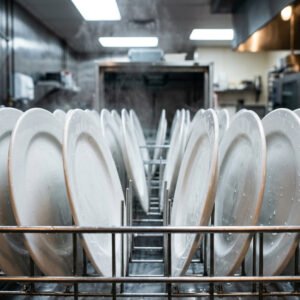
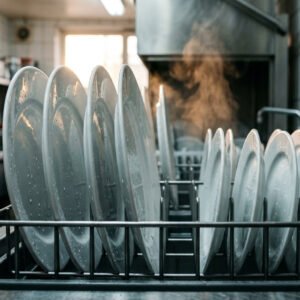
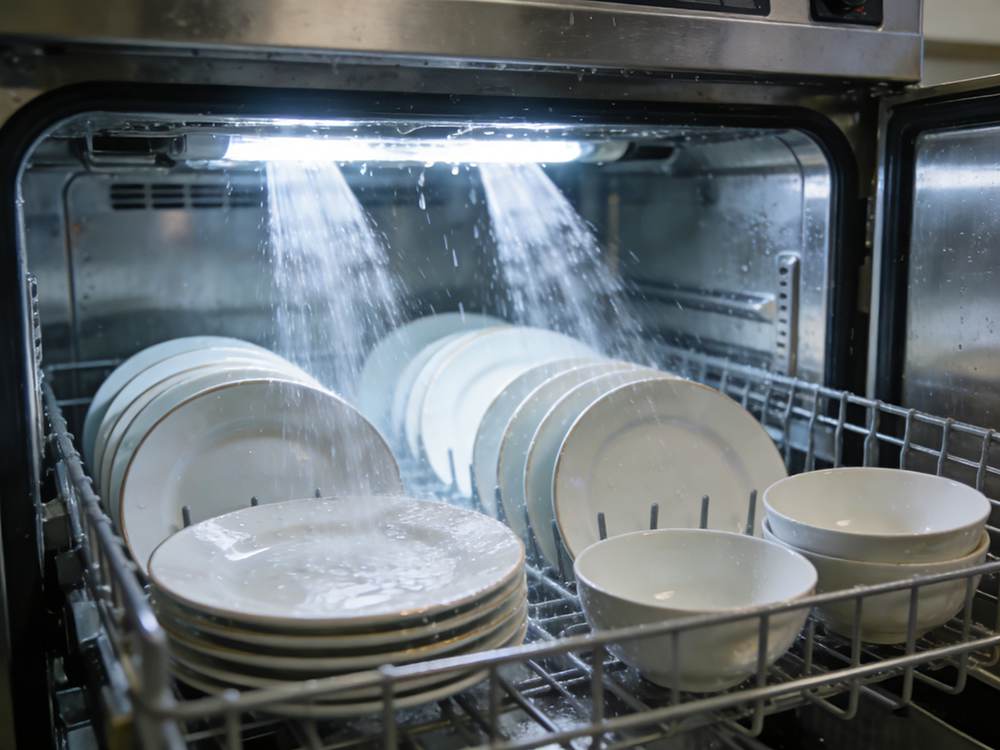
One commercial dishwasher cycle is a full wash. Heat, detergent, pressure, and steam are involved.
Most cycles run 5 to 10 minutes, and they repeat all day long. A typical restaurant runs around 50 cycles a day. Busy kitchens easily hit 100 to 150 cycles.
High-volume QSR pushes over 200 cycles daily without even blinking. 50 cycles a day across a working year can mean over 12,000 washes per plate. Durability is not about surviving that one hot run; it is about surviving these 12,000 washes.
How Different Materials Hold Up Over Time
Here is where things separate quickly. Porcelain and bone china dinnerware are built for repetition. They handle long-term washing better with slower wear and fewer replacements.
Stoneware sits close behind, especially in kitchens that avoid extreme heat swings. Melamine is the least durable when it comes to repeated heat and scrubbing.
In commercial kitchens, repeated wash cycles result in rim wear, dulling glazes, and plates leaving rotation earlier than planned.
High Volume in Kitchens
In a restaurant serving 300 covers per day, plates don’t rest. They are continuously stacked, cleared, washed, and stacked again.
Higher volume doesn’t make durability less important. In fact, it makes it more critical. The more cycles you run, the faster weaknesses show up, and that is why your dinnerware material choice matters more as service speed increases.
Where and Why Dinnerware Breaks in Restaurants
Durability doesn’t usually fail dramatically through one drop. A small chip, a hairline crack, or a broken rim at a time does not stop the service, but it is enough that the stack slowly thins out.
Understanding how this happens explains why some dinnerware lasts for years while others barely make it through a season.
Rim Chipping During Stacking
This is the most common failure point in restaurants where rims take the most abuse. Plates knock against the dishwasher, racks collide during cleaning, and rub against each other when stacks get tall.
Over time, tiny stress fractures form at the edges. Bone china and porcelain dinnerware handle this better, while stoneware shows wear sooner. Melamine avoids chipping but only because it bends instead of breaking.
Thermal Shock From Hot to Cold
Think about a hot plate going straight into a cool wash cycle. That rapid temperature change stresses the body and glaze.
Repeated often enough, it weakens even good ceramics. Porcelain and bone china tolerate these changes well. Stoneware needs a bit more care. Melamine has a low heat tolerance and is simply not built for hot surfaces.
Drops During Clearing and Dishwashing
It happens in every kitchen. A plate slips during rush hour. The question isn’t if plates get dropped, but how often they survive it.
Heavier, well-fired ceramics absorb impact better. Lighter or poorly fired pieces crack faster. No amount of staff training eliminates drops completely; therefore, it is important that you choose premium, high-quality dinnerware for commercial restaurants and kitchens.
Surface Wear From Chemicals and Scrubbing
Strong detergent and abrasive scrubbing slowly dull glazes. Over time, surfaces turn matte, feel rough, and stain more easily. High-quality glazes resist this longer. When a glaze breaks down, it exposes the surface beneath.
In poorly formulated ceramics, this wear increases the risk of lead or cadmium leaching, especially with acidic foods. High-quality, properly tested glazes resist both surface damage and chemical migration far longer.
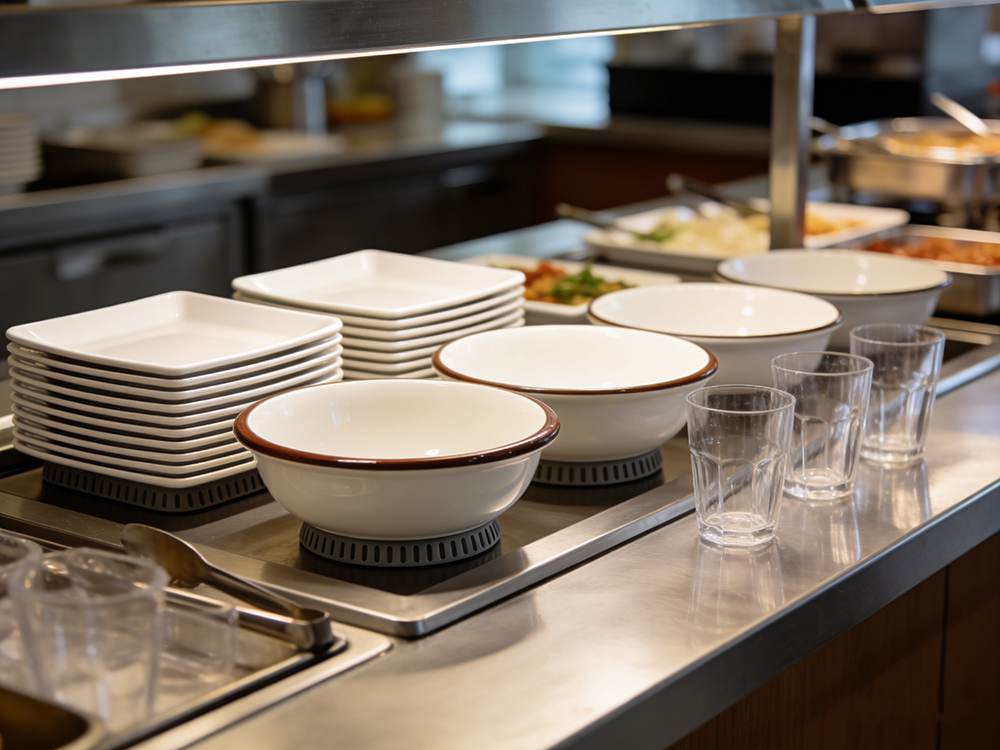
Cost Impact: How Durability Affects Your Budget
Most operators don’t feel dinnerware costs all at once. A few replacements here. Another top-up order a month later. Over time, durability becomes a budget line item that never really goes away.
Instead of focusing on sticker price, it helps to look at how often plates need replacing and how predictable that replacement cycle is. Durability doesn’t always mean “cheapest,” but it means fewer replacements in the long term.
Cost Impact by Material
Material | Upfront Cost | Replacement Frequency | Long-Term Cost Trend | Budget Predictability | Best Fit For |
Bone China | High | Low | Medium-high | Stable | Fine dining, premium concepts |
Porcelain | Medium-high | Medium | Medium | Very stable | Hotels, full-service restaurants |
Stoneware | Medium | Medium | Medium-low | Moderate | Casual to upscale casual dining |
Earthenware | Low-medium | High | High | Unpredictable | Accent use, low-volume service |
Melamine | Low | Very-high | Low-medium | Predictable | High-volume, speed-driven service |
In practice, the most expensive plate isn’t always the one with the highest price tag. It’s the one you keep reordering because it can’t survive your service pace. Durability turns dinnerware from a recurring expense into a controlled one.
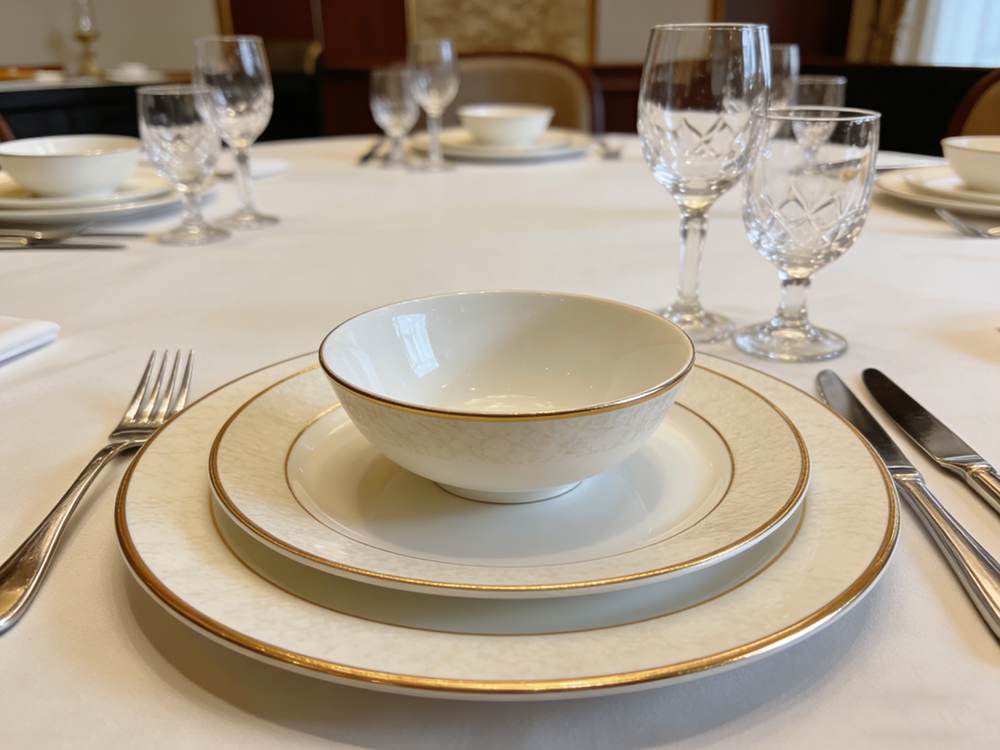
Cost Impact: How Durability Affects Your Budget
You will see a lot of certifications in dinnerware catalogs.
Badges look reassuring, and logos stack up, but the grounded truth most operators learn is that certifications don’t make the plates stronger. They only make the manufacturers accountable.
In hospitality, certifications matter because they set boundaries. They define what materials can’t touch food, how consistently products are made, and whether claims are backed by testing or just marketing language.
A plate without proper certification might look identical on day one, but there’s no paper trail when problems come up later. Third-party testing means an independent lab verifies the results.
Self-claims rely on internal assumptions. For restaurants and hotels, the difference matters more than any printed logo or brochure.
Certifications don’t replace durability. They also don’t stop drops or chips.
What they simply do is confirm that materials are safe, repeatable, and controlled from batch to batch. That consistency is what keeps replacements predictable, and your service is smooth.
What Each Certification Covers
Certification | What It Verifies | Where It Applies | Why It Matters in Hospitality |
Food-contact safety, migration limits | European Union | Confirms materials won’t transfer harmful substances into food | |
Lead/cadmium limits, safe food contact | United States | Mandatory for legal sale in the US food service | |
Quality management systems | Global reference | Proves consistent production and process control | |
Testing methods for strength and shock | Global reference | Defines how durability is measured, not certified |
For operators, the takeaway is simple: certifications don’t guarantee perfection, but they reduce risk.
Choosing Durable Dinnerware
Durable dinnerware is about finding a plate that handles heat, washing, stacking, and fast clearing.
Here’s how to choose durable dinnerware.
- Start by asking how the plates perform in commercial dishwashers.
- Look for third-party testing and not just catalogs and brochures.
- Match the material to your service speed and heat exposure.
- Plan for replacement and reorders from the same source.
- Choose suppliers that offer customization without sacrificing tested performance.
- Pay attention to how rims and edges are finished, since that’s where most wear shows up first.
- Make sure the supplier can support future reorders, so new pieces blend in without disrupting the table.
FAQs
How long does commercial dinnerware usually last in a restaurant?
That depends on how busy your kitchen is and how the plates are handled. In lower-volume dining rooms, quality dinnerware lasts several years. In high-turnover kitchens, durability matters more, and lifespan shortens if plates face constant heat, stacking, and heavy dishwashing.
Why should operators care about certifications if guests never see them?
Operators should care about certifications because they confirm that the plates are safe for food contact and consistently manufactured. When dinnerware lasts longer and behaves predictably in the kitchen, replacement costs drop, service stays smooth, and problems don’t show up months after opening.
Wrap Up
When dinnerware reminds you that quality shows up over time, the safest option is choosing a manufacturer that controls how pieces are made and tested.
Brett works as a source manufacturer and produces dinnerware that meets EC 1935/2004 food-contact requirements, with SGS and TUV certifications supporting material, safety, and production consistency.
If you want branding with fewer replacements and long-term use as part of the plan, contact Brett for custom high-quality dinnerware.