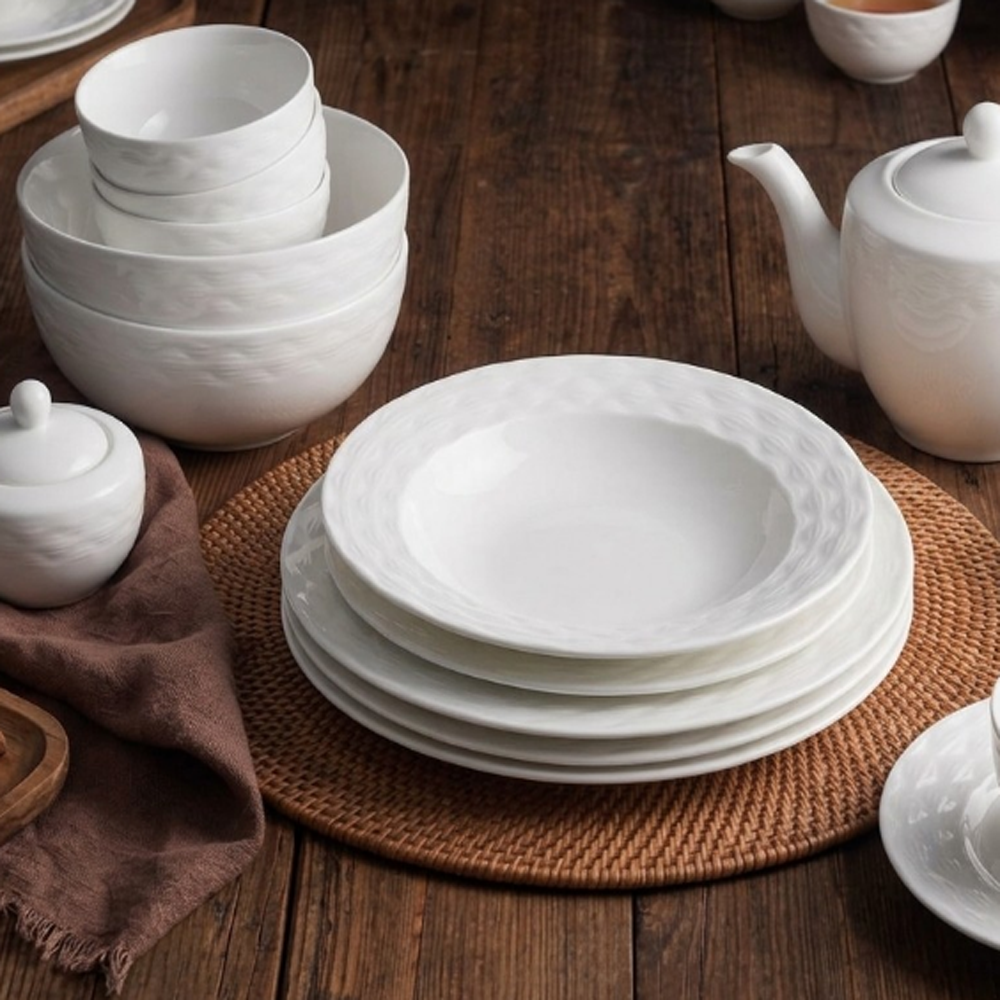
Every luxury hotel procurement manager has faced the same impossible choice. Normal porcelain is affordable and durable, but lacks the premium finish that five-star dining demands. Bone china is beautiful and prestigious, but simply too fragile to withstand the dishwashers, stacking and handling in a high volume hotel operation. Strengthened porcelain with 30% aluminium oxide sits between these two materials, and in the ways that matter most for five-star hotel service, it outperforms both. It provides the quality white finish of luxury hotel tableware and the commercial longevity to withstand thousands of uses without chipping, cracking or loss in appearance. It’s for that reason that properties such as Four Seasons, Shangri-La, Fairmont, Raffles, Crown Plaza, Wynn, Sheraton, Hyatt and Marriott are making the transition, as are Michelin Guide restaurants and Black Pearl Restaurant Guide destinations throughout Europe, the United States and the Middle East. Table of Contents Normal Porcelain vs Strengthened Porcelain vs Bone China — The Complete Comparison Strengthened porcelain exists somewhere between normal porcelain, and bone china, with the commercial durability of the former and the premium presentation of the latter. Here is how the three materials compare across the criteria that matter most for five-star hotel procurement: Criterion Normal Porcelain Strengthened Porcelain 30% Alumina Bone China Price point Most affordable Mid-range — best value for hotels Premium — highest unit cost Aesthetic quality Good Very good — premium hotel white Exceptional — fine translucent finish Edge impact resistance Standard baseline 888% more stable than household porcelain Moderate — vulnerable at rims Thermal shock resistance Moderate Up to 200°C — oven suitable Low — sensitive to temperature change Commercial dishwasher suitability Adequate for moderate volume Engineered for 6 to 9 cycles per day Requires careful handling Vegan friendly Yes Yes No — contains 50% animal bone ash Best application Casual and mid-range dining Five-star hotels, Michelin restaurants Low-volume fine dining Why Normal Porcelain Falls Short in Five-Star Service Normal porcelain chips and its glaze crazes under the cumulative stress of commercial hotel service. With a five-star operation, the deterioration becomes noticeable after 12-18 months and the need for replacement increases over time, causing budget and presentation issues the customer was not aware of when purchasing. Why Bone China Struggles at Commercial Volume The 50% bone ash content of bone china produces good translucency, and thermal shock sensitivity. In high volume use, where rapidly moving pieces are exposed to dishwasher heat and ambient storage, the pieces will crack and chip at the rim more than normal porcelain or alumina-reinforced pieces. Bone china requires significantly more careful handling in high-volume hospitality environments. How Strengthened Porcelain Solves Both Problems Strengthened porcelain with 30% aluminium oxide delivers the premium white finish and professional table presence of luxury hotel tableware without the fragility of bone china, and the commercial durability that five-star hotel service demands without the aesthetic limitations of normal porcelain. It is the material that gives five-star hotels and fine dining restaurants exactly what they have always needed. The Science Behind 30% Aluminium Oxide The performance difference between strengthened porcelain and conventional alternatives is not a marketing claim, it is a material science outcome that can be precisely measured and third-party verified. What Aluminium Oxide Does to Porcelain The alumina is added to the porcelain body at 30% content and fired at a higher temperature than 1,300°C, which causes the alumina to fuse with the quartz-crystalline minerals to create needle mullite crystal patterns throughout the piece. In short, these interlocking crystals distribute the mechanical stress over a much greater surface area than what is possible with conventional porcelain can achieve, and hence the final product is impact resistant to even an iron nail. Why Firing Matters The 30% alumina content is not enough to achieve the performance. An additional crucial firing temperature is above 1,300°C where the mullite crystal formation starts and gives the mechanical strength. The standard porcelain of hotels is fired at 1200-1280C and will not change material properties regardless of what type of Alumina may be added to it. Documented firing temperature is an essential specification to request from any supplier. The Durability Data — What the Numbers Show The following performance comparison of alumina-reinforced hotel porcelain is based on independent laboratory testing performed in accordance with DIN-EN-12980 standard, the European standard for testing hotel porcelain’s resistance to impact from its edges, which is verified by the Bureau Veritas and Lucideon. Comparison Material Stability Advantage Performance Factor Ordinary household porcelain 888% more stable 9.8 times stronger Asian hotel porcelain 534% more stable 6.4 times stronger European premium hotel porcelain 343% more stable 4.4 times stronger German premium hotel porcelain 154% more stable 2.5 times stronger These are edge impact resistance, the most operationally significant durability measure as almost all service induced breakage starts at an edge; stacking contact, bus tub impacts, dishwasher rack collisions. These figures equate to reduced replacement orders, reduced annual breakage budget and table presentation that maintains its quality standard for much longer for a five-star hotel procurement team. Why Five-Star Hotels and Fine Dining Restaurants Are Switching Strengthened porcelain solves three problems simultaneously for the world’s most demanding hospitality operations. Commercial Dishwasher Performance If a five star hotel is operating multiple food and beverage outlets, it can serve a single item up to 1,500 or more times per month. Both normal porcelain and bone china break down at rinse temperatures up to 82°C using alkaline chemistries. The 9.8 times higher edge impact resistance is designed to take this repeated impact over a much longer lifetime. The Fine Dining Presentation Standard The properties include Four Seasons, Shangri-La, Fairmont, Raffles, Wynn, Sheraton, Hyatt, Marriott and Crowne Plaza, and Michelin Guide restaurants and Black Pearl Restaurant Guide destinations throughout Europe, the United States and the Middle East maintain presentation standards where a single chipped rim is unacceptable. The Black Pearl Restaurant Guide covers 32 cities and is one of China’s most influential fine dining guides. Both the Michelin Guide and the Black Pearl Restaurant Guide evaluate the