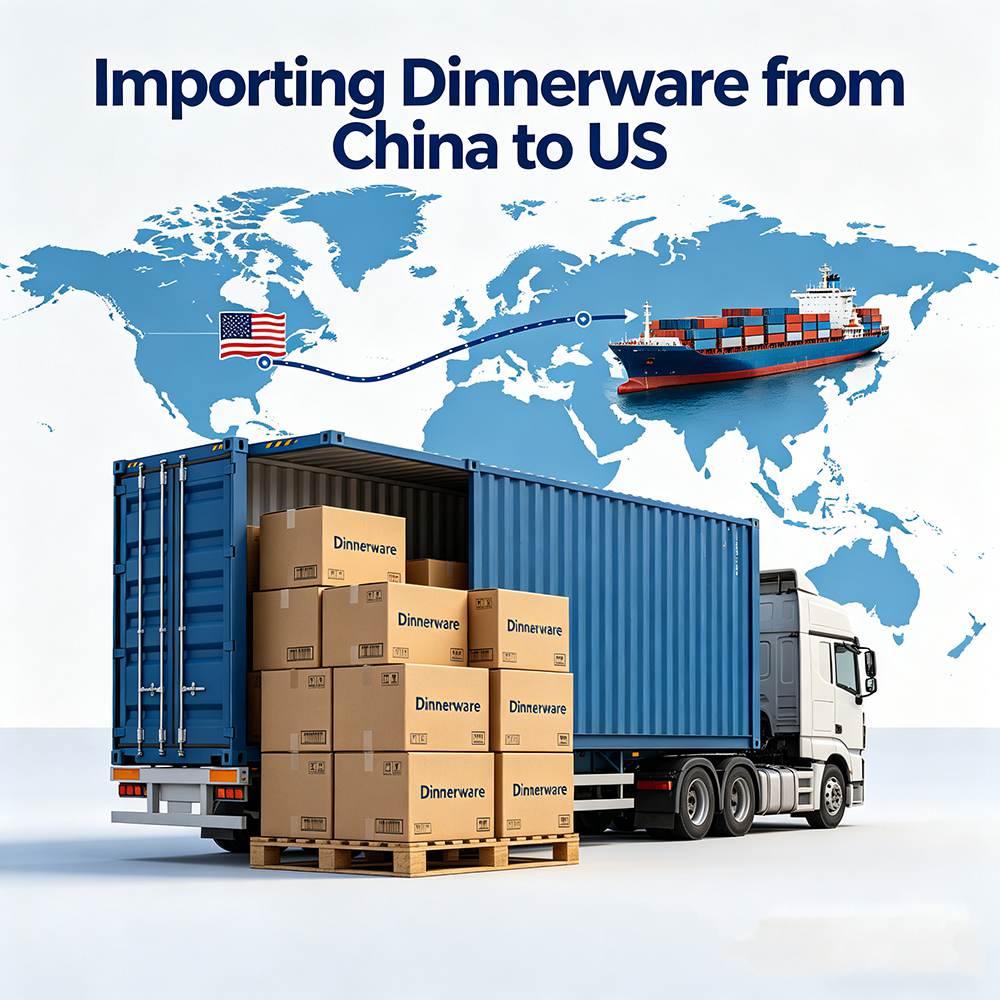
Dinnerware procurement sounds easy until you are juggling multiple samples, spreadsheets, and have a supplier asking you whether you want simple porcelain or ceramic. That’s when you realize, it’s really not that simple. It starts quite small. You like a plate, pick out a shape and color, and imagine your brand’s logo placed on it. But as you fill the brief, you’re looking at codes, compliance, tariffs, and tiny technical details that somehow have huge consequences. Take something as basic as the product code. One digit difference from HTS code 6911 to HTS code 6912 can flip your dinnerware from non-porcelain to porcelain, changing not just the material but also the applicable duties, pricing, and the way your shipment is classified at customs. Importing dinnerware from China is a path well-trodden. The U.S. imports billions of dollars’ worth of ceramic tableware annually, where China dominates the global exports under HS code 6912, according to the Observatory of Economic Complexity. But it’s not just about finding a supplier and arranging the shipping fee. If you want your dinnerware to arrive on time, match your brand, and make you money, you are at the right page. In this guide, we will explore the behind-the-scenes process involved in importing dinnerware from China. Why US Buyers Still Source Ceramic Dinnerware from China Importing ceramic dinnerware from China isn’t about following a trend; it’s about stepping into one of the most established industrial supply chains of the world. For the US restaurants and hotels, China is a low-cost option for sourcing tableware. But what makes it more attractive is that the country has a manufacturing ecosystem that’s been built over centuries. Cities such as Chaozhou, Dehua, Tangshan, Liling, and Jingdezhen are major ceramic production hubs. Much of the manufacturing processes, such as raw material processing, glazing, and kiln firing, happen within the nearby geographies. Such integration and clustering isn’t easy to replicate by other countries. Chaozhou is one of the largest ceramic tableware production hubs in the world because of its industrial density. There are not hundreds but thousands of factories sharing kiln infrastructure here. The labor force is specifically trained in ceramic production. All these factors make China the most lucrative land for sourcing dinnerware. Scale and Customization There are very few regions that can match China’s ability to offer low to mid-range MOQs at similar prices. Even fewer offer low to mid-range MOQs per SKU and flexible customization options. Learn more about MOQ, Pricing, and Supplier Negotiation here: For boutique hotels, restaurant chains, and event rentals, procuring dinnerware from China is the most feasible option as you get consistent replication, aka a scalable system, and a variety of material options to choose from. Here’s more about dinnerware material selection: Best Restaurant Dinnerware: Material Selection & Buying Guide. Time Discipline Importing dinnerware from China takes about 60-90 days to the US. The ocean freight is around 15-25 days on average for the US West Coast ports and 25-35 days to the East Coast ports. Then there’s production, QC, or customs clearance. The entire process takes 90–120 days for first orders and around 60–90 days for repeat orders. This is why China works best for hospitality groups and restaurant chains that plan procurement in advance. Understanding US Duties on Dinnerware from China Buyers who succeed in procuring dinnerware that lasts, costs low, and scales aren’t the ones who find the cheapest supplier. They’re the ones who understand the system. The one place where most first-time buyers underestimate the process is in understanding the duties. China’s dinnerware import duty US is a stack of numbers, all dependent on what exactly you are importing. The process starts with the HTS classification, which is where most errors take place. Every shipment entering the U.S. is classified under the Harmonized Tariff Schedule, maintained by the United States International Trade Commission. For dinnerware, there’s a split between the HTS code 6911, which is for porcelain, and the HTS code 6912 for Non-porcelain ceramics. Unfortunately, misclassification between HTS codes 6911 and 6912 is one of the most common buyer mistakes and also a trigger for review by the U.S. Customs and Border Protection. Base MFN Duty Once the imports are classified, your procured dinnerware is assigned a Most Favored Nation (MFN) duty rate. The variation in the ranges depends on the product type, i.e., plates, cups, or dinner sets, the value thresholds per piece, and the specific 10-digit subheading. Section 301 Tariff This is the real cost of procurement. Most ceramic tableware from China falls under Section 301 List 3, which adds a 25% tariff on top of the MFN rate. This Section 301 tariff on ceramics was placed in 2018 and remains active today, as of April 2026. IEEPA Tariffs As per the February 20, 2026, Supreme Court decision, the previously imposed 10% “fentanyl” tariff and the 10% “reciprocal” tariff were ruled invalid and removed. Following the ruling, a temporary 10% global tariff was introduced under Section 122 of the Trade Act of 1974. However, the tariff must be verified at the time of shipment. FDA Compliance: Lead, Cadmium, and the Real Reason Shipments Get Held A shipment’s inability to prove FDA compliance is one of the leading causes of shipment delays and rejections. When you import dinnerware from China, “food-safe” is not a label. It’s a measurable regulatory threshold. If the product doesn’t meet it, your shipment doesn’t clear. Under U.S. law (21 U.S.C. § 342(a)(2)(C)), ceramic dinnerware intended for food contact is regulated by the U.S. Food and Drug Administration. The FDA lead limits for ceramic dinnerware vary based on product geometry. They are dependent on how food interacts with the surface, which determines how much lead can leach. For instance, for flatware like plates and saucers, the limits are ≤ 3.0 ppm; for pitchers, cups, and mugs, it is ≤ 0.5 ppm. That’s because a shallow plate has only a brief contact with food, whereas a mug holds hot, acidic liquid for much longer. The surface-to-volume ratio and contact time determine